
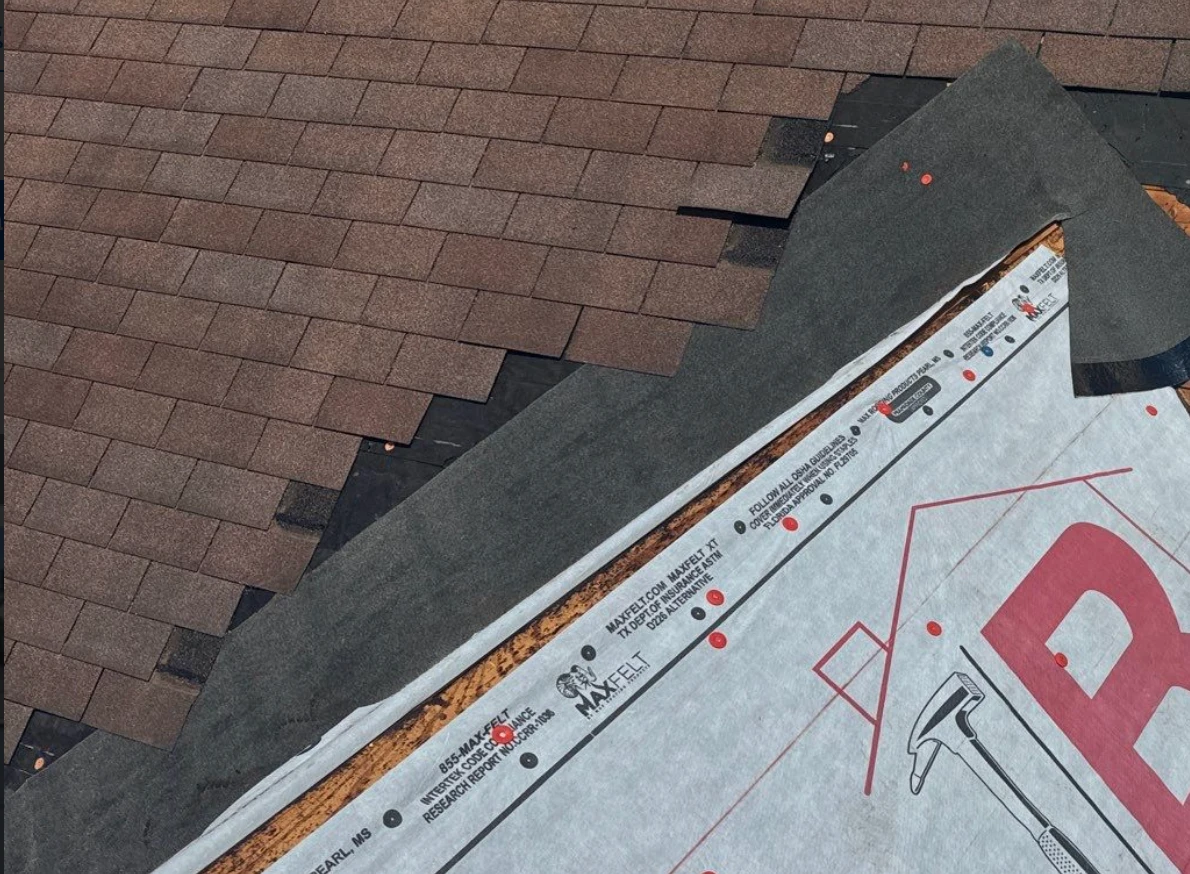
Brown's Roofing completed a 40-square partial roof replacement on First Presbyterian Church in Lake Providence, Louisiana. We installed the Owens Corning Supreme shingle system in Brownwood and reinforced the complex valley transitions with modified bitumen membrane. Project manager John Kelly scoped it as a partial replacement so the church could phase the remaining work across budget years — a practical call for a congregation that answers to a building committee.
Lake Providence sits in East Carroll Parish, along the oxbow lake that gave the town its name, about an hour northeast of our Monroe office. First Presbyterian is one of those buildings a local gives directions by. When a church like that needs a roof, you don't treat it like a tract house.
Why Church and Sanctuary Roofs Are Different
Most residential roofs are simple — a couple of planes, a ridge, maybe a valley or two. Church roofs are the opposite. They're built tall and steep on purpose, and that geometry brings hips, valleys, dormers, and transitions meeting at odd angles. Every one of those is a place water wants to get in.
That's the first difference: less margin for a sloppy detail. On a low-slope ranch house, a marginal valley might weep slowly for years. On a steep church roof with a valley dumping into a complex transition, water moves fast and finds the weak spot immediately.
The second is what's underneath. A sanctuary isn't drywall and carpet. There's stained glass that can't be replaced, original plaster, historic woodwork, pews, an organ. A leak that's an annoyance in a house is a catastrophe in a sanctuary — so the job gets planned around protecting what's below the deck, not just what's on top of it.
Third, a church is in use. Services, weddings, funerals, midweek meetings. You can't show up whenever and run a compressor over a memorial service. Coordinating around the congregation's calendar is part of doing the job right, and it gets settled with the building committee before a single bundle goes up.
Finally, there's the weight of the building itself. People have been baptized, married, and buried out of that sanctuary for generations. We wrote more about that mindset in Church Roofing: A Commitment to Excellence — it's the same philosophy we brought to Lake Providence.
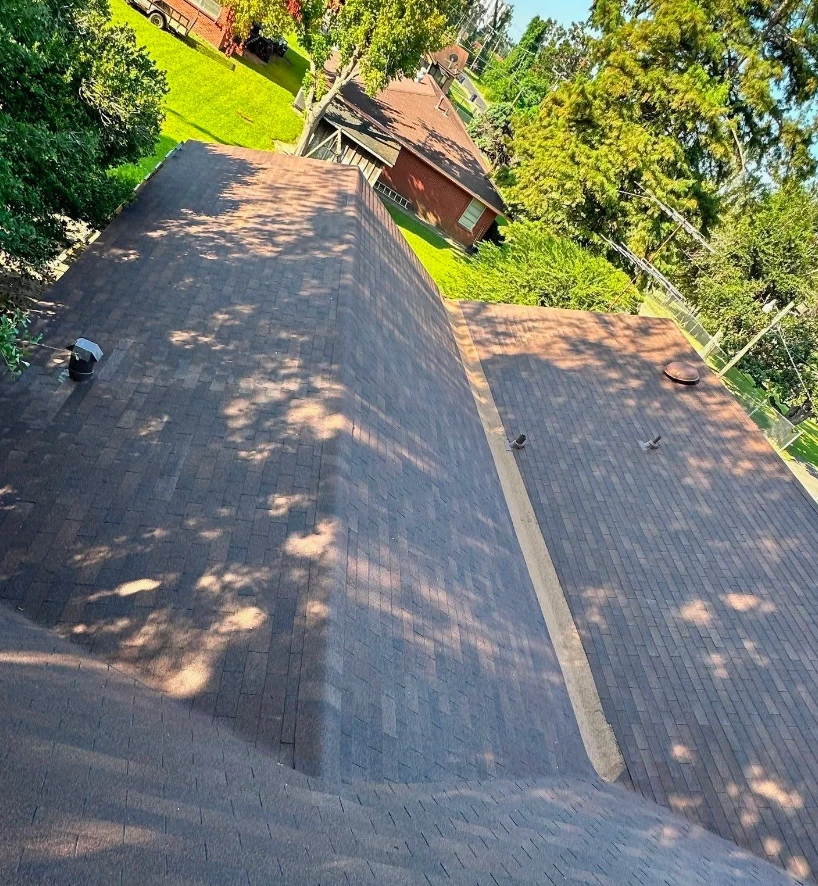 Planes, ridges, and vents meeting at angles — every junction on a roof like this is a place water has to be routed, not just covered.
Why We Scoped It as a 40-Square Partial Replacement
A partial replacement means what it sounds like: we replaced a defined section — roughly 40 squares, or about 4,000 square feet of roof surface — rather than tearing off everything at once.
Why not all of it? Budget, mostly, and there's no shame in that. Churches don't run on the same finances as a business. They run on giving, on budgets a committee approves, sometimes on capital campaigns that take time to build. When the whole roof needs attention but one year's budget won't cover it, phasing is the honest answer.
The method matters more than the label. We walk the roof with the building committee and identify which sections are failing first — the ones actively leaking or closest to it — and those go first. The congregation protects the most vulnerable part of the building now and plans the balance around next year's budget, without watching interior damage pile up in the meantime.
That's the difference between a contractor writing the biggest ticket available today and one planning to still be your roofer in five years. Brown's has been a stable, local outfit for decades. If a phased approach serves the building better, that's what we recommend — and if financing helps bridge the gap, we walk owners through the options, which we covered in Roof Financing in 2026.
The Shingle System: Owens Corning Supreme in Brownwood
For this section we installed the Owens Corning Supreme shingle system — a traditional three-tab asphalt shingle with a clean, uniform, low-profile appearance that suits older institutional buildings. On a church where the roofline is the whole visual statement, that evenness matters. It reads as dignified rather than busy. The line carries a Class A fire rating and Owens Corning's StreakGuard algae resistance, which earns its keep in humid northeast Louisiana where north-facing slopes streak first.
We ran it in Brownwood, a warm, earthy brown that works with historic masonry and trim instead of fighting it. Color on a landmark building isn't a small decision — you're not picking what looks good on a sample board, you're picking what looks right on that building, from the street, for the next couple of decades.
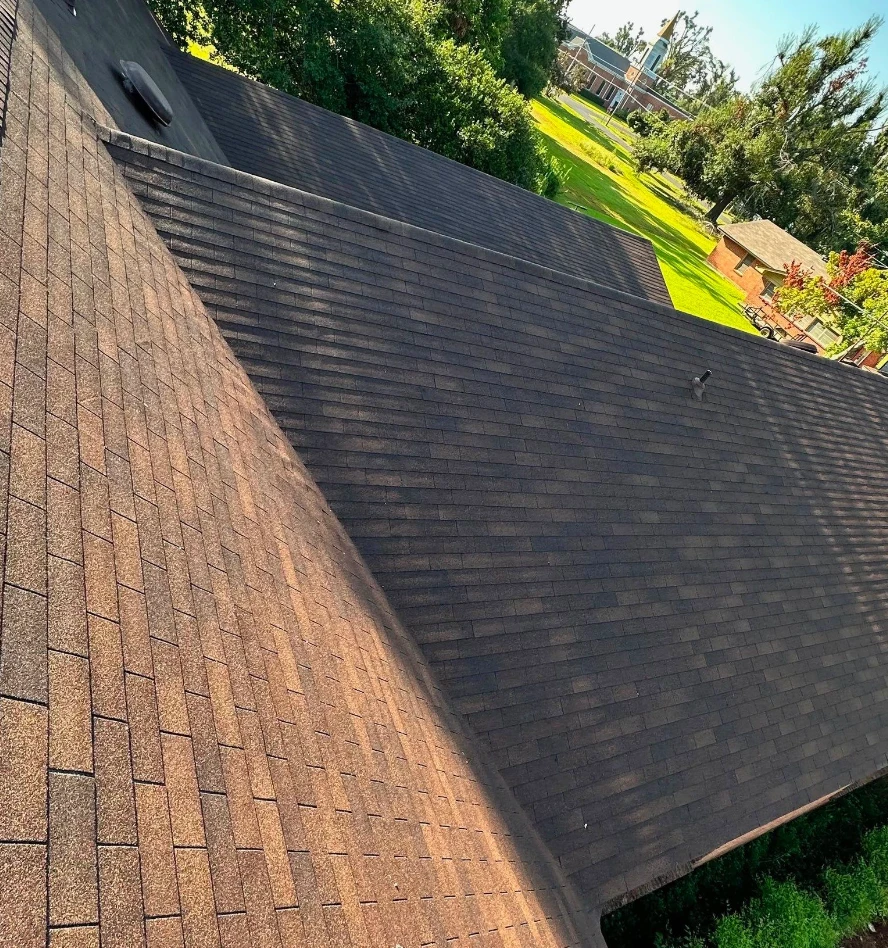 The finished field. Brownwood reads warm against brick rather than competing with it.
Because Brown's is an Owens Corning Platinum Contractor, the system goes down the way Owens Corning specifies it: the right underlayment, the right fasteners, the right nailing pattern. That certification isn't a logo on a truck — it's what stands behind the warranty, and it only means anything if the crew installs to spec. That's where a lot of roofs quietly go wrong. Our full install standard is in The Ultimate Guide to a Quality Roof Installation.
Reinforcing the Valley Transitions with Modified Bitumen
Here's the detail that separates a roof that lasts from one that leaks in three years.
A valley is where two roof planes meet and channel water toward the gutters or eaves. On a steep, complex church roof, valleys carry a lot of water fast, and where they meet dormers, walls, or other planes at awkward angles, you get transitions the standard shingle detail doesn't cleanly cover.
Those spots need extra treatment, which is why we ran modified bitumen membrane into the valley transitions before the shingle courses went over. Modified bitumen is a tough, fully waterproof asphaltic membrane — the same family of material used on flat roofs. Laying it into the complex valley areas gives you a continuous waterproof layer exactly where volume and velocity are highest. It's belt-and-suspenders where the roof is most likely to fail.
It's also recognized practice, not improvisation: the International Residential Code's valley provisions permit polymer-modified bitumen underlayment in place of conventional valley lining for closed valleys, alongside metal and roll-roofing options.
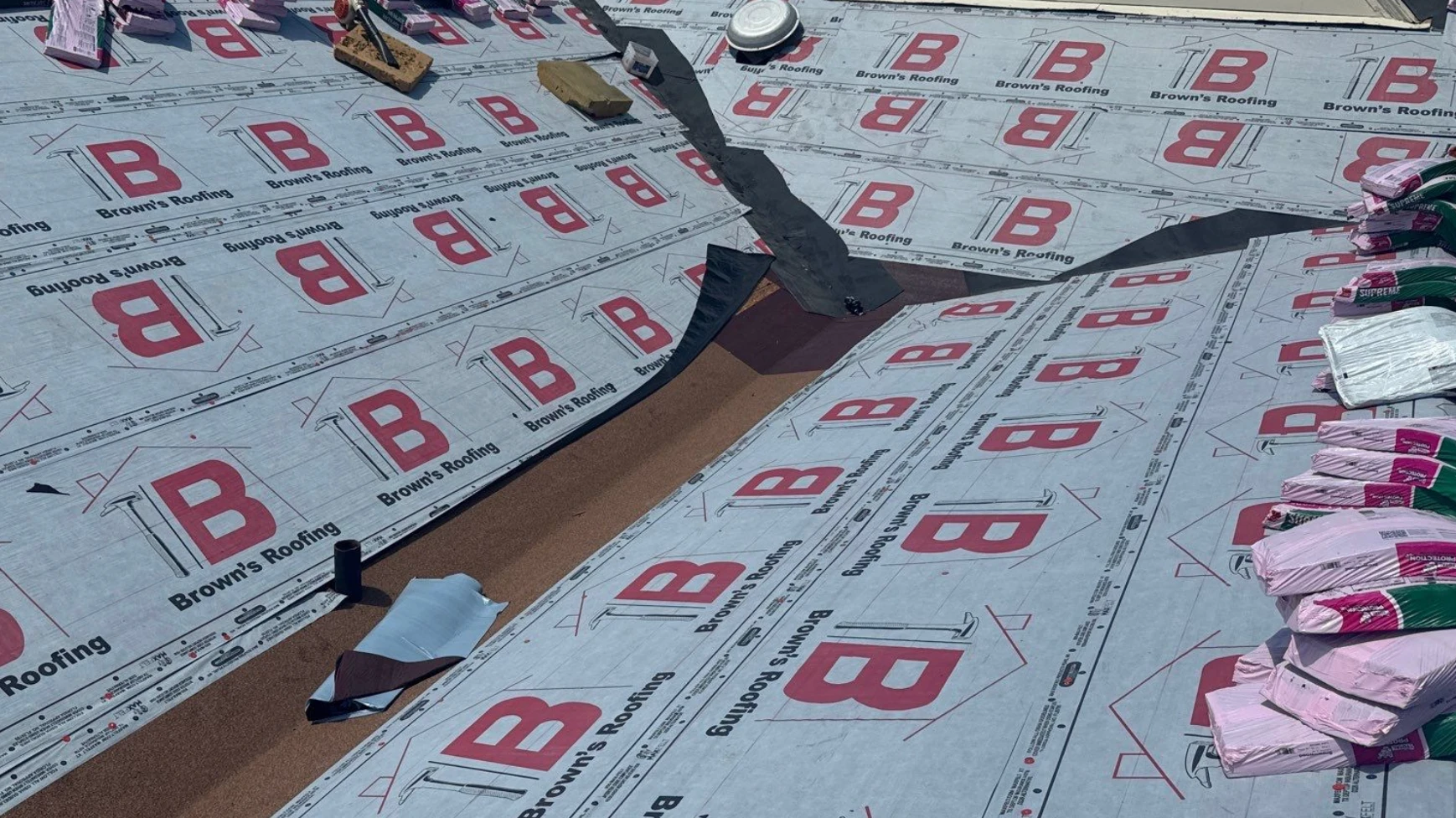 The valley going in: modified bitumen membrane run down the transition over the underlayment, with the Supreme bundles staged and ready to course over it.
Plenty of crews would shingle the valley, call it done, and move on. Steep church geometry doesn't forgive a marginal valley. Reinforcing those transitions never shows up in a sales pitch and makes all the difference on the roof itself — execution of the details is the whole job.
If the geometry side of this interests you, we broke down how slope works in Roof Pitch Explained: Common Pitches and How to Measure.
Warning Signs a Church Building Committee Can Watch For
You don't need to climb up there to catch trouble early. From the ground and from inside:
- Water stains on sanctuary ceilings or high on interior walls, especially where roof planes meet — often a valley or transition failing.
- Shingles that look curled, cupped, or bare from the parking lot. Granule loss and curling mean the shingle is near the end.
- Dark streaking or moss on north-facing slopes — common in humid northeast Louisiana and a sign of retained moisture.
- Granules collecting in gutters after a rain.
- Daylight or damp spots in the attic or bell tower space, if it can be checked safely.
Catch it at the stain stage and you're phasing a roof on your timeline. Ignore it and water finds the plaster, the woodwork, and eventually the glass.
Managing Work Over an Occupied Sanctuary
On a church, project management is more than scheduling a crew. It's coordinating around the congregation's calendar, keeping the work zone tight and safe, protecting the grounds and plantings around a building people care about, and making sure cleanup is complete — no stray nails in the lot where families park on Sunday.
That coordination is easy to underrate. A steep partial replacement over an occupied sanctuary takes a crew that stages materials carefully, keeps the interior protected, and tells the church staff what's happening and when. That's crew discipline, and it's what a building committee is really buying when they hire a roofer for a landmark.
Church and Historic Building Work Across Northeast Louisiana
Lake Providence is one of a number of churches and historic buildings Brown's has taken care of across northeast Louisiana and the Ark-La-Tex. The range runs from steep asphalt sanctuary roofs to specialty work like the historic tile roof repair in Vivian, north of Shreveport — the kind of job that demands respect for the original material rather than a fast tear-off.
East Carroll Parish and the surrounding communities are served from our Monroe office, with crews running up that way regularly. These are the buildings that hold a community together, and they deserve a roofer who'll still be around when the next phase comes due.
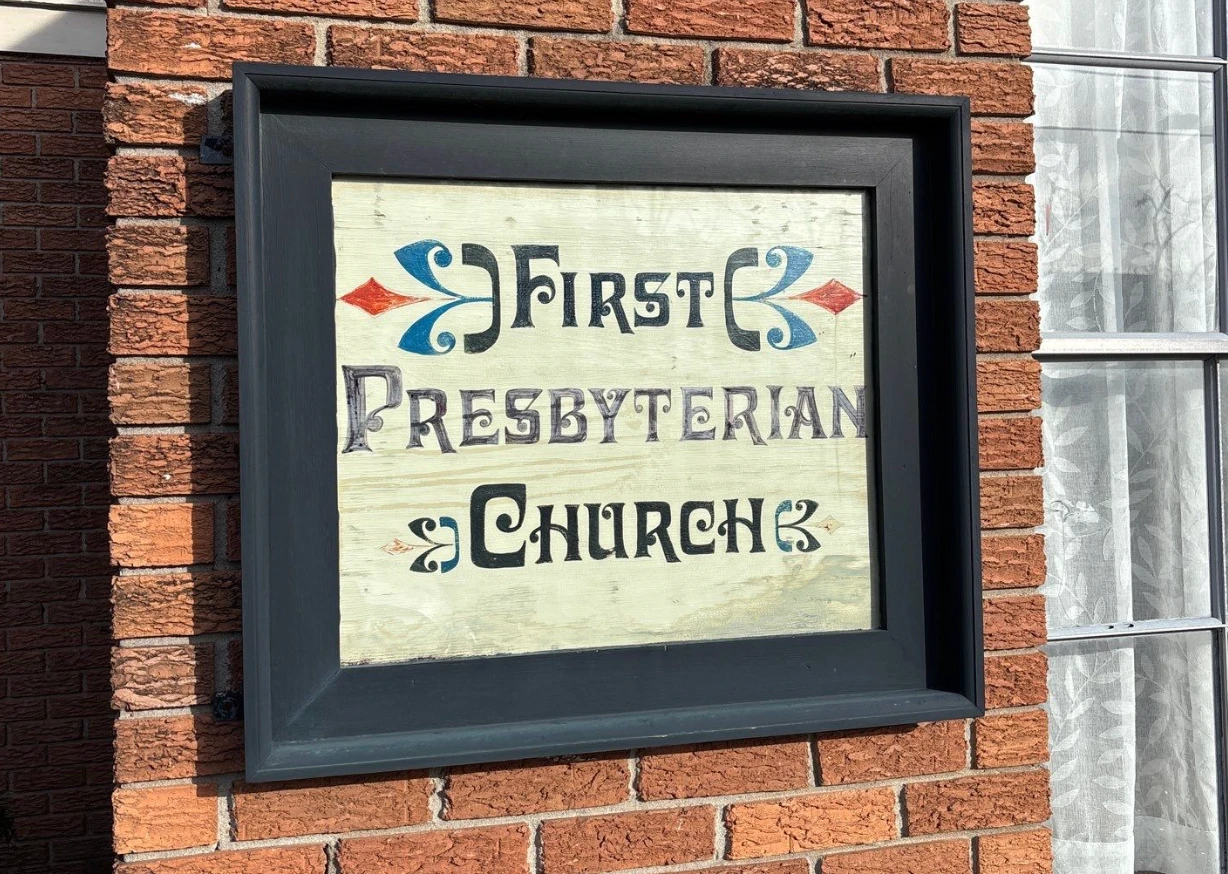 Hand-lettered and mounted on the brick — the kind of detail that tells you how long a congregation has been in a building.
Frequently Asked Questions
How much does it cost to re-roof a church in Louisiana?
There's no honest flat number for a sanctuary roof. Steep, multi-plane church roofs take more labor, more safety staging, and more detail work per square than a simple house, and material specification swings it further. Pricing depends on roof size, slope, complexity, access, and material specification — we provide a written estimate after a free on-site inspection, and we'll tell you whether phasing it in sections makes financial sense.
Can a church roof be replaced in sections over several years?
Yes, and it's often the smart move. That's exactly what we did in Lake Providence — a 40-square partial so the congregation could phase the rest across budget years. We help the building committee prioritize the sections failing first, so the most vulnerable areas get protected now and the balance gets planned around the finances.
What roofing material is best for a steep church roof?
For most congregations it's an asphalt shingle system, and the choice within that comes down to budget and appearance. Traditional three-tab shingles give a uniform, historically appropriate look at the most accessible price point; architectural and impact-resistant lines cost more and carry higher wind-warranty ratings, which is worth weighing in hail and high-wind country. Historic tile and slate are their own specialty. The right answer depends on the building's original character and what the committee can fund.
How do you protect stained glass and interiors during roof work?
Careful staging and sequencing. We keep the interior covered where needed, control debris so nothing falls through onto plaster or glass, and reinforce the vulnerable transitions so no water gets in during the work. Protecting irreplaceable interiors is planned into the job from the start, not handled as an afterthought.
Why use modified bitumen in roof valleys?
Valleys and odd transitions carry the most water on a steep roof and fail first. Modified bitumen is a tough, fully waterproof membrane, and laying it into those transitions before the shingles gives you a reinforced, watertight layer exactly where the roof is under the most pressure. The residential code recognizes polymer-modified bitumen as an accepted valley lining alongside metal and roll roofing.
Does Brown's Roofing work on historic and landmark buildings?
Yes. We've worked on churches and historic structures across northeast Louisiana and the Ark-La-Tex, including historic tile roof repair in Vivian. Landmark buildings need a contractor who respects the architecture and executes the details.
Planning Your Church's Next Roof Phase
If your church, chapel, or historic building has a roof you're worried about — or a building committee trying to plan the next few budget years — we'll come out and give you an honest assessment at no cost. We'll tell you what's actually failing, what can wait, and whether phasing the work makes sense. No pressure, just a straight read from someone who's been on the roof. Call Brown's Roofing at (318) 329-6579 for a free inspection with same-day response.