Roof Soft-Wash & Rejuvenation
Clean It. Restore It. Skip Replacement.
Two treatments, one visit. ARMA-spec soft-wash kills the algae, moss, and Gloeocapsa magma streaks that pressure washing can't — without damaging granules or voiding your warranty. Soy-based rejuvenation soaks back into aging shingles and restores the flexibility that makes them weather-tight, adding up to 15 years of service life for a fraction of replacement cost.
What Soft-Wash & Rejuvenation Do
Two Treatments, One Roof
Soft-wash is the chemistry-based roof cleaningmethod specified by the Asphalt Roofing Manufacturers Association (ARMA) — the only method approved by GAF, Owens Corning, CertainTeed, and the other major shingle manufacturers. Under 100 PSI of water pressure (about the same as a garden hose), low-concentration sodium hypochlorite plus a wetting surfactant kills the algae, moss, and mildew at the cellular level. The dead organism weathers away over the following 2–4 weeks and the roof returns to near-original appearance. Pressure washing the same roof would blast off the ceramic granules that give shingles their UV protection — voiding the warranty in the process — and wouldn't kill the underlying organism anyway.
Rejuvenationis a different problem and a different fix. Asphalt shingles fail because they slowly lose the petroleum oils that keep the asphalt mat flexible. UV, heat cycling, and oxidation deplete those oils a little more every summer. Once they're gone, granules let go, edges curl, and the mat cracks. Brown's Roofing's rejuvenation program — applied through our WeatherPro partnership — uses a bio soy-ester spray that soaks into the shingle and replaces those lost oils. The same treatment carries built-in UV inhibitors, an algaecide, and hydrophobic/hydrophilic nano-tech for water shedding. Flexibility testing under ASTM D3462 protocols (the same standard new shingles have to pass) shows treated shingles bend again instead of cracking.
Most mid-life homes need both. Cleaning kills what's living on top of the shingle; rejuvenation restores the shingle itself. On a 12-year-old roof under live-oak canopy in Baton Rouge, or a 15-year-old roof baking through Shreveport summers, the combined visit takes a roof that visually reads as a replacement candidate and turns it back into something the homeowner can ride another 10–15 years.
The economic math is straightforward. A bio rejuvenation treatment runs roughly 15–30% of full roof replacement cost. Independent program data shows up to 5 years of extra service life per treatment and up to 3 treatments cumulatively — so up to 15 years of additional roof life for the price of one tear-off. The chemistry is USDA BioPreferred-certified, plant-derived, and avoids sending 3–5 tons of asphalt shingles to landfill per house. Brown's Roofing crews work to ARMA Technical Bulletin specification on the cleaning side and to manufacturer applicator training on the rejuvenation side, document the method on every job, and back asphalt-shingle soft-wash with a 1-year algae return warranty.
Why Homeowners Choose Soft-Wash & Rejuvenation
Restores Roof Aesthetic Without Replacement
Black-streaked, moss-covered, or mildew-stained roofs that would otherwise look like replacement candidates can often be cleaned to near-original appearance for 5–10% of replacement cost. The roof keeps its remaining service life; the home regains curb appeal and resale value.
ARMA-Compliant Soft-Wash Method
We follow the Asphalt Roofing Manufacturers Association (ARMA) Technical Bulletin specification for roof cleaning — low-pressure (under 100 PSI) application of a properly diluted sodium hypochlorite and surfactant solution. The method is the only one approved by major shingle manufacturers; pressure washing voids most warranties.
Removes Gloeocapsa Magma Black Streaks
Those dark vertical streaks on Southern roofs aren't mildew or dirt — they're a cyanobacteria called Gloeocapsa magma that feeds on the limestone filler in asphalt shingles. Soft-wash chemistry kills the organism and bleaches the staining; a single treatment lasts 4–6 years in our humid climate.
Kills Moss, Lichen, and Mildew
Moss and lichen growth on shingle roofs is a structural problem, not just an aesthetic one — moss holds moisture against the shingle granules, accelerating deterioration. Soft-wash chemistry kills the organism at the rhizoid level, allowing dead growth to weather away naturally over the following 2–4 weeks.
Rejuvenation Restores Shingle Flexibility
Asphalt shingles fail because they lose the petroleum-based oils that keep them pliable. Once the oils dry out, granules let go, edges curl, and the mat starts to crack. A soy-based rejuvenation spray penetrates the shingle and replaces those oils — flexibility testing under ASTM D3462 protocols shows treated shingles bend without cracking again. The roof goes back to behaving like a roof, not a brittle puzzle.
Up to 15 Years of Added Service Life
Independent program data on bio-rejuvenation treatments shows asphalt shingles regain roughly 5 years of service life per treatment, with a maximum of three treatments over a 15-year window before replacement is the right call. A 12-year-old roof that would have failed at year 20 can realistically reach year 30 — buying back a full second decade for 15–30% of replacement cost.
Protects Granule Adhesion
Heavy algae and moss buildup holds moisture against the shingle surface, accelerating the loss of ceramic granules that protect the underlying asphalt mat from UV. Soft-wash chemistry kills the biology at the root and rejuvenation restores the asphalt oil that binds granules to the mat in the first place — two halves of the same protection.
Manufacturer-Approved Method
GAF, Owens Corning, CertainTeed, IKO, and the major shingle manufacturers all approve ARMA-spec soft-wash cleaning and explicitly disapprove pressure washing. Cleaning by the wrong method (pressure wash) is one of the few homeowner-driven actions that can void a manufacturer warranty. We document the method we used so warranty status stays intact.
Eco-Footprint of Roof Replacement Avoided
A typical asphalt roof replacement sends 3–5 tons of tear-off shingles to landfill. Bio-based rejuvenation chemistry is USDA BioPreferred-certified, plant-derived, and avoids that waste stream entirely by keeping the existing roof in service. For homeowners who care about the environmental side of homeownership, this is one of the few exterior choices that actually moves the needle.
Pre-Listing & Curb-Appeal Standard
Real estate agents in LA, MS, AL, and the Gulf Coast regularly request the soft-wash / rejuvenation combo as a pre-listing improvement — modest cost, dramatic curb-appeal transformation, and a measurably-younger-looking roof in the listing photos. Often pays back through faster sale and higher list-price defense.
Soft-Wash Method Specs
ARMA-spec soft-wash is the only method approved by major shingle manufacturers. Pressure washing voids most warranties.
Rejuvenation Method Specs
Bio soy-ester chemistry, applied through Brown's WeatherPro partnership. USDA BioPreferred-certified; flexibility validated to ASTM D3462 protocols.
Selling soon?
The soft-wash + rejuvenation combo is one of the highest-ROI pre-listing improvements — modest cost, dramatic curb-appeal transformation, and an honestly-younger roof for the listing photos.
Request Pre-Listing Quote →What We Treat
Four Categories of Roof Staining
The chemistry adjusts to the staining type and substrate. Most homes need a single treatment; severe moss or lichen sometimes needs two passes 4–6 weeks apart.
Black Streaks (Gloeocapsa Magma)
The dark vertical streaks running down Southern roofs are caused by Gloeocapsa magma — a cyanobacteria that feeds on the limestone filler in asphalt shingles. Most aggressive on north-facing slopes (less UV), shaded areas, and in humid climates like ours. Soft-wash chemistry kills the organism and bleaches the staining; a single treatment is typically 4–6 years lasting.
Best For
Asphalt shingle roofs in LA, MS, AL, MS, TX, FL with visible vertical dark streaks
Moss & Lichen
Green or gray-green organic growth on shingles, in valleys, and around penetrations. Common on shaded, north-facing, and tree-covered roofs. Moss is structurally damaging — it holds moisture against the shingle, accelerating granule loss and underlayment rot. Soft-wash kills the rhizoid root system; dead growth weathers away over 2–4 weeks naturally.
Best For
Shaded roofs, tree-covered properties, homes in chronically humid microclimates
Mildew & Mold (Surface)
Black or dark patches concentrated in low-airflow areas — under tree canopies, at valleys, around dormers. Distinct from Gloeocapsa magma because it's patch-shaped rather than streaked. Same soft-wash chemistry treats both; the application pattern adjusts to the staining pattern.
Best For
Roofs with localized dark patches, homes near standing water or drainage issues
Tile, Metal & Slate Cleaning
Specialty soft-wash for tile (clay and concrete), metal (standing seam, stamped, stone-coated), and slate roofs. Different chemistry concentrations and dwell times based on substrate sensitivity. Tile particularly benefits from periodic cleaning because biological staining penetrates the porous surface; slate cleans the most resistantly. Same low-pressure principle on all substrates.
Best For
Premium roof materials with biological staining, historic restoration cleaning, pre-listing premium homes
Roof Rejuvenation
Restoring the Oils That Make a Shingle Work
Cleaning the surface is one job. Restoring the shingle itself is a different one. Most asphalt roofs we see between year 8 and year 18 don't need a tear-off — they need their oils put back. That's what rejuvenation does.
The Problem: Oil Depletion
Asphalt shingles are roughly 30–35% petroleum-based oil by weight when they leave the factory. Those oils are what make the asphalt mat flexible, what binds the ceramic granules to the surface, and what lets the shingle expand and contract with daily temperature swings without cracking.
Every summer those oils get a little thinner. UV breaks them down at the surface. Heat drives them out of the mat. Oxidation chemically alters them. By year 10 in a Southern climate, a shingle has measurably lost flexibility; by year 15, granule release accelerates; by year 18–20, the mat itself starts to crack. None of this is sudden — it's a slow drying-out you can see in the way the shingle edges curl and the way it rains granules into your gutters every storm.
Replacement is the obvious fix. It's also expensive, disruptive, and sends 3–5 tons of asphalt shingles to a landfill. For a roof that's structurally sound but losing flexibility, there's a cheaper and faster intervention: put the oils back.
The Treatment: Bio Soy Ester
Brown's rejuvenation program uses a USDA BioPreferred-certified spray treatment built on a bio soy-ester base — a plant-derived oil chemically engineered to behave like the petroleum oils a fresh shingle contains. Applied at low pressure, the solution soaks into the shingle (not just sits on top of it) and replenishes what UV and heat have taken out. The treatment carries three additional layers we built in specifically for our climate:
- UV inhibitors — slow the photodegradation that drove oil loss in the first place, so the new oils last longer than the originals would have at the same shingle age.
- Algaecide — a built-in biocide layer that suppresses the Gloeocapsa magma regrowth we just soft-washed off. The combined visit cleans the slate, then keeps it cleaner for longer.
- Hydrophobic / hydrophilic nano-tech — a dual water-management surface that sheds rainwater faster off the granules while letting normal moisture migrate evenly across the slope. Less moisture sits = less biology takes hold.
The application itself is a single half-day visit for most homes. We spray, the treatment dries within a few hours, and the roof is back in service the same day. No tear-off. No dumpster. No interior disruption.
The Math: Years vs. Dollars
Independent program data shows treated asphalt shingles regain roughly 5 years of service life per application. The protocol allows up to 3 applications over a 15-year window before tear-off becomes the right call — so a roof that would have failed at year 20 can realistically reach year 30 to 35 on the cumulative program.
The pricing math compares well to replacement: a full rejuvenation treatment runs roughly 15–30% of a tear-off and re-roof on the same home. For a typical 1,800–2,400 sq ft Southern home, that's a 4-figure expense versus a 5-figure one — with the option to defer replacement nearly a full roof cycle. On any maintenance plan, the rejuvenation line item beats almost any other dollar-per-year-of-life metric you can buy on a roof.
The Test: ASTM D3462 Flexibility
The honest question on any rejuvenation chemistry is whether it actually does what the marketing says. The objective answer is in the flex test. ASTM D3462 is the test protocol new asphalt shingles have to pass before they can be sold — a controlled bend that measures whether the mat cracks under stress. Treated shingles consistently outperform untreated shingles of the same age on the same test, often returning flexibility readings comparable to new product. That's the technical case for the category.
When It's Not the Right Scope
Rejuvenation isn't a save-everything chemistry. A roof with widespread cracking, missing tabs, failed underlayment, or structural decking issues is past the point where oil replacement helps — at that point we'll tell you replacement is the honest scope, not rejuvenation. Same on a roof that's less than 7 years old: native oil content is still high, treatment doesn't add meaningful life yet, and you'd be paying for something you don't need. Most of the failed-rejuvenation jobs we've walked as second opinions were either applied to a roof that should have been replaced or to one that wasn't old enough to benefit. We'll inspect first and put it in writing.
What Rejuvenation Saves a Homeowner
Up to 15 yrs
Cumulative Added Life
Up to 5 years per treatment, up to 3 treatments on the program. A 12-year-old roof can realistically reach year 27 with the right timing.
15–30%
Of Replacement Cost
A single rejuvenation treatment runs at a fraction of full tear-off — and buys back roughly a third of a typical asphalt roof's service life.
3–5 tons
Landfill Waste Avoided
Per-house tear-off waste a rejuvenation cycle prevents. Plant-derived chemistry, USDA BioPreferred-certified, no asphalt shingles to a dumpster.
When These Treatments Pay Back
Home Conditions & Applications
Soft-wash and rejuvenation each make economic sense in specific roof, climate, and timing situations — and we'll tell you when neither one fits.
Humid Gulf-South Markets
LA, MS, AL, and the Gulf Coast see persistent humidity year-round, fueling the Gloeocapsa magma growth that creates the characteristic black streaks. Most asphalt roofs in these markets show visible algae within 5–8 years of installation; soft-wash treatment every 4–6 years keeps roofs presentable.
Heavy Tree Coverage
Homes under significant oak, pine, or magnolia coverage develop biological staining faster — shaded roofs miss the UV that suppresses growth, and falling organic debris feeds the algae directly. Soft-wash treatment is more frequent on these homes; gutter and roof maintenance go hand in hand.
Aging Mid-Life Asphalt Roofs
Asphalt shingles 7–18 years old are the sweet spot for rejuvenation — old enough to have lost meaningful oil content, young enough that the mat is still structurally intact. This is the window where a $1,500–$4,000 treatment realistically buys a decade of additional service life. Outside that window, rejuvenation either isn't needed yet or won't save a roof that's already failed.
North-Facing Slopes
North-facing roof faces in our latitudes get less direct sun and stay damp longer — the optimal growth environment for Gloeocapsa. North-facing slopes typically show streaking 2–3 years before south-facing slopes; we treat both for uniform appearance.
Hail-Hardened or Heat-Cycled
Roofs that have lived through repeated thermal cycling — North TX, KS, and inland AR see the worst of this — lose oil faster than coastal roofs do. The expansion and contraction works the asphalt mat against itself daily, and oil depletion is what shows up first. Rejuvenation is most cost-effective on these roofs at year 10–12, before brittleness translates into actual cracking.
Pre-Listing & Real Estate
Real estate agents routinely include the soft-wash / rejuvenation combo in pre-listing scope. The visual transformation removes a common buyer-inspection complaint, supports list-price defense, and lets the listing honestly describe the roof as recently restored. Typically completes in a single half-day visit.
HOA & Architectural Compliance
Many HOA architectural review committees require visible roofs to be free of biological staining and debris. Soft-wash brings non-compliant roofs back into HOA compliance without requiring full replacement — typically the cheapest path back into compliance, and a useful first step before considering rejuvenation.
Premium & Historic Homes
Tile, slate, copper, and historic asphalt roofs benefit from periodic specialty cleaning. The chemistry adjusts to substrate; the method (low-pressure, chemistry-driven) stays the same. Often paired with annual maintenance program inspections.
Maintenance Program Add-On
Brown's Roofing maintenance program members commonly add soft-wash at year 4–5 of the program, and rejuvenation around year 10–12 based on inspection findings. Pricing for members is reduced; scheduling coordinates with annual inspection visits.
Cost Factors
What Determines Pricing
Pricing is driven by a handful of specific variables — different ones matter for cleaning versus rejuvenation. Maintenance program members typically receive 15–25% reduced pricing on bundled visits. We provide a written, itemized estimate after a free site visit.
Relative tiers for a typical Southern home (1,800–2,400 sq ft of roof area):
- Asphalt shingle soft-wash: Lowest-cost option
- Heavy moss / lichen treatment: Mid-tier
- Tile / slate specialty cleaning: Higher tier
- Bio rejuvenation treatment: Roughly 15–30% of full roof replacement cost
- Combined soft-wash + rejuvenation visit: Best per-dollar value on mid-life roofs
- Multi-story access: +20–35% premium on either scope
Final pricing depends on roof size, age, material, staining severity, and access — we provide a written estimate after a free site visit.
Request a Written EstimateVariables That Drive Pricing
- 01Scope chosen (cleaning only, rejuvenation only, or combined visit)
- 02Roof size (squares — 100 sq ft each — drive material and labor)
- 03Roof material (asphalt baseline, tile/slate/metal specialty)
- 04Roof age and oil content (rejuvenation candidacy depends on remaining mat life)
- 05Severity of staining (light black streak vs. heavy moss / lichen)
- 06Story height and access (ladder, lift, or ground-spray)
- 07Roof complexity (steep pitches, multiple penetrations, dormers)
- 08Pre-rinse, post-rinse, and landscape protection scope
- 09Number of rejuvenation passes (single application vs. 3-treatment program)
- 10Distance from nearest Brown's Roofing office
- 11Bundling with maintenance program or other services
Pairs Naturally With
Related Roofing Services
Soft-wash typically bundles with maintenance, pre-listing inspection, or photo documentation of roof condition before the homeowner files an insurance claim. Often the same site visit handles multiple scopes.
Roof Maintenance
Maintenance program members get reduced soft-wash pricing and coordinated scheduling with annual inspections.
Learn more →
Roof Repair
Soft-wash visits sometimes surface repair needs the homeowner didn't know about — pipe boots, ridge caps, isolated shingle damage.
Learn more →
Pre-Claim Cleaning
Cleaning the roof before an insurance-claim documentation visit ensures the carrier sees the actual roof condition, not algae stains on top of it.
Learn more →
Real Results
Before & After: Residential Soft-Wash
Same roof, same visit. ARMA-spec chemistry kills algae, moss, and Gloeocapsa magma streaking at the root — shingles return to near-original color without high-pressure damage to the granules or the manufacturer warranty.
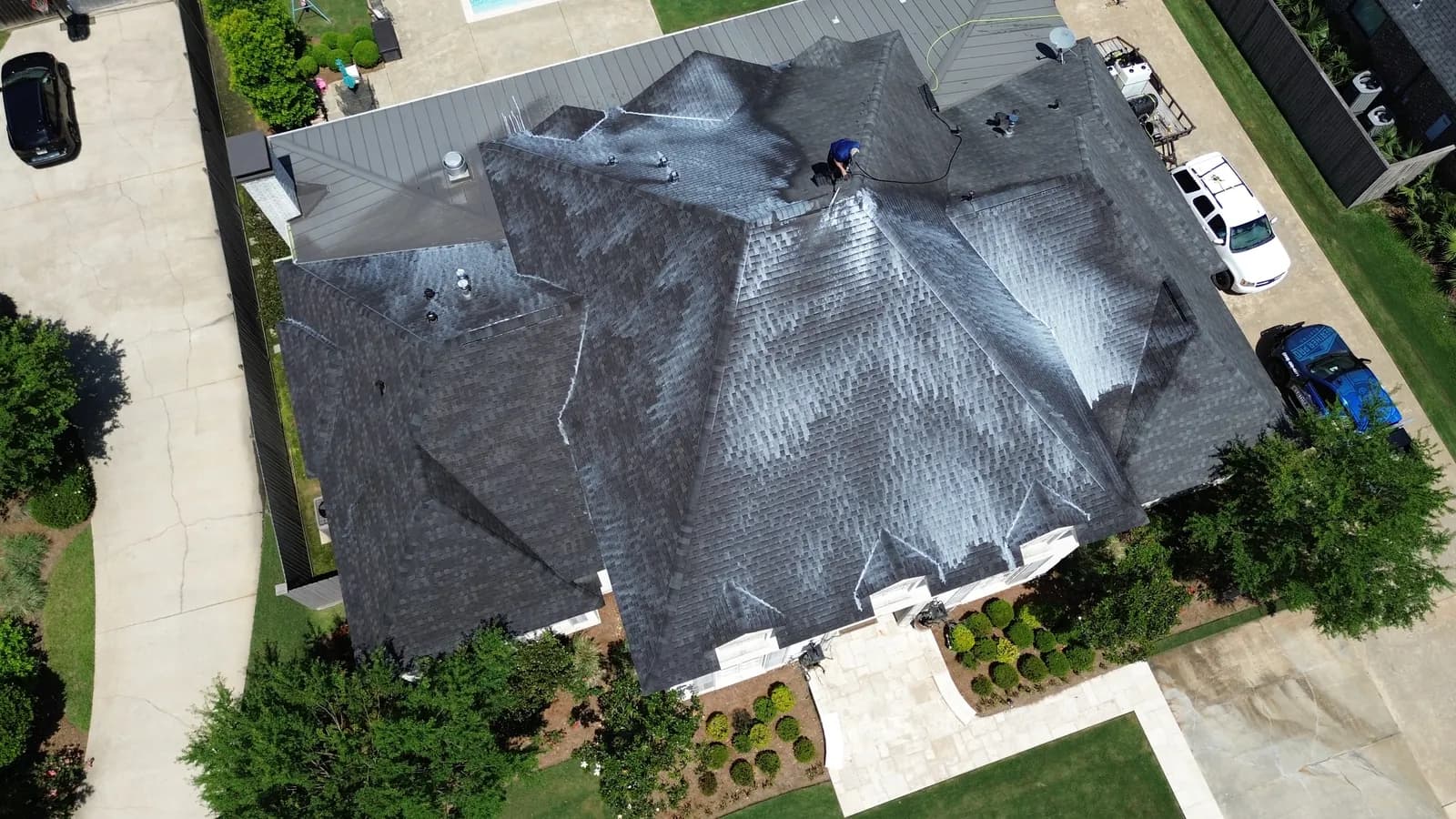
Chemistry application underway — low-pressure ARMA-spec solution penetrating algae and biological staining at the root.
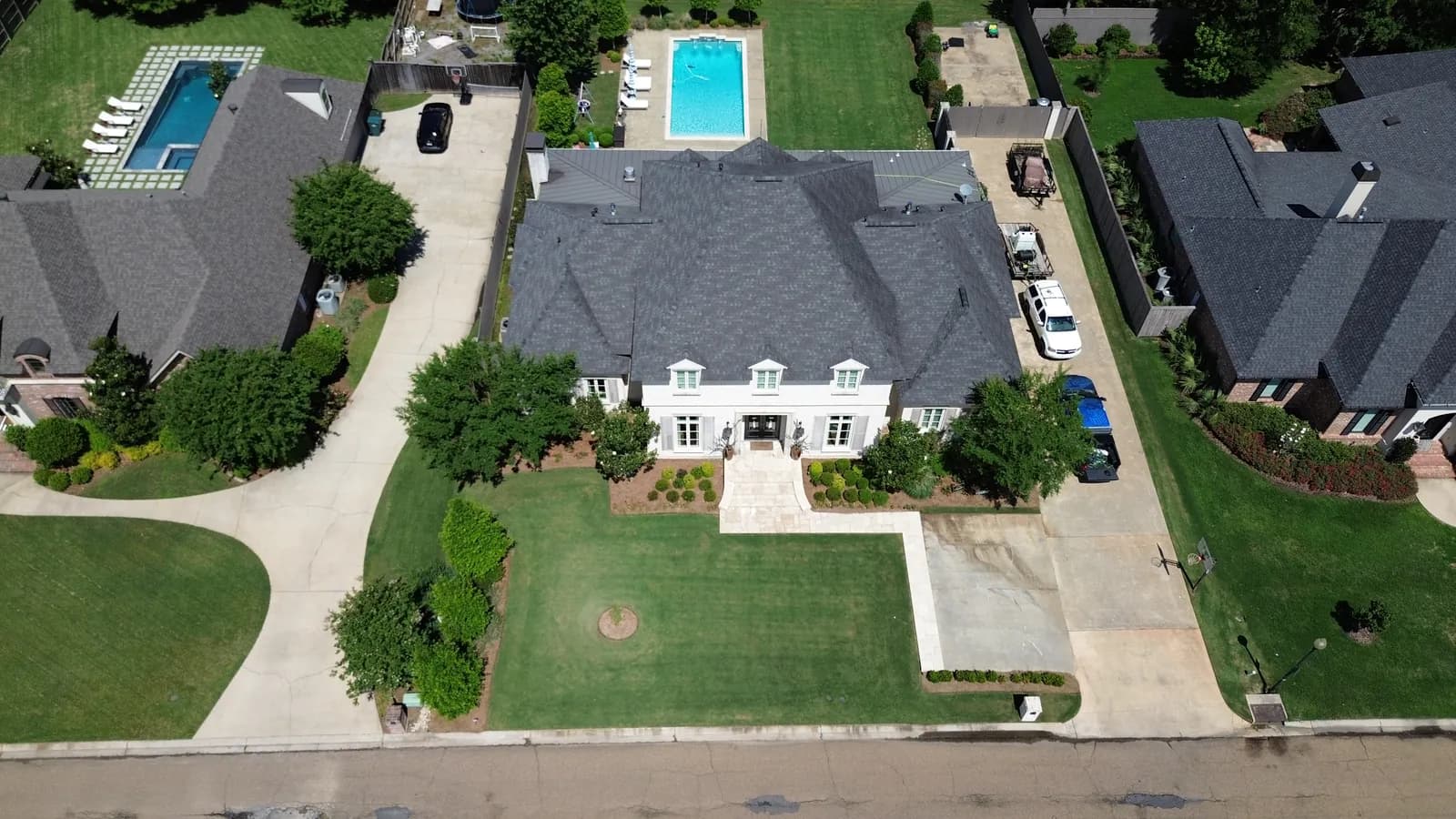
Algae and surface staining gone, granules intact, manufacturer warranty preserved. Curb appeal restored without replacement.
More Soft-Wash in Action
The ARMA-Spec Method Across Roof Types
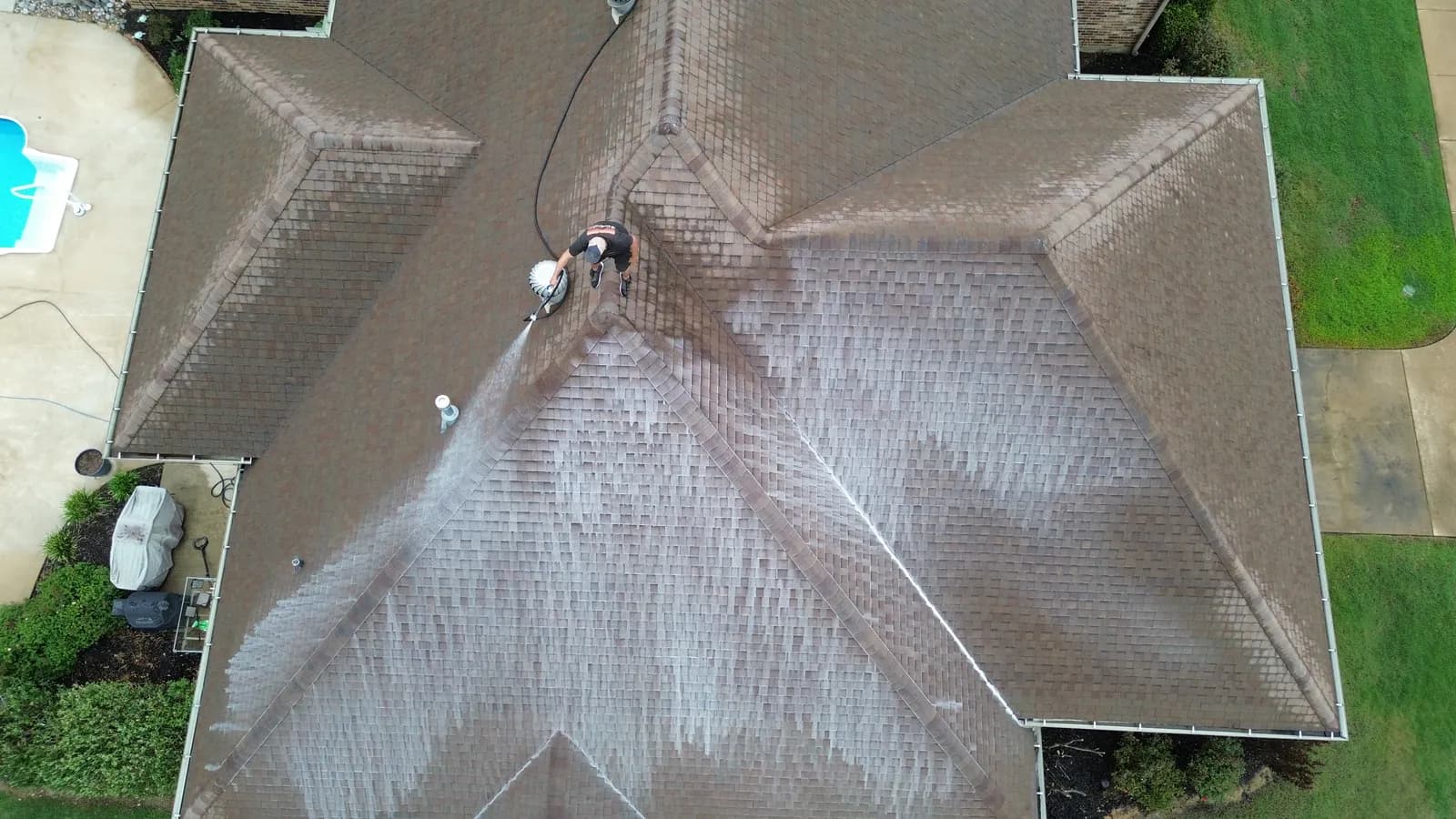
Low-pressure wand application — under 100 PSI, the ARMA-specified method approved by every major shingle manufacturer.
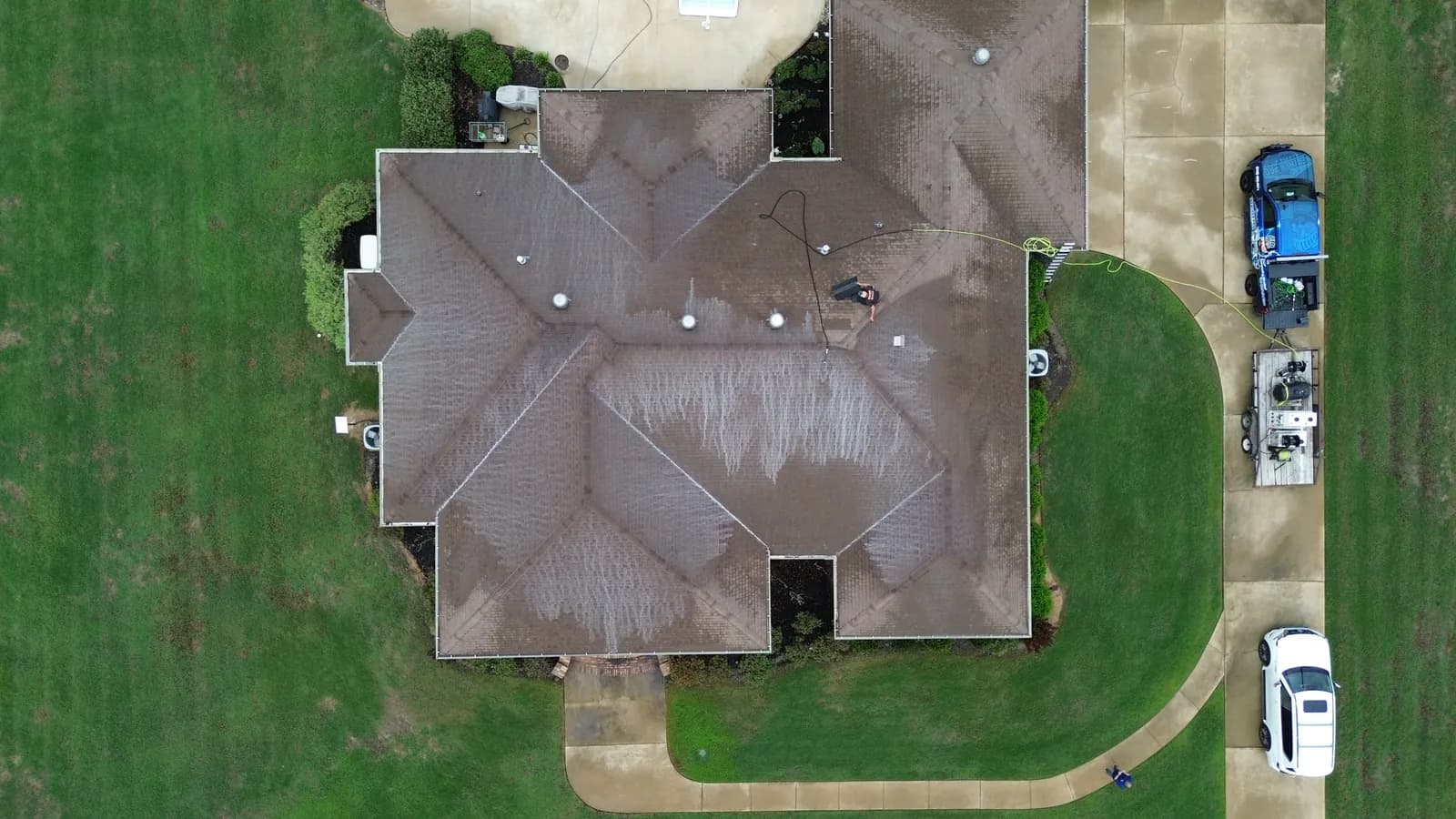
Aerial drone documentation — every slope, valley, and dormer reached for full coverage, not just the visible street-facing sides.
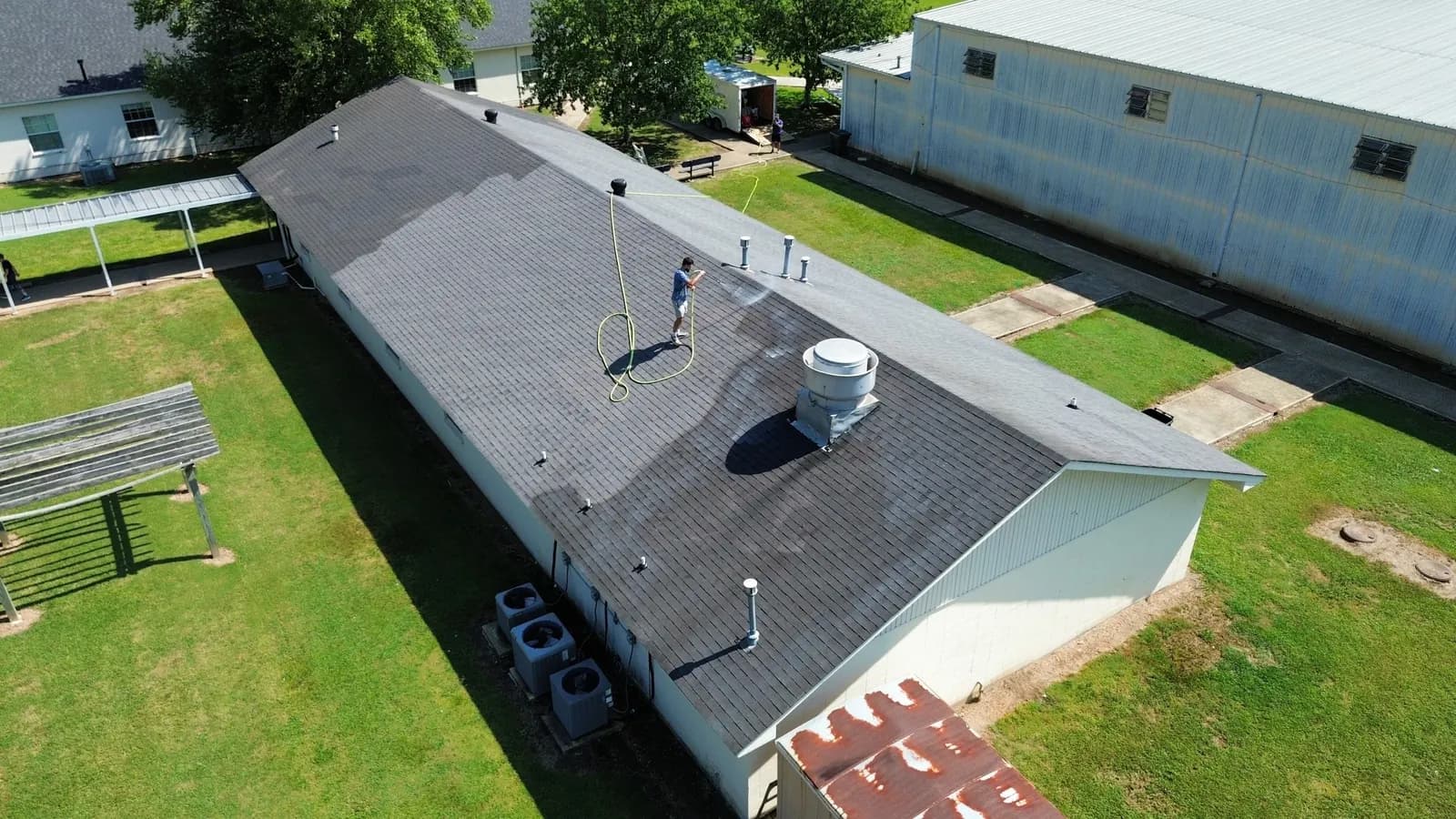
Treated vs. untreated sections visible in a single frame — the chemistry kills the algae, and the staining lifts as the dead organism weathers away.
FAQ
Soft-Wash & Rejuvenation FAQ
- Two different problems, two different treatments — frequently paired on the same visit. Soft-wash is a cleaning method: low-pressure ARMA-spec chemistry that kills algae, moss, and biological staining on the surface of the shingle. Rejuvenation is a restoration treatment: a spray-applied bio soy-ester formula that soaks into the shingle itself, replacing the petroleum oils the shingle loses as it ages. Cleaning makes the roof look new. Rejuvenation makes it act new. A typical mid-life home with shaded slopes gets both — clean first, restore second — in a single half-day visit.
- Gloeocapsa magma — a cyanobacteria that feeds on the limestone filler in asphalt shingles. It grows aggressively in humid climates like ours (LA, MS, AL, Gulf Coast) and shows up first on north-facing slopes and shaded areas where less UV reaches the surface. The streaking pattern (vertical, dark, persistent) is the visual signature. It's a biological staining problem, not dirt — pressure washing won't help, but it can damage shingles. Soft-wash chemistry is the only effective and warranty-preserving treatment.
- No — soft-wash done to ARMA (Asphalt Roofing Manufacturers Association) Technical Bulletin specifications is the only roof cleaning method explicitly approved by major shingle manufacturers (GAF, Owens Corning, CertainTeed, IKO). It's pressure washing that voids warranties. Soft-wash uses low pressure (under 100 PSI) and a properly diluted sodium hypochlorite + surfactant solution that's gentle on shingles but lethal to algae and moss. We document the method we used so warranty status stays intact.
- Asphalt shingles age because they lose petroleum-based oils to UV, heat, and oxidation. Once the oils are gone, the shingle goes brittle — granules let go, edges curl, the mat cracks. Bio rejuvenation sprays use a soy-based ester (a plant-derived oil chemically similar to the original petroleum oils) that soaks into the shingle and replaces what was lost. The version we use also carries UV inhibitors, a built-in algaecide, and hydrophobic / hydrophilic nano-tech that helps the surface shed water and self-clean. Flexibility testing under ASTM D3462 protocols shows treated shingles bend without cracking again — the same test new shingles have to pass.
- The sweet spot is asphalt shingle roofs 7–18 years old that are structurally sound — granule loss starting, flexibility dropping, but no widespread cracking, no underlayment failure, and no missing tabs. Roofs newer than 7 years still have plenty of native oil and don't need it. Roofs older than 18 years (or already failed in localized areas) usually can't be saved by oil replacement alone — at that point replacement or a coating system is the honest scope. We inspect first and tell you which bucket your roof actually falls into.
- Independent program data shows asphalt shingles regain roughly 5 years of service life per treatment, with up to three treatments cumulatively before replacement is the right call — so up to 15 years total. In practice, a 12-year-old roof that would have failed at year 20 can realistically reach year 30 with the right rejuvenation timing. The exact gain depends on the starting condition of the roof, the climate, and how soon between treatments the next pass happens.
- Roof Maxx is the best-known retail brand in the bio-rejuvenation category, but it's not the only one. Brown's Roofing applies treatments through our WeatherPro partnership — the underlying chemistry is the same family (USDA BioPreferred-certified, soy-based ester, with UV and algaecide additives), and the application standard is the same. What matters is who applies it and whether the roof is actually a good candidate. Most failed rejuvenation jobs we've seen as second opinions were applied to roofs that should have been replaced, not the chemistry's fault.
- In our LA, MS, AL, and Gulf Coast climate, a single soft-wash treatment typically lasts 4–6 years before noticeable re-staining appears. Drier markets (KS, North TX, AR) often see 6–8 year cycles. Heavy tree coverage, persistent shade, or severe humidity can shorten the cycle to 3–4 years. We include a 1-year algae return warranty on asphalt shingle treatments — if the streaking returns within 12 months, we re-treat at no charge.
- Three reasons. First, high-pressure water blasts off the protective ceramic granules that give shingles their UV resistance and color — visibly shortening roof life by 5–10 years. Second, pressure washing voids most manufacturer warranties; the method is explicitly disapproved by GAF, Owens Corning, CertainTeed, and the rest. Third, pressure water doesn't kill the algae or moss organisms — the staining returns within 12–18 months because the underlying biology is still alive. Soft-wash chemistry kills the organism; pressure water just removes today's growth.
- Not when applied correctly. We pre-saturate landscaping with fresh water before chemistry application (dilutes anything that runs off), pre-cover sensitive plants where appropriate, and post-rinse the entire perimeter after treatment. Sodium hypochlorite breaks down quickly under sunlight, and the soft-wash dilution at the spray nozzle is much weaker than household pool chlorine. The rejuvenation spray is plant-derived bio soy ester — also low-toxicity by design. We do this work daily across our seven-state footprint without landscape damage.
- Soft-wash cleaning on a typical Southern home (1,800–2,400 sq ft of roof area) runs at the lowest tier — heavy moss / lichen sits in the mid-tier, tile and slate specialty cleaning higher. Bio rejuvenation typically runs 15–30% of a full roof replacement on the same home — meaningful money, but a fraction of what tear-off and re-roof costs. Multi-story or complex-access homes carry a 20–35% premium on either scope. Maintenance program members typically receive 15–25% reduced pricing on bundled visits. We provide a written estimate after a free on-site walk-through.
- Yes — full general liability and workers' compensation, with documented compliance for ARMA-spec soft-wash methodology and trained applicators for the rejuvenation chemistry. Our crews are trained on the chemistry, the equipment, and the safety protocols; we're not subbing this work to landscape pressure-wash crews unfamiliar with shingle warranty implications. Roof cleaning and rejuvenation sit inside our roofing operation by design — the team doing the work is qualified to identify pre-existing roof issues during the visit.
Soft-Wash Roof Cleaning in Your Market
Free Assessment
Get a Soft-Wash & Rejuvenation Quote
Free site visit, written estimate, and an honest opinion on whether your roof is a cleaning candidate, a rejuvenation candidate, both, or neither. ARMA-spec method, USDA BioPreferred rejuvenation chemistry, fully insured.