Commercial Asphalt
Shingle Roofing
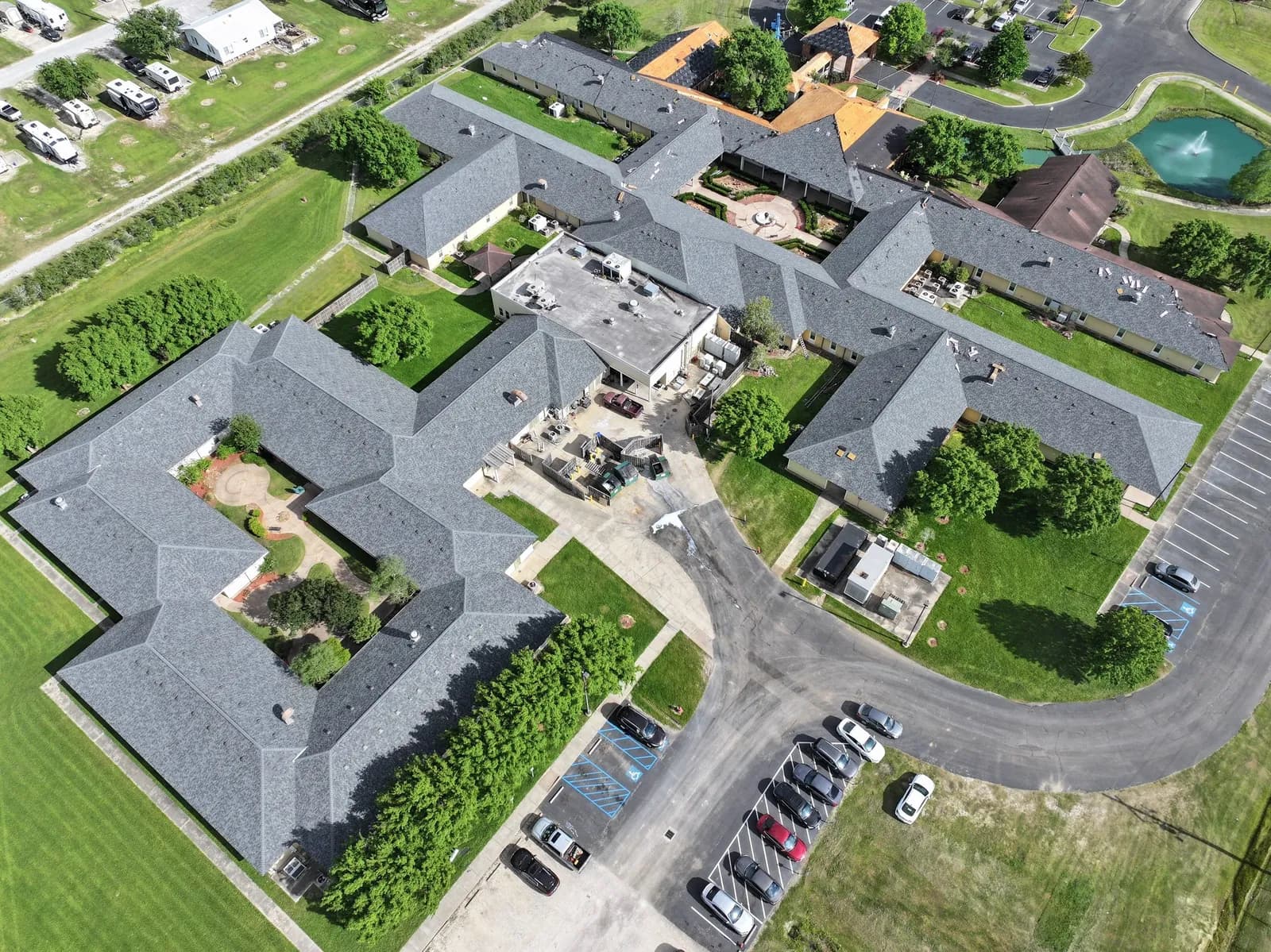
Not every commercial building needs a membrane system. For churches, low-rise offices, retail centers, schools, and multifamily properties with sloped roofs, Class 4 architectural shingles deliver decades of performance at a fraction of the cost — with insurance-discount-eligible severe weather performance.
When Asphalt Is Right
The Right System for Sloped Commercial Roofs
Commercial roofing decisions are too often defaulted to membrane systems regardless of whether the building's roof geometry actually warrants it. On sloped commercial roofs — any pitch greater than 3:12 — architectural asphalt shingles are frequently the most cost-effective and appropriate system available.
They're manufactured in commercial-grade and impact-resistant variants, carry long-term manufacturer warranties, and are installed by the same crews handling residential and commercial membrane work. For property managers and facility managers, the lower material and labor cost means more capital budget available for the flat or low-slope membrane sections that genuinely require specialty systems.
Class 4 impact-resistant shingles are manufactured to withstand hail up to 2 inches and sustained winds up to 130 mph — critical performance specs in storm-prone markets across Louisiana, Arkansas, Kansas, and beyond. We install Class 4 as our commercial standard because it reduces callbacks, extends warranty periods, qualifies for insurance discounts, and performs better over time.
Most commercial shingle jobs happen on occupied buildings. We schedule around tenant and operational requirements, phase work to minimize disruption, and coordinate debris removal and material staging with your property management team. Projects stay on schedule without your tenants or clients being affected.
Why Commercial Asphalt Works
Cost-Effective for Sloped Sections
On commercial roofs with pitch greater than 3:12, architectural asphalt shingles are typically 40–60% less per square foot than membrane systems. For property managers stretching capital across multiple buildings, the math works.
Class 4 Impact Resistance
Modern Class 4 impact-resistant shingles withstand 2-inch steel ball impacts (UL 2218 Class IV) — performance comparable to metal in hail events. Insurance carriers across our markets offer 5–25% premium discounts for Class 4 installation.
Aesthetic Range
Architectural shingles come in dozens of colors and texture profiles, allowing churches, professional buildings, and HOA properties to match historic appearance, brand identity, or community design standards.
Familiar Repair Process
Unlike membrane systems, asphalt shingle repairs are straightforward — any qualified roofing contractor can perform them. No specialized welders, no proprietary parts. Critical for property managers who need long-term repairability.
Insurance & Code Familiarity
Asphalt shingle commercial roofing has been on US buildings for over 100 years. Adjusters, code officials, and lenders all know the system. No unfamiliar specifications complicating insurance claims or property transactions.
Fast Installation
Commercial asphalt installation moves quickly compared to membrane systems. A 20,000 sq ft sloped commercial roof can typically be replaced in 5–10 working days, minimizing operational disruption.
Algae & Streak Resistance
Standard commercial-grade architectural shingles include 3M Scotchgard or copper-infused granules that resist Gloeocapsa magma algae streaking — particularly important in our humid Southern markets where algae growth is rapid.
Long-Term Warranty
Manufacturer warranties on commercial-grade architectural shingles run 30–50 years, with enhanced contractor-installed warranties available from GAF, Owens Corning, and CertainTeed when installed by certified contractors like Brown's Roofing.
Commercial Asphalt Specifications
Mixed-System Buildings
Many commercial buildings have both sloped and flat sections. Brown's Roofing handles both — architectural shingles on the pitched sections, membrane systems on the flat — under a single contract and warranty structure.
Decision Framework
Is Asphalt Right for Your Building?
Four factors drive whether commercial asphalt is the right system spec or whether you should consider membrane or metal alternatives.
Roof Pitch
Asphalt shingles require a minimum 3:12 (3-inch rise per 12-inch run) pitch to drain reliably. Below 3:12, switch to a low-slope membrane system (TPO, PVC, or Mod-Bit). Many commercial buildings have mixed pitches — we install both under one contract.
Building Hold Period
If the building owner intends to hold the property for 25+ years, Class 4 architectural shingles deliver the right balance of upfront cost and lifecycle performance. For shorter hold periods, standard architectural shingles may be the better economic choice.
Severe Weather Risk
In hail-active markets (Wichita, Little Rock, Shreveport), Class 4 impact-resistant is the right specification. The insurance discount alone often justifies the upgrade — and the long-term performance advantage is significant.
Aesthetic Requirements
Churches, HOA properties, and historic-district buildings often have specific design constraints. Architectural shingles offer the broadest color and profile range of any commercial roofing system — and can match historic slate, wood shake, or tile appearance.
Who We Serve
Commercial Asphalt Applications
Churches & Worship Facilities
Steepled and gabled roof sections on religious facilities are prime candidates for dimensional architectural shingles — balancing aesthetics, durability, and long-term maintenance costs.
Low-Rise Office Buildings
Sloped roofs on 1–2 story office buildings, medical offices, and professional complexes are routinely reroofed in architectural or Class 4 shingles at significantly lower cost than membrane alternatives.
Retail & Strip Centers
Visible sloped sections on retail centers require shingles that look professional and hold up to regional weather. We match existing systems and coordinate with property management schedules.
Schools & Institutions
Educational facilities and institutions often have large, complex sloped roof systems. We provide accurate scoping, competitive pricing, and the documentation school districts and institutions require.
Multifamily / HOA Properties
Apartment complexes, condos, and HOA-managed townhomes need contractors who can manage scope, phasing, and resident communication. We handle all of it — from board presentations to door-hangers.
Light Industrial / Mixed-Use
Sloped roof sections on mixed-use industrial properties are a common application, particularly when coordinating with flat membrane work on the same building under a single contract.
Auto Dealerships
Dealership showroom buildings often have prominent sloped roof sections that drive curb appeal. Class 4 architectural shingles deliver high-end aesthetics with hail resistance critical in our markets.
Hotels & Hospitality
Mid-scale and limited-service hotels often combine flat-roofed corridors with sloped guest-room roofs. Architectural shingles match the residential aesthetic that brand standards typically require.
Cost Factors
What Determines Project Cost
Commercial asphalt shingle installations are the lower-cost commercial roofing tier. Pricing depends on roof complexity, shingle grade, decking condition, and accessibility. Class 4 upgrades typically add 10–15% over standard architectural shingles.
Brown's Roofing provides written, detailed estimates after a free assessment. We don't quote per-square-foot averages over the phone — every commercial property gets an actual scope.
Request a Written Estimate10 Variables That Drive Project Cost
- 01Roof size and complexity (square footage and waste factor)
- 02Number of stories and access difficulty
- 03Existing roof — tear-off vs. layover (when code-permitted)
- 04Decking condition (replacement of damaged sheathing)
- 05Underlayment type (synthetic, ice & water shield)
- 06Shingle grade (architectural vs. Class 4 impact-resistant)
- 07Manufacturer and warranty selection
- 08Flashing replacement (chimney, valley, step, drip edge)
- 09Ventilation upgrades (ridge vent, soffit vent, attic fans)
- 10Disposal and dumpster fees
FAQ
Commercial Asphalt Roofing FAQ
- Yes — for any commercial building with sloped roof sections (3:12 pitch or steeper), architectural asphalt shingles are often the most cost-effective and appropriate system. Churches, low-rise offices, schools, multifamily properties, and retail centers routinely use commercial-grade architectural or Class 4 impact-resistant shingles. Membrane systems (TPO, PVC, Mod-Bit) are appropriate for flat and low-slope sections — not for sloped commercial roofs.
- Class 4 shingles are tested under UL 2218 to withstand 2-inch steel ball impacts at 90 mph — the highest impact resistance rating available for asphalt shingles. They typically cost 10–15% more than standard architectural shingles. In our hail-active markets (Wichita, Little Rock, Shreveport, Lafayette), most commercial property insurance carriers offer 5–25% premium discounts for Class 4 installation — often paying back the upgrade premium in 3–5 years through insurance savings alone, before considering the longer service life.
- Properly installed Class 4 architectural shingles typically last 25–35 years in our climate, depending on installation quality, ventilation, and weather exposure. Manufacturer warranties run 30–40 years on commercial-grade products. The single biggest factor in shingle longevity is proper attic ventilation — under-ventilated commercial roofs see significantly accelerated shingle degradation regardless of product quality.
- In most jurisdictions, building code allows up to two layers of asphalt shingles on commercial buildings. A second-layer 'layover' costs 30–40% less than tear-off replacement and is faster. However, layover hides any decking damage and reduces the visible inspection surface — we generally recommend tear-off for any roof that's leaked, has visible decking deflection, or is more than 15 years old. We assess and recommend the right approach during the inspection.
- Brown's Roofing works in markets across LA, AR, KS, AL, MS, TX, and FL and understands local building codes and insurance documentation standards. We document hail and wind damage thoroughly with photographs and written reports, and can be present during your insurance adjuster's inspection to point out documented damage. We provide written, itemized estimates and repair scopes — you work with your carrier on claim decisions. We do not inflate claims; we document all visible damage thoroughly so your adjuster has a complete picture.
- A 20,000 square foot single-story commercial sloped roof can typically be replaced in 5–10 working days under normal weather conditions. Larger projects, multi-story buildings, complex roof geometries, or projects requiring decking replacement may take 2–4 weeks. We schedule around your operations and can phase work to minimize disruption — particularly important for multifamily, schools, and active retail.
- Yes — mixed-system buildings are routine. We install architectural shingles on the sloped sections and TPO, PVC, or Mod-Bit on the flat sections under a single contract, single project schedule, and single warranty package. This is significantly easier than coordinating two contractors — and ensures the flashing transitions between sloped and flat sections are properly executed.
Available Across Our Markets
Commercial Roofing
Get a Commercial Asphalt Assessment
We'll evaluate your property and give you an honest recommendation on whether asphalt, membrane, or a mixed-system approach is right for your building.