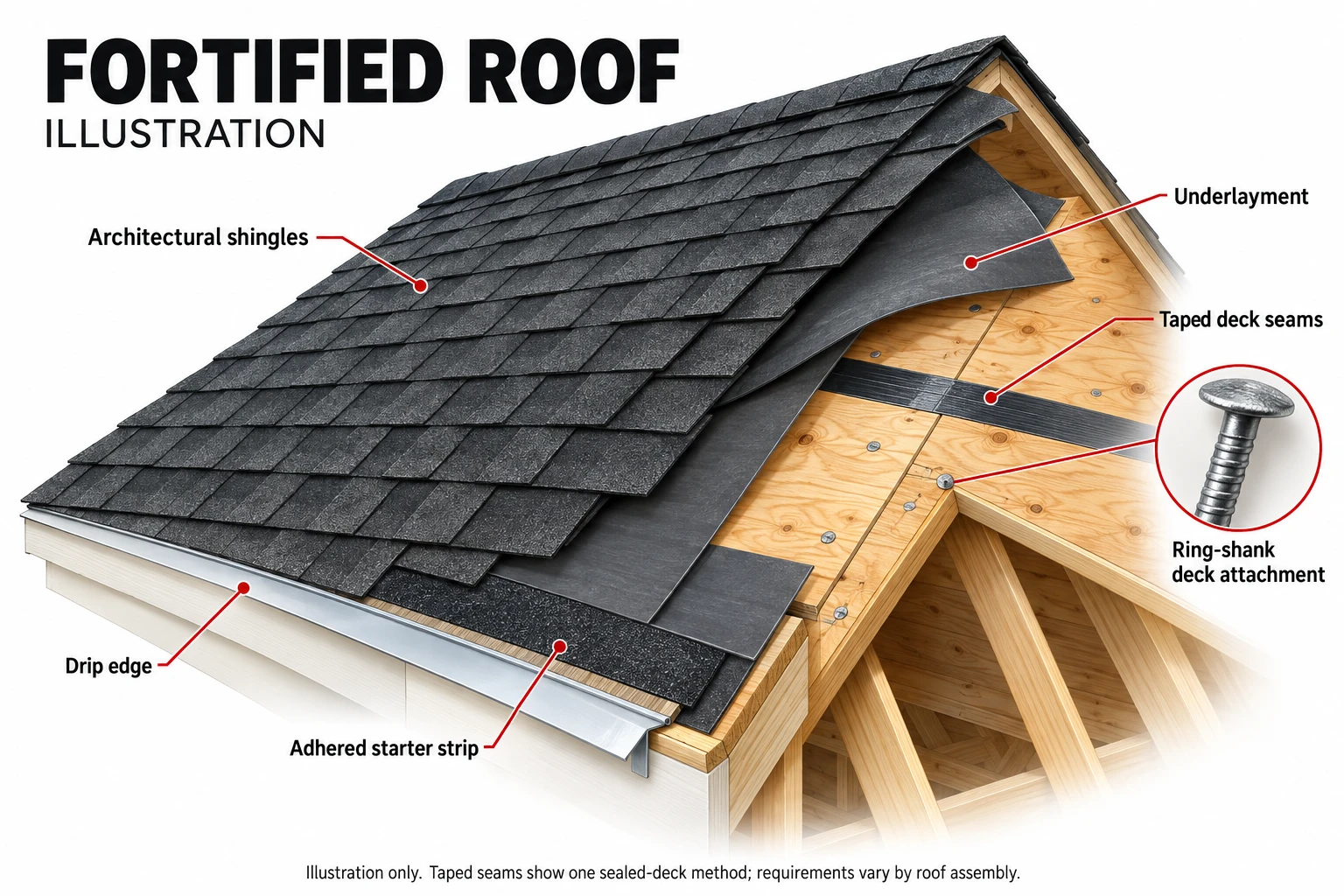
Two new roofs can look identical from the driveway — same color, same architectural profile, same clean ridge line. Lift the shingles, though, and one may be held down by smooth nails over open deck seams while the other has ring-shank nails, a sealed deck, and locked-down edges. A FORTIFIED roof is built to that second standard, and the difference lives in the part you can't see once the crew packs up. Before you choose a shingle, ask what's going underneath it.
Why FORTIFIED Roofs Are Getting More Attention
In May 2026, the Insurance Institute for Business & Home Safety (IBHS) announced that its FORTIFIED program had passed 100,000 designations nationwide, with more than half of them earned in the last three years. FORTIFIED is a voluntary, beyond-code re-roofing and construction standard built on IBHS lab research into how roofs actually fail in high wind and wind-driven rain.
That research lines up with what we see across our markets: hurricane and tropical-storm wind around Baton Rouge and Lafayette, and spring hail and straight-line wind through Shreveport, Monroe, Little Rock, and Wichita. The weak points are the same almost everywhere — the deck connection, the seams between deck panels, and the roof edges. FORTIFIED targets all three.
For a homeowner comparing bids, the practical upshot is simple: you can ask a contractor to explain the protection built into the roof system, not just the product name on the sample board.
What Makes a FORTIFIED Roof Different From a Standard Re-Roof?
The FORTIFIED Roof standard addresses the whole roof assembly. On a typical asphalt shingles replacement, these are the upgrades that matter most — and the question to ask about each one.
Better deck attachment
Instead of common smooth nails, FORTIFIED requires 8d ring-shank nails installed in a tighter pattern. IBHS testing shows that switch can double the uplift a roof deck can withstand. On a re-roof, this work happens after tear-off, while the deck is exposed — it's the one practical window to do it. Under the current 2025 standard, the tighter nailing pattern applies to all FORTIFIED roof decks, inland and coastal alike.
Ask: "What deck attachment work is included, and how will you handle deck boards that need replacing?"
A sealed roof deck
If wind strips off the shingles, the wood deck underneath is exposed and rain pours through the gaps between panels. A sealed roof deck is the second line of defense. According to IBHS, sealing the deck seams can reduce that water intrusion by up to 95%.
Ask: "Which sealed roof deck method are you proposing?"
Locked-down roof edges
Wind damage often starts at the edge, where gusts get under the eave or rake and start peeling the roof back. FORTIFIED requires a wider drip edge and a fully adhered starter strip, which work together as a stronger edge system.
Ask: "How will the eaves and rakes be secured?"
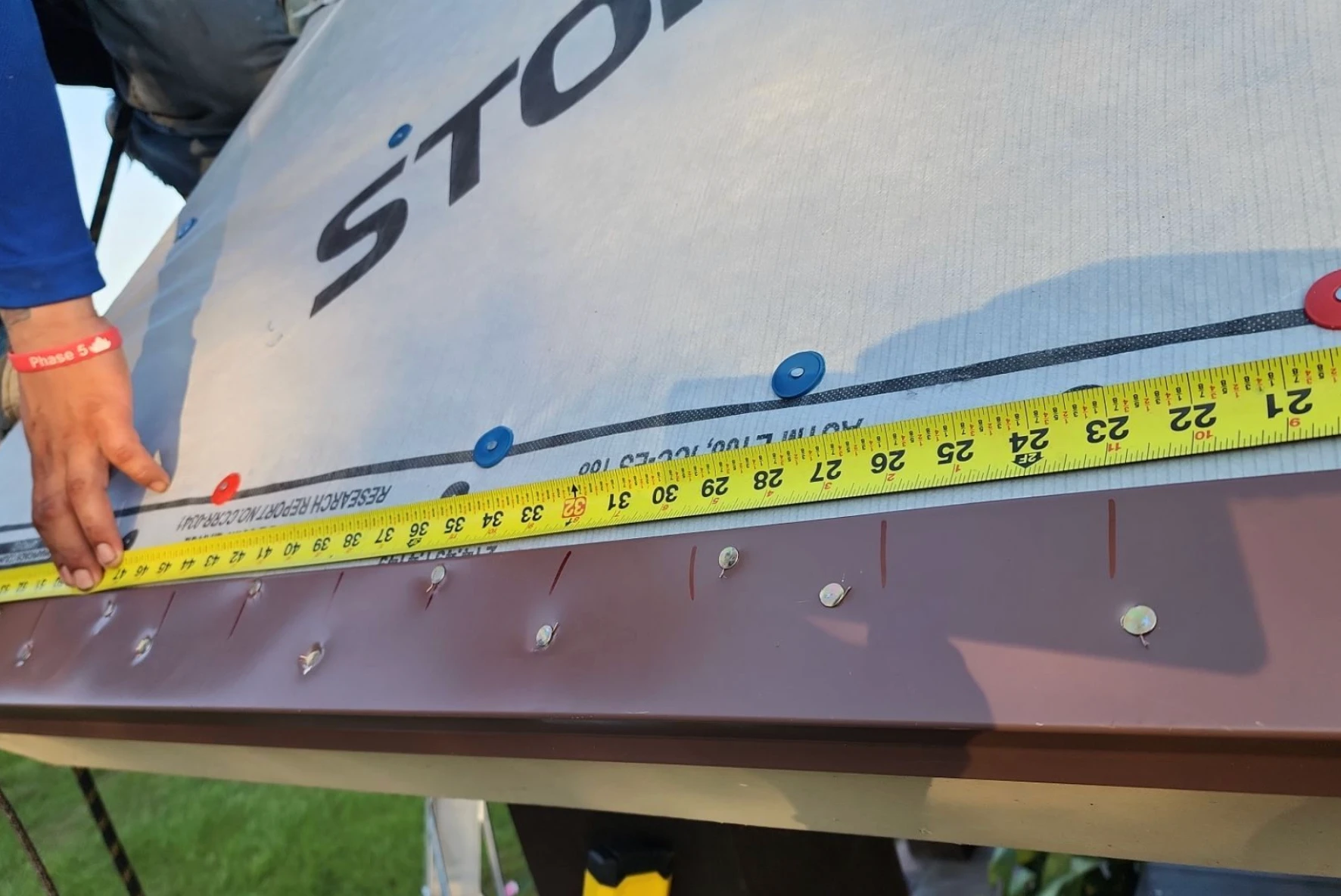
Edge fastener spacing gets measured and photographed while it's still exposed — the kind of detail an evaluator documents during installation.
Rated shingles and vents
The roof cover has to meet the standard too. Asphalt shingles must carry the highest wind ratings (ASTM D3161 Class F or ASTM D7158 Class H), and roof-mounted vents must be tested to resist wind-driven rain.
Does Synthetic Underlayment Mean You Have a Sealed Roof Deck?
Not by itself. FORTIFIED publishes several approved sealed-deck details, and depending on the roof assembly they include taped deck seams under underlayment, specified two-layer underlayment systems, and fully self-adhered membranes. Each one is an installation method — how the materials go down together — not a product you buy off the shelf.
So when an estimate lists "premium synthetic underlayment," that tells you what's on the truck, not whether the deck will be sealed. Ask the contractor to walk you through the complete method. You shouldn't need to be a roofer to understand what's being installed and why.
Are Class 4 Shingles the Same as a FORTIFIED Roof?
No. A shingle's impact rating describes the roof cover. It doesn't certify the deck attachment, the sealed deck, or the edges.
Hail protection inside FORTIFIED is handled by the optional Hail Supplement, and the bar is higher than most homeowners expect. Under the current standard, asphalt shingles must be rated Good or Excellent on the IBHS Hail Impact-Resistant Shingle Ratings, a test that uses manufactured hailstones designed to behave like real ones. A UL 2218 Class 4 label alone no longer qualifies, and not every Class 4 shingle earns a Good or Excellent score. IBHS says the qualifying shingles better protect against hail up to 2 inches in diameter.
If you're upgrading shingles, ask for the exact manufacturer and product line in writing. Then ask a separate question: "Does this proposal include a FORTIFIED designation, and are we including the Hail Supplement?" That keeps the material choice and the project scope from blurring together. For a closer look at how specific products hold up, see our guide to the best impact-resistant shingles in Arkansas.
The Verification Belongs in the Plan From Day One
A FORTIFIED designation isn't a claim a roofer makes — it's a certificate IBHS issues. An independent third-party evaluator documents the work during installation, and IBHS reviews that documentation before designating the home. A contractor describing a roof as "built to FORTIFIED standards" has not given you a designation.
Timing matters here. Nail patterns and deck seams get photographed while they're exposed. Once the shingles are on, that evidence is gone, and it can't be recreated after the fact.
The 2025 standard also requires FORTIFIED roofs to be installed by a certified FORTIFIED roofing contractor. Brown's is an IBHS FORTIFIED Certified Contractor: we install to the standard and coordinate with the independent evaluator, who verifies the work separately.
Before approving an estimate, get clear answers to these:
- Who is coordinating the evaluator?
- Are evaluation and designation-related costs included in the price?
- How will each required construction detail be documented?
- What records will you receive when the project is complete?
How to Compare FORTIFIED Roof Estimates
Ask each contractor for a written comparison between a standard replacement and the FORTIFIED option, then work through it in this order.
- Pin down the roof cover. Get the exact manufacturer and product line, its wind rating, and — if you want the Hail Supplement — its IBHS hail rating.
- Confirm the deck attachment scope. The proposal should state the ring-shank re-nailing and how damaged decking will be identified and replaced.
- Identify the sealed-deck method. It should be named specifically, not implied by an underlayment brand.
- Check the edge details. Look for the drip edge and adhered starter strip at both eaves and rakes.
- Confirm the verification plan. Evaluator coordination, documentation, and any evaluation fees should be spelled out.
- Compare written totals side by side. Each added material, labor item, and verification cost should be identified so you can see what the FORTIFIED option actually buys.
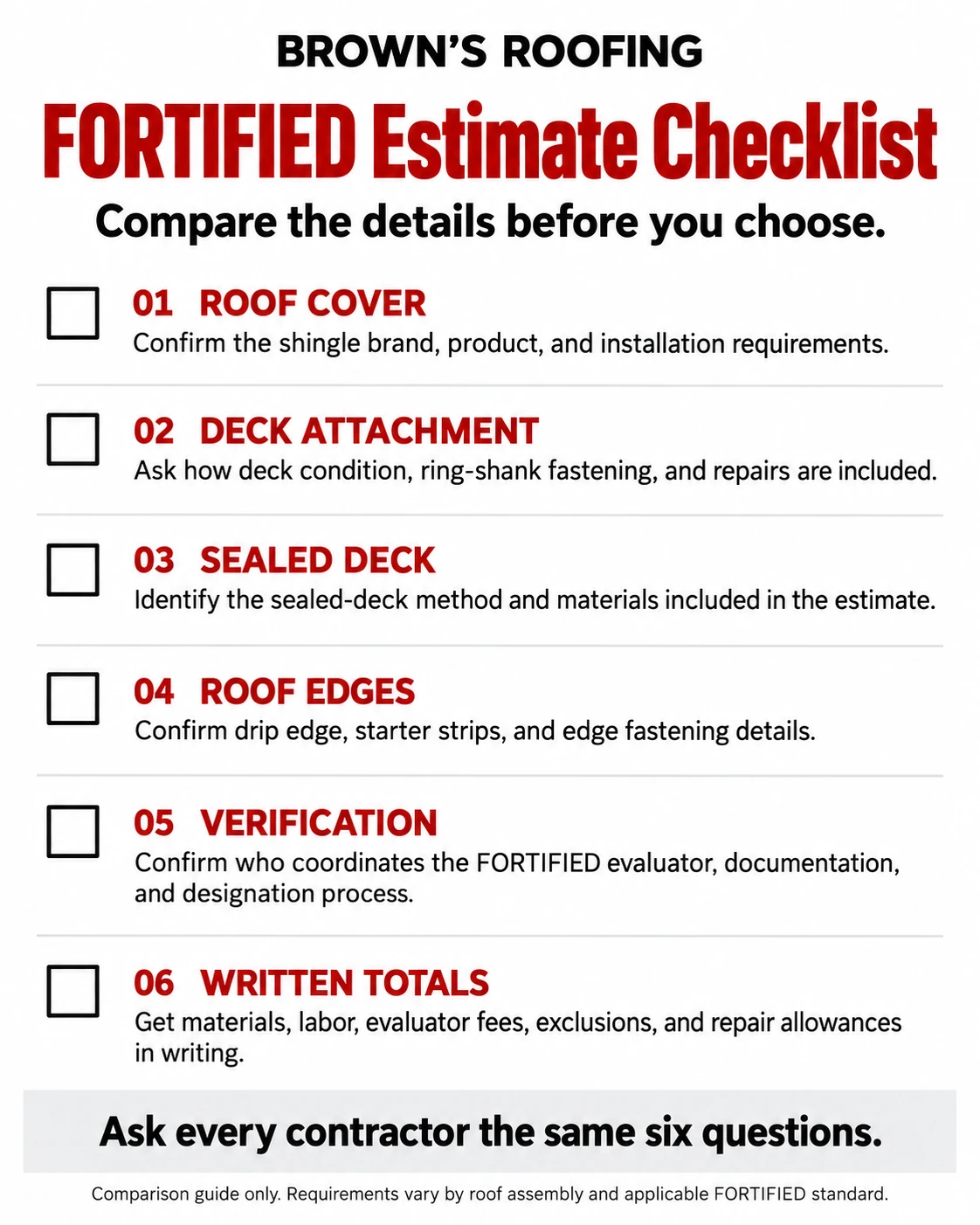
Print this and ask every contractor the same six questions.
The goal is to understand what each number includes. A shingle brand and a bottom-line total leave too many questions unanswered. A FORTIFIED upgrade adds materials, labor, and verification compared with a standard roof replacement, and IBHS notes the cost varies with the home and the applicable requirements. For our part, pricing depends on roof size, slope, complexity, access, and material specification — we provide a written estimate after a free on-site inspection.
Some designated homes qualify for insurance discounts or state incentive programs. Those vary by insurer and state, so confirm any benefit directly with your agent before you count on it. If you're in Louisiana, our Louisiana FORTIFIED roofing guide breaks down the insurance discounts, tax credits, and grant programs in detail.
Frequently Asked Questions
Can a FORTIFIED roof still be damaged in a storm?
Yes. FORTIFIED reduces the risk of damage; it doesn't make a home stormproof. Severe weather can still damage a designated roof. The standard is designed to keep the roof deck attached and limit water intrusion so that damage doesn't cascade into the rest of the house.
How long does a FORTIFIED designation last?
An initial designation certificate expires five years after it's issued. A redesignation inspection is then required to keep it. If the structure hasn't changed substantially and the roof covering is still within its life expectancy, the designation is typically renewed. Details are in the FORTIFIED program FAQ.
Can any roofer install a FORTIFIED roof?
Under the 2025 FORTIFIED Home standard, the roof must be installed by a certified FORTIFIED roofing contractor. The work is then verified by an independent evaluator — never by the installing contractor.
Is a sealed roof deck the same as synthetic underlayment?
No. A sealed roof deck is an installation method, such as taped deck seams under underlayment, a specified two-layer underlayment system, or a fully self-adhered membrane. Synthetic underlayment on its own doesn't establish compliance.
Do Class 4 shingles qualify for the FORTIFIED Hail Supplement?
Not automatically. Asphalt shingles must be rated Good or Excellent on the IBHS Hail Impact-Resistant Shingle Ratings. Some Class 4 products earn that score and some don't, so the specific product matters.
What should I ask before choosing shingles?
Ask for the complete roof scope first: deck attachment, sealed-deck method, edge details, and the verification plan. Then compare shingle options within that scope rather than the other way around.
Look Beneath the Shingle Sample
Your new roof should look good from the driveway. You should also understand the work you won't be able to see once it's finished. If you're planning a replacement, Brown's will get on the roof, walk you through what a standard re-roof and a FORTIFIED roof would each involve on your home, and put both in writing so you can compare them line by line. Call (318) 329-6579 for a free roof inspection — no obligation, same-day response.