Commercial Emergency Roof Repair
Fast. Documented. Warranted.
An active commercial roof failure is a business continuity problem. Brown's Roofing dispatches fast, stops the damage, documents everything your insurance carrier needs to review the damage and our permanent repair scope, and performs permanent repairs that preserve your existing roof warranty.
Commercial Emergency Repair Is Not the Same as Residential
A residential emergency repair stops a leak and protects a family's home. A commercial emergency repair has to do that — plus protect tenants or occupants, preserve warranty coverage, document a covered loss, and create documentation for your facility file. An undocumented quick fix on a commercial property can cost you more in voided warranty and denied claims than the repair itself.
Brown's Roofing treats commercial emergency calls as documentation events from the first minute on site. We photograph pre-repair conditions, document temporary protection deployed, and build a repair record that stands up to adjuster scrutiny and manufacturer warranty review.
What to Do Right Now
If you have active water intrusion: call us immediately, move sensitive equipment and inventory away from the affected area, place buckets and containment if possible, and do not allow anyone on the roof. Post-storm roofs are structurally unpredictable and the liability risk of an unauthorized roof entry is significant.
Call Immediately If You Have...
- Active water intrusion through the roof membrane or flashings
- Fallen trees, branches, or debris that has punctured the roof
- Wind uplift or blow-off of membrane sections or edge metal
- HVAC or rooftop equipment displacement exposing the deck
- Drain or scupper blockage causing dangerous roof loading
- Any condition that risks structural integrity or tenant safety
What Happens Next
From Your Call to Permanent Repair
Call First — Commercial Emergencies Get Priority Dispatch
When you call with an active commercial roof failure, we route it immediately to the nearest available crew. Provide your address and a brief description of what you're seeing. We give you an ETA on the call.
Site Safety & Immediate Containment
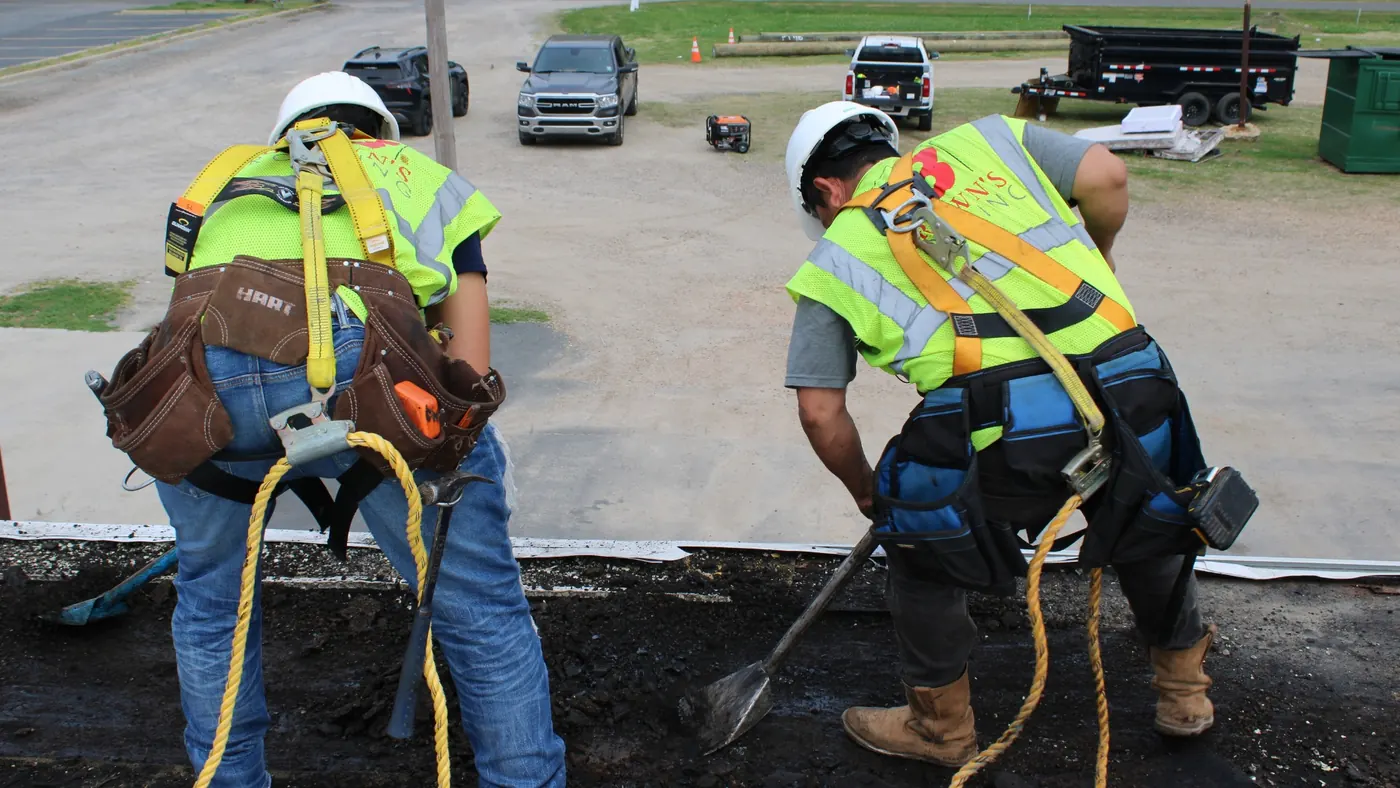
Our first action is stopping the damage. We assess structural risk, deploy temporary membrane patches or professional tarping, and contain the affected area. Interior protection recommendations are provided if damage has already spread.
Damage Documentation Before Anything Is Disturbed
Before permanent repair begins, we photograph and document the pre-repair condition systematically. This creates a record of pre-repair conditions for your facility file, warranty documentation, and provides an accurate baseline for your insurance adjuster's assessment.
Scope & Written Estimate
You receive a written scope of work and estimate before any permanent repair begins. If insurance is involved, we provide a written scope of work and itemized estimate that clearly describes the damage and our recommended repairs. No surprises, no unauthorized work.
Permanent Repair to Manufacturer Spec
Repairs follow the manufacturer installation requirements for your specific system — TPO, PVC, Mod-Bit, metal, or built-up. Work is performed by trained crews using approved materials to preserve your existing warranty.
Completion Report for Facility Records
You receive a written completion report with before-and-after photos, materials used, areas repaired, and warranty information. This goes into your facility file for your records and creates a documented completion record for your insurance adjuster and warranty files.
Common Scenarios
Six Scenarios That Trigger Emergency Calls
We've handled all of these — across all commercial roof systems, in all weather conditions, across all our markets.
Storm Damage Aftermath
After a major storm — hurricane, tornado, severe thunderstorm — buildings often have multiple damage points. Lifted membrane, missing edge metal, debris penetrations, and broken skylights all need rapid temporary protection followed by documented permanent repair.
Active Membrane Failure
Sudden seam separation, blister rupture, or membrane tear during a heavy rain event causes active interior leaking. Temporary patch deployment stops water entry within hours; permanent repair follows within days.
HVAC or Equipment Damage
Falling HVAC units, displaced equipment, or service damage during HVAC work creates immediate roof penetrations. Often requires coordination with the HVAC contractor on permanent re-flashing.
Tree or Debris Impact
Fallen tree limbs, branches, or wind-driven debris can puncture commercial membranes and damage decking. Temporary tarping prevents further water intrusion while permanent repair scope is developed.
Drain or Scupper Failure
Clogged drains during heavy rain create immediate ponding and dangerous structural loading. Emergency response includes drain clearing, alternative drainage paths, and assessment of any membrane damage from the loading event.
Wind Uplift Event
Severe wind events can lift large sections of mechanically attached membrane. Even if the membrane drops back into place, the seal is compromised. Emergency re-attachment and resealing prevents subsequent leak events.
FAQ
Commercial Emergency Roof Repair FAQ
- For active emergencies during business hours, our goal is same-day response — typically within 2–6 hours of the initial call depending on location and crew availability. After-hours emergencies typically receive next-morning response unless the situation is life-safety critical. During major storm events when multiple buildings need attention, our maintenance program customers get priority dispatch.
- Yes. Professional tarping is one of our most common emergency services. We deploy commercial-grade tarps with proper anchoring, edge sealing, and ballast appropriate for commercial flat roofs. Our temporary protection is designed to last 30–90 days while permanent repair scope is developed and scheduled — not a quick fix that fails in the next storm.
- Not when performed by a manufacturer-certified contractor like Brown's Roofing using approved materials. We carry manufacturer certifications across all major commercial systems and use warranty-compliant materials and methods on every emergency repair. Repairs by uncertified contractors using off-spec materials can absolutely void your warranty — verify warranty status before any emergency contractor touches the roof.
- Insurance carriers expect — and often require — that you take reasonable steps to prevent further damage immediately after a covered loss. Emergency tarping, temporary patching, and documentation of the pre-repair condition are all considered reasonable mitigation. Brown's Roofing photographs pre-repair conditions, deploys temporary protection, and provides written documentation of the damage and temporary protection deployed for your records and insurance adjuster's review. We provide written documentation of the damage and our itemized repair scope for your adjuster's review.
- Emergency response and temporary protection (tarping, patches) pricing depends on roof size, accessibility, and scope of temporary work. Permanent repair costs depend on the damage scope. Most commercial emergency situations resolve in two phases: immediate emergency mitigation, then permanent repair scoped and priced separately based on damage assessment. We provide written estimates before any permanent repair work begins.
- No. Post-storm and post-failure commercial roofs are structurally unpredictable — damaged decking, weakened framing, hidden membrane failures, and unstable equipment all create serious fall hazards. Commercial roof failures have caused fatal accidents to building staff who attempted self-inspection. Brown's Roofing crews carry full PPE, fall protection, and roof safety training. Let trained personnel handle the post-failure inspection.
- Yes. The majority of our emergency response calls are on commercial roofs installed by other contractors. We work with all major commercial systems (TPO, PVC, EPDM, Mod-Bit, BUR, metal) and all major manufacturers. Establishing a relationship with us before an emergency happens — through a maintenance program — typically results in faster response and priority dispatch when emergencies occur.
Commercial Emergency Response in Your Market
Permanent offices and trained crews across all our markets — fast response when it counts.
Free Assessment
Active Roof Failure on Your Property?
Call now — commercial emergencies get priority dispatch. Documentation included, no extra charge.