Commercial Roof
Soft-Wash & Algae Removal
Extend membrane life. Restore reflectivity. Eliminate algae, moss, lichen, and biological growth from commercial roofs with the only cleaning method approved by every major manufacturer — low-pressure, biodegradable, warranty-compliant soft-wash.
Why Commercial Roofs Need Soft-Wash
Biological Growth Is Damaging Your Roof — Quietly
TPO, PVC, modified bitumen, EPDM, and metal commercial roofs are all susceptible to biological growth — Gloeocapsa magma algae, moss, lichen, and bacterial colonies that colonize the membrane surface. In our humid Southern markets, growth begins within months of installation and accelerates with shade, tree overhang, and standing moisture.
The damage is gradual and easy to miss. Algae and moss retain moisture against the membrane, accelerate UV degradation, reduce solar reflectivity by 20–40%, and can eventually grow into seams and flashings. Left untreated, biological buildup quietly shortens membrane life by 5–10 years and increases your cooling costs through reduced reflectance.
Pressure washing is not the answer for commercial membranes. High-pressure water forces its way into seams, can void manufacturer warranties, lifts seam tape, damages granular surfacing, and still doesn't address the underlying biological growth — only knocks off visible top growth that regrows within weeks. Every major commercial roofing manufacturer explicitly prohibits pressure washing as a cleaning method.
Soft-wash is the warranty-compliant alternative. Low-pressure application (60–100 PSI), biodegradable biocidal solution, and proper dwell time kill biological growth at the root, restore membrane reflectivity, and protect your investment. It's approved by GAF, Carlisle, Firestone, JM, Sika Sarnafil, and every other major commercial manufacturer.
Why Soft-Wash Wins
Membrane-Safe Pressure
Soft-wash uses 60–100 PSI — about the same as a standard garden hose. Pressure washing for residential decks runs 1,500–4,000 PSI; for commercial roofs that pressure forces water into seams, voids manufacturer warranties, and damages membranes. Soft-wash never does.
Kills Growth at the Root
Soft-wash applies a biocidal cleaning solution that penetrates and kills the algae, moss, lichen, and bacterial colonies at their root structure — not just rinses them off the surface. Pressure washing only knocks off the visible top growth, which regrows within weeks.
Restores Solar Reflectivity
Algae streaking and biological discoloration reduce a white membrane's solar reflectance by 20–40%. Soft-wash returns the membrane to its as-installed reflectance — measurable in lower attic temperatures and reduced cooling costs after treatment.
Warranty Compliant
Soft-wash is approved by every major commercial roofing manufacturer (GAF, Carlisle, Firestone, JM, Sika Sarnafil) as the recommended cleaning method. Pressure washing is explicitly prohibited by most manufacturers and can void your warranty.
Extends Membrane Life
Biological growth retains moisture against the membrane surface, accelerates UV degradation, and can grow into seams over time. Removing growth — and treating to prevent regrowth — adds documented service life to TPO, PVC, EPDM, and Mod-Bit systems.
Tenant & Customer Appearance
On multifamily, retail, and office buildings, visible algae streaks signal neglect. Clean roofs improve curb appeal, support property valuations, and align with HOA appearance standards.
Faster Than Pressure Cleaning
Soft-wash treatment kills the growth and rinses; the process is typically 50–70% faster than pressure cleaning the same square footage. Less time on the roof, less disruption to building operations.
Documented Service
Every soft-wash service includes pre-treatment photos, condition documentation, and a post-treatment report. Goes directly into your facility records — useful for warranty compliance, inspection records, and property transactions.
What You Get
- Pre-treatment inspection and condition documentation
- Biodegradable, membrane-safe cleaning solution
- Low-pressure application (60–100 PSI) — no seam or flashing risk
- Algae, moss, and biological growth eliminated at the root
- Restored membrane reflectivity (energy savings)
- Manufacturer-approved process — warranty preserved
- Post-treatment photos and condition report
- Optional bundling with maintenance program
Bundle With Maintenance
Soft-wash pairs naturally with our commercial maintenance programs. Bundle both for simplified scheduling, consistent documentation, and combined pricing.
View Maintenance Programs →Substrate Compatibility
Roof Types & Building Applications
TPO & PVC Membranes
White single-ply membranes show algae streaking dramatically. Soft-wash returns them to as-installed white and restores ENERGY STAR-grade reflectance — particularly meaningful in our Southern markets.
EPDM Rubber Roofs
Black EPDM hides algae less visibly but still suffers degradation from biological retention. Soft-wash extends EPDM service life and prepares the surface for any future coating restoration.
Modified Bitumen & BUR
Granule-surfaced and smooth-surface Mod-Bit and BUR systems benefit from soft-wash treatment to remove organic growth and prepare the surface for routine inspection or recoat.
Metal Commercial Roofs
Standing seam and structural metal roofs accumulate algae, lichen, and oxidation streaking. Soft-wash restores appearance and extends Kynar / Galvalume coating life — critical for visible, branded buildings.
Multifamily & HOA
Apartment complexes and HOA properties have visible roofs that affect curb appeal and resident satisfaction. Annual or bi-annual soft-wash is standard practice for properties pursuing premium positioning.
Retail & Hospitality
Hotels, restaurants, and retail centers depend on professional appearance. Soft-wash maintains the visual baseline tenants and customers expect — without operational disruption.
Schools & Institutions
Educational and institutional buildings often have large visible roof areas and limited maintenance budgets. Soft-wash extends membrane life enough to defer replacement projects and stretch capital.
Healthcare Facilities
Medical buildings benefit from soft-wash both for appearance and for reducing biological accumulation that can contribute to indoor air quality concerns through HVAC intakes.
The Process
Five-Step Soft-Wash Process
Pre-Treatment Inspection
We document the existing condition with photos, identify any membrane damage that should be repaired before cleaning, and confirm there are no warranty issues with the planned treatment chemistry.
Surrounding Area Protection
Plants, landscaping, and adjacent surfaces are protected with tarps and pre-rinse where needed. The biocidal solution is biodegradable but is contained to the treatment area.
Solution Application
A membrane-safe biocide is applied at low pressure across the entire roof surface — penetrating into the algae, moss, and biological growth to kill it at the root. The solution dwells per manufacturer guidance.
Low-Pressure Rinse
After dwell time, the roof is rinsed with low-pressure water (typically 60–100 PSI). Dead growth, dirt, and biological residue rinse cleanly off the membrane without high-pressure damage.
Final Inspection & Report
Post-treatment visual inspection confirms full coverage and complete growth removal. You receive a written report with before-and-after photos, treatment date, and recommended retreatment schedule.
Real Results
Before & After: Commercial Soft-Wash
Same roof, same day. Biological growth, tar staining, and surface contamination removed with membrane-safe chemistry and low-pressure rinse — reflectivity restored, warranty preserved.
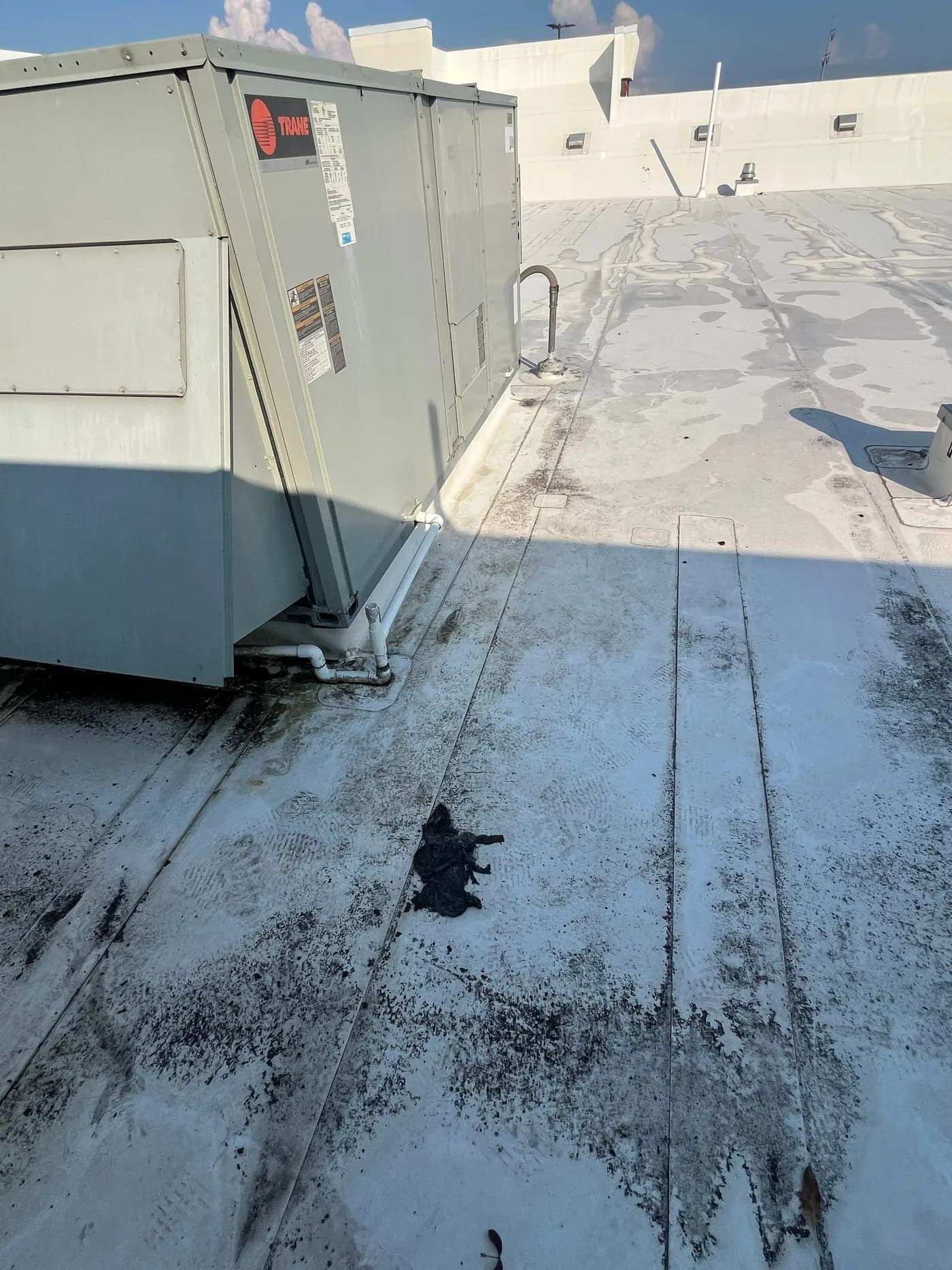
Surface contamination, oxidation, and tar staining accumulated around rooftop equipment — reducing reflectivity and signaling neglect.
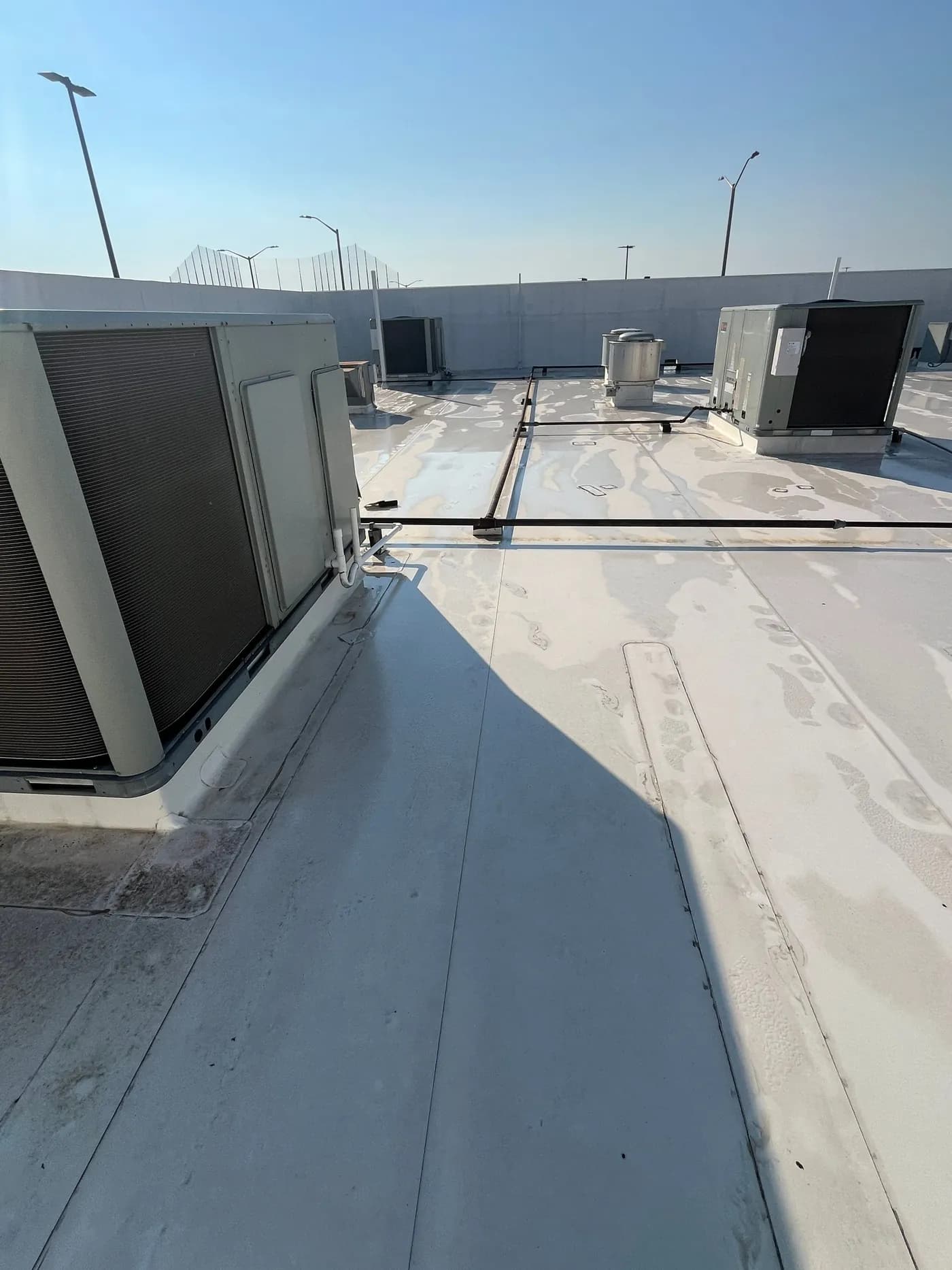
Membrane returned to as-installed white. Reflectivity restored, surface contamination removed, warranty intact — no high-pressure damage to seams or flashings.
FAQ
Roof Soft-Wash FAQ
- In the humid Southern markets we serve (LA, MS, AL, FL, TX), most commercial roofs benefit from soft-wash treatment every 18–36 months — sooner on shaded roofs, north-facing pitches, or roofs with overhanging tree cover. In drier markets (KS, AR), every 24–48 months is typical. Many of our maintenance program customers schedule soft-wash on a bi-annual or annual cadence for consistent appearance and documented care.
- No — when performed correctly, soft-wash is the safest cleaning method for commercial roofs. The pressure (60–100 PSI) is below garden-hose level. The biocidal cleaning solution is membrane-safe and approved by every major manufacturer. The chemistry is biodegradable and breaks down in the environment within hours. We have full insurance coverage on all soft-wash services.
- Pressure washing is explicitly prohibited by most commercial roofing manufacturers and can void your warranty. High-pressure water forces its way into membrane seams, lifts seam tape, can cause membrane delamination, and damages the protective surface granules on Mod-Bit and BUR systems. It also doesn't kill biological growth — it just rinses off the visible portion, which regrows within weeks. Soft-wash is faster, safer, and lasts dramatically longer.
- Commercial soft-wash pricing depends on roof size, accessibility, severity of biological growth, and substrate type. Larger roofs trend toward the lower end of the per-square-foot range; smaller or harder-to-access roofs trend higher. We can bundle soft-wash with our maintenance programs for combined pricing on multi-building portfolios — written estimate provided after a free walk-through.
- Yes. Soft-wash is one of the least disruptive maintenance services available — no loud equipment, no extended drying time, no operational impact. The roof is treated in a single visit, with rinse water managed through normal roof drainage. We schedule around tenant operations and can perform soft-wash work during off-hours where access requirements allow.
- Eventually, yes — biological growth is unavoidable in humid climates. However, soft-wash kills the existing growth at the root, so regrowth typically takes 18–36 months in our Southern markets and 24–48 months in drier markets. Some treatment chemistries include a residual biostatic component that further delays regrowth. Regular soft-wash on a maintenance schedule prevents biological growth from ever causing roof damage.
- Yes. Metal commercial roofs accumulate algae, lichen, oxidation streaking, and contaminants from atmospheric exposure. Soft-wash removes biological growth and surface contaminants without compromising Kynar 500 / PVDF or Galvalume coatings. Particularly important on visible metal roofs (retail, hospitality, office) where appearance affects building presentation.
Available Across Our Markets
Commercial Roofing
Get a Commercial Soft-Wash Quote
We'll evaluate your roof and provide a no-obligation quote. Available across all our markets.