Commercial Roof Coatings
Add 10–15 Years. Defer Replacement. Cut Cooling Costs.
A seamless coating system restores your existing membrane without tear-off — at 30–50% of the cost of replacement. Silicone, acrylic, and polyurethane systems with ENERGY STAR reflectivity and 10–20 year manufacturer warranties.
Why Coatings
Why Roof Coatings Make Sense
Replacing a commercial roof means tearing off the existing system, disposing of the old material, and rebuilding from the deck up. It disrupts building operations, generates significant waste, and carries a substantial price tag. For many commercial roofs that are aging but structurally sound, full replacement isn't the only option — and often isn't the right one.
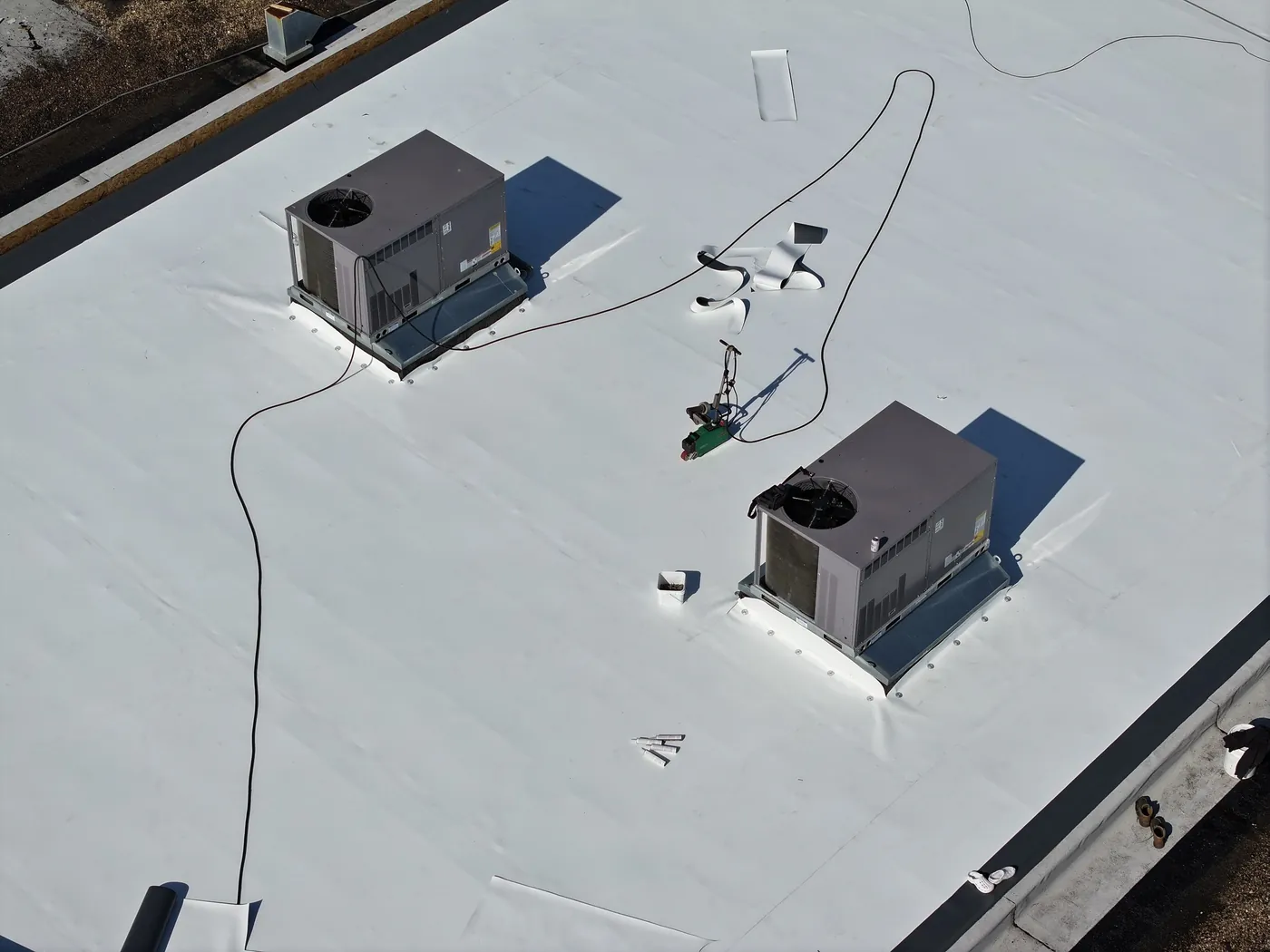
A professionally applied coating system can restore the membrane, seal seams and penetrations, and add 10–15 years of service life. The total cost is typically 30–50% less than full replacement, with no tear-off, no debris removal, and minimal disruption to daily operations.
In the South, where cooling costs are a significant operating expense, reflective coatings provide an additional benefit: highly reflective surfaces reduce heat absorption, lowering attic temperatures and HVAC load. Many building owners see measurable reductions in cooling costs after a white or light-colored coating installation.
Most major coating manufacturers offer extended warranties on installed systems — 10, 15, or 20 years — giving you documented protection on your investment.
Why Coatings Win on the Right Roof
Capital Expenditure Deferral
A coating restoration is typically 30–50% of the cost of full membrane replacement. For property managers, this means another budget cycle before facing a full re-roof — and significant breathing room for capital planning across a portfolio.
10–15 Year Service Life Extension
Properly applied coatings on structurally sound roofs add 10–15 years of waterproofing performance. On a 20-year-old membrane that's still structurally intact, a coating effectively buys another decade-plus before tear-off becomes necessary.
Energy Cost Reduction
Most commercial coatings are formulated with high-reflectivity pigments. White or light-colored coatings reflect 80%+ of solar radiation, reducing rooftop temperatures by 50–60°F on hot summer days. The cooling-cost reduction is particularly meaningful in our Southern markets.
Minimal Operational Disruption
Coating installation is fast — typically 1–3 weeks for most commercial projects vs. 3–8 weeks for full replacement. No tear-off, no debris hauling, no dumpster on-site for weeks. Tenants and operations continue normally.
Manufacturer Warranties
Major coating manufacturers (GAF, Henry, GACO, Tropical) offer warranties of 10–20 years on installed systems applied by their certified contractors. Brown's Roofing carries certifications across multiple manufacturers, allowing us to register manufacturer-backed warranties on your project.
ENERGY STAR Qualification
White silicone, acrylic, and elastomeric coatings achieve ENERGY STAR / Cool Roof Rating Council certification. May qualify for utility rebates, LEED credits, or local energy incentive programs depending on your jurisdiction.
Seamless Waterproofing
Coatings cure into a monolithic, fully-bonded membrane that fills hairline cracks, seals seams, and bonds around penetrations. The result is fewer joints and seams than the original system — and therefore fewer leak points.
Documented Roof Asset
Coating installation includes pre-coating moisture scan documentation, photo records, manufacturer warranty registration, and a written completion report. Critical for facility records, capital planning, and property transactions.
Coating vs. Replacement
Decision Framework
Is Your Roof a Good Coating Candidate?
Four factors determine whether coating restoration or full replacement is the right specification. We assess all four during the free on-site evaluation.
Existing Roof Condition
Coatings only work on roofs that are structurally sound — no widespread blistering, no major seam failure, no significant decking damage. We perform a full visual inspection plus a moisture scan to confirm the existing roof is a good candidate before recommending coating.
Wet Insulation Status
Coatings cannot be applied over wet insulation. The moisture trapped beneath would degrade the new coating from below and cause early failure. An infrared or nuclear moisture scan identifies any wet areas — those sections must be cut out and replaced before coating can proceed.
Roof Age & Remaining Life
Coatings make economic sense on roofs that are 5–15 years old — old enough to need restoration but young enough to be structurally sound. On a 25-year-old roof at end of life, full replacement is typically the better long-term decision.
Membrane Type
Most commercial membrane and metal roofs accept coatings: TPO, PVC, EPDM, modified bitumen, BUR, smooth metal panels. Each substrate requires a specific primer and coating compatibility match. We specify the right system for your existing roof.
System Selection
Three Coating System Categories
We specify the right system for your roof type, climate, and usage — not the cheapest or most readily available product.
Silicone
Silicone coatings provide the best long-term UV resistance of any coating type and won't chalk, fade, or degrade under sustained sun exposure. Silicone is also the only coating system that remains stable when submerged — making it the right choice for roofs with chronic ponding water that other coatings can't handle.
Best For
Roofs with ponding water, high UV exposure, premium specifications
Warranty
15–20 year manufacturer warranties available
Acrylic
Acrylic coatings offer excellent solar reflectivity at the lowest cost per square foot of any coating system. They perform best in climates where the roof drains fully between rain events — ideal for most of our Southern markets where rapid drainage is the norm. Standard ENERGY STAR reflectivity with good adhesion to most existing membranes.
Best For
Tight budget projects, roofs with reliable drainage, ENERGY STAR upgrades
Warranty
10–15 year manufacturer warranties available
Polyurethane
Polyurethane coatings provide superior impact and abrasion resistance, making them the right choice for roofs with regular foot traffic, rooftop equipment maintenance, or HVAC service activity. Aliphatic polyurethanes also deliver excellent UV stability comparable to silicone.
Best For
High-traffic roofs, equipment-dense rooftops, hospitality and retail
Warranty
10–20 year manufacturer warranties available
The Process
Six-Step Coating Process
Coating quality is 80% surface preparation and 20% application. Skipping any step compromises the manufacturer warranty and the long-term performance.
Moisture Scan
We perform an infrared or nuclear moisture scan to identify any wet insulation beneath the membrane. Coatings cannot be applied over wet insulation — this step confirms the roof is a good candidate. Wet sections must be cut out and replaced before coating begins.
Surface Prep
The existing roof surface is cleaned, degreased, and any damaged areas are repaired before coating begins. Penetrations, drains, and edge metal are inspected and re-flashed where needed. Proper surface prep is the single biggest factor in coating longevity.
Primer Coat
A primer is applied where needed to ensure adhesion between the existing membrane and the coating system. Primer selection is matched to your specific roof type — different primers for TPO, EPDM, Mod-Bit, BUR, and metal substrates.
Base Coat & Reinforcement
The base coat is applied at the manufacturer-specified dry-film thickness. Reinforcing fabric is embedded over seams, penetrations, and field expansion joints to prevent cracking at stress points. This step is critical for warranty compliance.
Top Coat & Inspection
The finish coating is applied in the specified dry-film thickness, achieving full coverage and the manufacturer's required mil thickness. We perform wet-film and dry-film thickness checks during application to confirm spec compliance.
Final Report & Warranty
After cure, the project receives a final visual inspection and dry-film thickness verification. You receive a written completion report with photos, manufacturer warranty registration, and recommended bi-annual maintenance schedule.
Cost Factors
What Determines Coating Project Cost
Coating pricing depends on coating system, mil thickness, existing roof condition, and warranty term. Acrylic systems are the lowest cost; silicone and polyurethane are mid-range; premium NDL warranty systems are the highest.
Compared to full membrane replacement, coatings typically deliver 30–50% savings on the right roof — we provide a written estimate after a free moisture scan and roof condition evaluation.
Request a Free Moisture Scan10 Variables That Drive Project Cost
- 01Roof size (square footage)
- 02Coating system selected (acrylic, silicone, polyurethane, hybrid)
- 03Number of coats (single-coat vs. base-and-finish)
- 04Existing membrane type and surface preparation
- 05Reinforcement fabric and detail work density
- 06Penetration count (drains, vents, equipment, skylights)
- 07Repair work required prior to coating
- 08Warranty term (10-, 15-, or 20-year)
- 09Site access and equipment staging
- 10Operational coordination (occupied building scheduling)
FAQ
Roof Coatings FAQ
- Coating pricing depends on coating system, mil thickness, existing roof condition, and warranty term. Relative tiers: acrylic systems are the lowest cost; silicone and polyurethane are mid-range; premium NDL warranty systems are the highest. Compared to full membrane replacement, coatings typically deliver 30–50% savings on overall lifecycle cost. We provide a written estimate after a free on-site assessment.
- Properly installed commercial coatings deliver 10–20 years of service life depending on system type, application thickness, climate, and roof traffic. Silicone systems with NDL warranty typically reach the longest service life — 20+ years possible. Acrylic systems typically deliver 10–15 years. Coatings can be re-applied at the end of their service life — extending the original roof's service life indefinitely so long as the structure remains sound.
- Most commercial membrane and metal roof systems accept coatings: TPO, PVC, EPDM, modified bitumen, built-up roofing (BUR), smooth-surface and granule-surface bitumen, and bare or coated metal panels. Each substrate requires a specific primer and coating compatibility match. The two systems that are not good candidates are gravel-surfaced built-up roofs (gravel must be removed first) and ballasted single-ply systems (ballast must be removed and the membrane must be inspected for damage before coating).
- It depends on the leak source. Coatings effectively seal hairline cracks, surface degradation, minor seam separations, and small punctures. They do not fix leaks caused by structural failure (failed flashings at major penetrations, separated metal counter-flashing, decking damage). If your roof has active leaks, we'll diagnose the source first — sometimes the leak source must be repaired before coating; sometimes the roof isn't a coating candidate and full replacement is the right answer.
- Coating application requires specific temperature conditions for proper cure: most coatings need 50°F+ ambient and surface temperatures for at least 24 hours after application. In our Southern markets, this allows coating work nearly year-round with brief winter pauses. We schedule application around weather windows to ensure proper cure and full warranty validity.
- Generally no — but it depends on your existing warranty terms. Most manufacturers allow approved coating systems to be applied without voiding the original warranty, as long as the coating manufacturer is approved and the application meets specifications. We review your existing warranty before coating any roof and ensure the new coating system is compatible with your existing warranty's requirements.
- No. Roofing coatings are engineered elastomeric membrane systems applied to manufacturer-specified mil thickness, often with reinforcing fabric at seams and penetrations. The dry-film thickness on a typical commercial coating is 25–60 mils — comparable to a single-ply membrane. Quality coating systems carry 10–20 year manufacturer warranties and undergo accelerated weathering and waterproofing performance testing comparable to membrane systems. The application looks like painting; the engineering and performance are membrane-grade.
Available Across Our Markets
Commercial Roofing
Get a Roof Coating Assessment
We'll inspect your roof, perform a moisture scan, and tell you honestly whether coating or replacement makes more sense for your building.