Commercial Roof Replacement
Tear-Off, Recover, Re-Roof — Done Right
Full commercial roof replacement across every major system — TPO, PVC, modified bitumen, standing seam metal, and FORTIFIED commercial. Manufacturer-certified installation, tenant-occupied scheduling, 20–30 year NDL warranties, and the documentation your facility records and capital plan require.
When to Replace
Eight Reasons a Commercial Roof Gets Replaced
Commercial replacement is rarely a single-variable decision. It's usually some combination of system age, accumulated repair history, storm damage, code requirements, and capital planning timing. Brown's Roofing scopes the actual condition and presents replacement only when it's the right answer — not by default.
If you're weighing repair, coating restoration, recover, or full replacement, we walk you through all four options with honest cost-benefit analysis. We don't up-sell replacement when a coating or recover delivers the right outcome.
End-of-Life System
When an aging Mod-Bit, BUR, or single-ply roof has reached the end of its service life — typically 20–30 years — and repairs are no longer cost-effective. Membrane has lost flexibility, seams are separating, and patching no longer holds. Replacement preserves the building.
Recurring or Systemic Leaks
Multiple repairs in the same calendar year, leaks tracking across slopes, or membrane failure across a wide area all signal systemic failure rather than localized damage. Continuing to repair becomes more expensive than replacement, and recurring water intrusion damages decking and interiors.
Wet Insulation Discovered
When an infrared scan or core sample shows substantial wet insulation across the roof, recovers are off the table — wet insulation must be removed before any new system goes down. Full tear-off, decking inspection, and replacement is the only durable answer.
Storm Damage Exceeds Repair
Significant hail bruising across the entire field, widespread wind-stripped membrane, or hurricane-driven assembly damage often exceeds the threshold for cost-effective repair. Insurance carriers in our markets routinely fund full replacement when documented damage scope justifies it.
Code Upgrade Requirements
Energy code updates, wind uplift requirements, or insurance-driven specifications (FM Global, IBHS FORTIFIED) sometimes mandate replacement rather than repair. Code-driven replacement is also an opportunity to upgrade insulation R-value and reduce long-term operating costs.
Warranty Exhaustion
When the existing manufacturer warranty has expired and the roof is past replacement age, continuing to invest in repairs on a warranty-less roof rarely makes financial sense. A new system restores 20–30 year manufacturer coverage.
Property Acquisition
On a property acquisition where roof condition is a deciding factor, a planned replacement can be scoped, priced, and scheduled as part of the deal. Buyers often credit replacement cost against closing; sellers sometimes complete replacement to remove a sticking point.
Building Reuse or Conversion
When a building's use is changing — light-industrial converting to medical, warehouse converting to retail, vacant property being repositioned — the new use may require a different roof spec entirely. Replacement is often coordinated with broader building improvements.
The First Question
Tear-Off or Recover?
The first real question on any commercial replacement is whether to tear off the existing roof or install a new system over the top. Both are valid commercial methods. Both can deliver full manufacturer NDL warranty coverage. The difference is cost, disruption, and what the existing roof looks like underneath.
Recover (new roof over existing) saves 20–40% versus full tear-off, eliminates disposal of the existing roof, and dramatically reduces project disruption — the building stays watertight throughout because the existing system stays in place. Building code allows up to two roof systems on most commercial buildings before tear-off is required.
Full tear-off and replacement is required when there are already two existing roof systems, when the insulation is wet, or when substrate damage is suspected. It's also the right call when the building's capital plan includes structural or decking work that needs access from above.
The deciding test is a moisture survey — typically infrared scan, sometimes core samples. Wet insulation has to come out. Dry insulation that's structurally sound is a candidate for recover. We perform the moisture survey before quoting either approach.
Quick Comparison
| Factor | Recover | Tear-Off |
|---|---|---|
| Cost | 20–40% lower | Full system cost |
| Disruption | Minimal | Higher |
| Timeline | Faster | Longer |
| Disposal | None | Existing roof removed |
| Substrate access | Limited | Full inspection |
| Wet insulation | Disqualifies | Required path |
| Warranty | Full NDL | Full NDL |
| Best when | Roof is dry/sound | Wet or damaged |
Systems We Install
Every Major Commercial Roof System
We install and replace every major commercial roofing system, with manufacturer certifications backing each one. We don't have a default — we recommend based on your building, its use, and your capital plan.
TPO Replacement
The most-specified commercial system. Heat-welded seams, ENERGY STAR reflectivity, 20-year NDL warranties. Right for the majority of warehouses, retail, offices, schools, and multifamily.
Best For
Most commercial buildings
PVC Replacement
Premium chemical-resistant single-ply. Specified for restaurants with grease exhaust, medical and food-processing environments, cold storage. 25–30+ year service life.
Best For
Grease, chemical, cold-storage
Modified Bitumen Replacement
Multi-ply asphalt-based system with excellent puncture resistance. Right for roofs with heavy equipment service traffic, complex geometry, or where multi-layer redundancy matters.
Best For
Heavy-traffic, complex roofs
Commercial Metal Replacement
Standing seam and structural metal panels. 40–70 year service life and lowest lifecycle cost. Right for warehouses, retail, manufacturing, and severe-weather zones.
Best For
Long-hold buildings, severe weather
Commercial Asphalt Replacement
Class 4 architectural shingles for sloped commercial roofs — churches, low-rise offices, schools, multifamily. The sloped-commercial alternative to single-ply.
Best For
Sloped commercial roofs
FORTIFIED Replacement
IBHS above-code commercial construction with third-party verification. Insurance-discount eligible in hurricane and severe-weather markets. Available with most system types.
Best For
Hurricane and tornado zones
What to Expect
The Commercial Replacement Process
Every commercial replacement runs through the same eight stages — from free assessment through documented warranty registration. Repeatable process is what makes commercial roofing predictable for facility planning.
Free On-Site Assessment
We come out, walk the roof, document existing conditions, identify membrane condition and substrate concerns, and — where appropriate — perform an infrared moisture scan to map wet insulation. No charge. The output is a written condition report you can keep.
Recommendation & Written Scope
We present recover, replacement, or coating options where applicable — with honest cost-benefit analysis. The recommendation is based on your roof, not on what generates the largest job. Final scope includes system specification, attachment method, insulation, warranty term, and timeline.
Permit & Pre-Construction
We pull commercial roofing permits through the right jurisdiction, coordinate material staging, schedule crane or hoist work, and confirm tenant communication plans. Mobilization paperwork (insurance certificates, safety plans, manufacturer registration) is handled before the first day on site.
Tear-Off (or Prep for Recover)
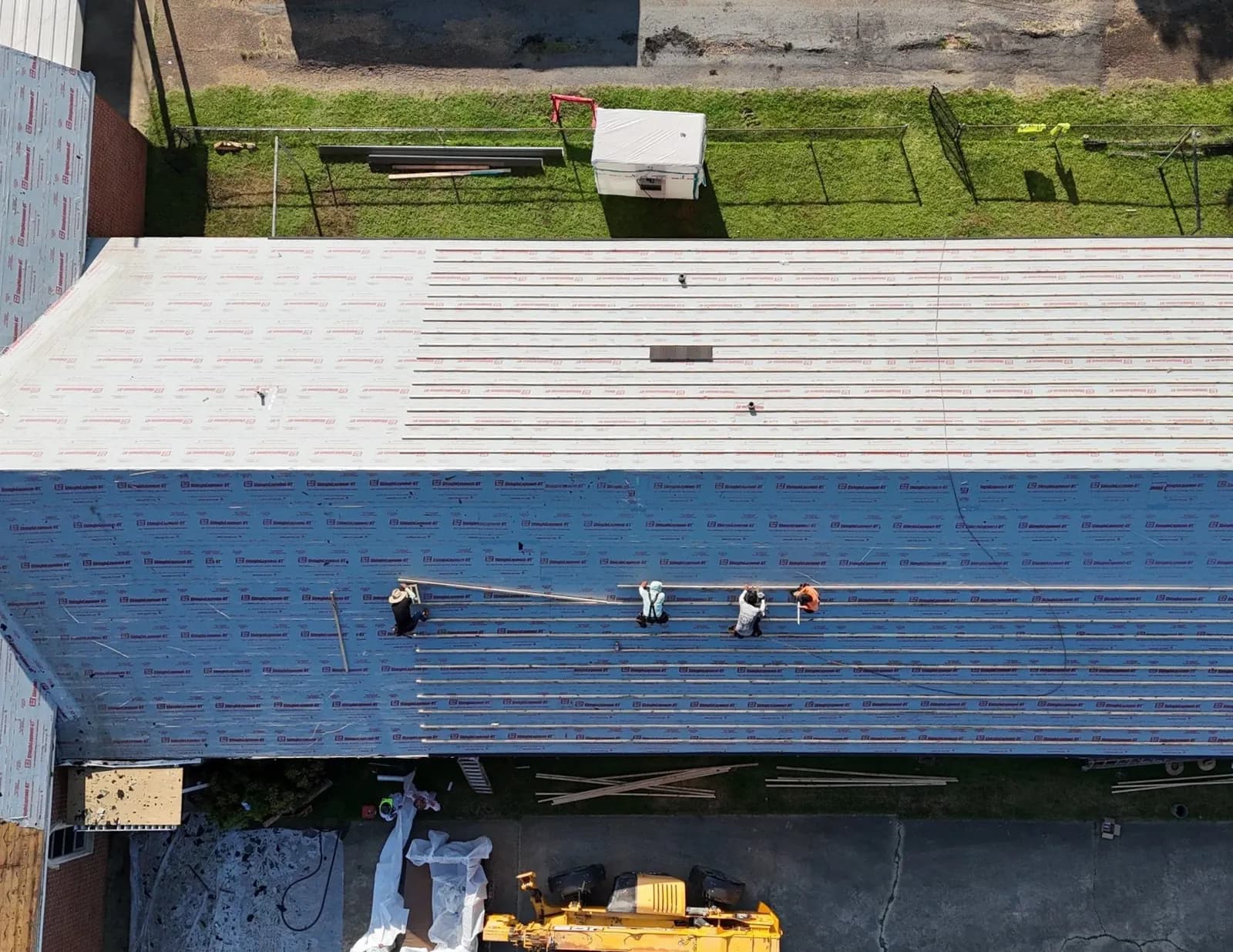
Full tear-off removes existing roof system down to decking; recover prep installs cover board over existing system. Either way, we manage debris flow off the building, protect landscaping and adjacent surfaces, and maintain a clean job site every day.
Decking Inspection & Substrate Repair
Once existing roof is off, decking is inspected for rot, fastener pull-out, structural deflection, or damage. Substrate repairs are documented, priced, and approved before proceeding. A clean substrate is the foundation of any warranty-eligible installation.
Insulation & Membrane Installation
Insulation is installed to spec — single-layer or stacked, taper-cut for positive drainage, code-compliant R-value. Membrane installation follows manufacturer specification: mechanically attached, fully adhered, or induction-welded. Seams are welded or seamed by certified installers.
Final Inspection & Warranty Registration
Manufacturer technical representative walks the completed roof (on NDL warranty registrations), confirming installation matches specification. Warranty paperwork is filed and registered. Punch-list items resolved. Final invoice issued only after sign-off.
Documentation Package
You receive a complete project documentation set — photos of substrate condition, decking repair, insulation install, membrane install, and final completion. Plus warranty paperwork, manufacturer registration, and maintenance recommendations. Critical for facility records and capital planning.
Property Types
Commercial Buildings We Replace
We replace roofs across the full commercial spectrum — from 5,000 sq ft single-tenant storefronts to 250,000+ sq ft warehouse distribution facilities.
Warehouses & Distribution
Large flat-roof footprints on logistics, 3PL, and fulfillment facilities. TPO or PVC recovers and replacements, schedule around dock operations.
Retail & Shopping Centers
Big-box stores, shopping plazas, and standalone storefronts. Phased work for occupied properties, brand-aligned aesthetics, after-hours staging.
Office & Corporate Campuses
Multi-tenant offices, corporate HQ, professional complexes. Tenant communication management, after-hours work, premium documentation.
Healthcare & Medical
Hospitals, medical offices, surgery centers. Self-adhering and cold-process systems for occupied buildings; infection-control-compatible scheduling.
Schools & Universities
K–12 districts, colleges, university facilities. Summer-window scheduling, public-sector procurement requirements, long-cycle capital planning.
Manufacturing & Industrial
Manufacturing plants, fabrication facilities, light industrial. Heavy-equipment-rated systems, shutdown coordination, multi-ply puncture resistance.
Multifamily & Apartments
Apartment complexes, condominiums, HOA-managed properties. Resident communication, phased work across buildings, portfolio pricing.
Churches & Religious
Worship facilities, parish centers, religious schools. Coordination with worship schedules, complex roof geometry, long-term capital planning.
Hotels & Hospitality
Hotels, restaurants, hospitality properties. Brand-standard aesthetics, occupancy-aware scheduling, high-traffic-rated systems.
Restaurants & Food Service
Quick-service, full-service, food processing. PVC for grease exhaust environments, cold-chain refrigeration roofing, USDA/FDA-relevant standards.
Capital Planning
What Determines Replacement Cost
No two commercial replacements cost the same per square foot. Twelve specific variables drive pricing — and the only honest way to scope a number is a free on-site assessment with a moisture survey where needed. We give you a written, itemized estimate, not a per-square-foot guess.
For capital planning, we can also build phased pricing across multiple years where a full single-year replacement isn't financially feasible. Phasing by building section, by roof area, or by fiscal year is all standard.
Request a Written Estimate12 Variables That Drive Project Cost
- 01Roof square footage (the primary cost driver)
- 02Existing roof condition — full tear-off vs. recover
- 03Deck type (steel, wood, concrete, gypsum)
- 04Insulation specification (R-value, taper, multi-layer)
- 05System selected (TPO, PVC, Mod-Bit, metal, asphalt)
- 06Attachment method (mechanical, adhered, induction-welded)
- 07Penetrations, equipment, parapets, and complexity
- 08Site access, crane / hoist, and material staging
- 09Warranty term selected (15-, 20-, 25-, 30-year NDL)
- 10Code upgrades and wind-uplift requirements
- 11Phasing and tenant-occupied scheduling needs
- 12Substrate or decking repair scope, if needed
Representative Project
45,000 sq ft Light-Industrial Facility — Mod-Bit Tear-Off to TPO
Building Type
Light-industrial / fabrication
Square Footage
45,000 sq ft
System Replaced
30-year-old multi-ply Mod-Bit
New System
60-mil mechanically attached TPO, 20-year NDL
Existing modified bitumen roof had reached end-of-life with widespread blistering, alligatoring, and seam separation. Moisture survey showed approximately 30% wet insulation across the field — disqualifying a recover. Full tear-off proceeded in phased sections to maintain plant operations throughout, with night-shift dry-in on each section. Decking inspection identified two areas of minor steel deck corrosion, scoped and replaced before insulation install. New polyiso insulation (R-25 stacked), 60-mil mechanically attached TPO, manufacturer technical rep walked completion, 20-year NDL warranty registered. Project completed in 24 working days over phased sections. Maintenance program established for bi-annual inspections.
FAQ
Commercial Roof Replacement FAQ
- Depends on substrate condition. If the existing insulation is dry and the substrate is structurally sound, a recover (new system over existing) typically saves 20–40% over full tear-off and avoids the disruption of removal. Code allows up to two roof systems on most commercial buildings before tear-off is required. If the substrate is wet or compromised, full tear-off and replacement is the only durable answer — covering over wet insulation traps the problem and voids any warranty. We perform a moisture survey before scoping so the recommendation is based on the actual condition of your roof.
- Depends on size and system. Small commercial (under 10,000 sq ft) typically completes in 1–2 weeks. Mid-size (10,000–50,000 sq ft) runs 2–4 weeks. Large warehouse-scale or industrial projects (50,000+ sq ft) can run 4–10 weeks or longer with phasing. Weather, tenant-occupied scheduling, and substrate repair scope all affect the timeline. We provide a specific schedule with the proposal — not a generic range.
- Yes — the majority of our commercial replacements are done with the building fully occupied. We coordinate phased work so active areas don't disrupt tenant operations, schedule loud activities (deck fastening, crane work) for off-hours where appropriate, maintain interior protection during tear-off, and handle tenant communication as part of standard scope. For specific tenant types — medical, food service, schools — we adjust process to match operational requirements.
- Depends on your building's specific exposure conditions. TPO is the right choice for the majority of commercial buildings — warehouses, retail, offices, schools, multifamily. PVC is preferred when your roof has grease exhaust (restaurants), chemical exposure (medical, food processing), or cold-storage applications. Mod-Bit handles heavy foot traffic and complex geometry. Metal delivers the longest lifecycle for long-hold properties. We assess the building, its use, and your capital plan before recommending a system.
- Standard manufacturer warranties run 15–20 years on most commercial systems. Enhanced 'No Dollar Limit' (NDL) warranties — available when the system is installed by a manufacturer-certified contractor like Brown's Roofing — cover both material and labor for repairs, with no cap on the manufacturer's exposure. NDL terms can extend to 25 or 30 years on premium specifications. NDL warranties typically require periodic documented maintenance to remain valid; we register the warranty and establish a maintenance program at completion.
- Commercial replacement pricing depends on twelve specific variables — size, system, attachment, insulation, warranty term, and a half-dozen project-specific factors. Smaller projects (under 10,000 sq ft) trend toward the higher end of per-square-foot pricing; large warehouse-scale projects trend toward the lower end. Recover installations cost 20–40% less than full tear-offs. Brown's Roofing provides a written, itemized estimate after a free on-site assessment — never a per-square-foot phone quote.
- Most modern commercial roof replacements are. White TPO, white PVC, white-coated metal, and reflective-coating restoration systems all carry ENERGY STAR ratings and qualify under utility rebate programs and ENERGY STAR Portfolio Manager. Reflective roofs reduce rooftop temperature by 50–60°F on hot summer days, lowering cooling loads and operating costs for the building owner. Some markets and utilities offer incentives — we'll identify what's available for your property as part of the assessment.
- Yes — our crews attend inspections when adjusters visit. We document storm damage with photos and measurements, meet with adjusters to explain the repair scope based on the damage we've documented, and ensure our repair work aligns with the scope the carrier approves. If the carrier's approved scope differs from our estimate, we explain the discrepancy and repair to the approved scope. If you dispute the carrier's scope, we can refer you to a licensed public adjuster or attorney. Adjuster coordination is included in our standard service — no additional charge.
Commercial Roof Replacement in Your Market
Commercial Roofing
Get a Commercial Replacement Assessment
Free on-site walkthrough, moisture survey where appropriate, and a written estimate with system recommendation. We scope what your building actually needs.