
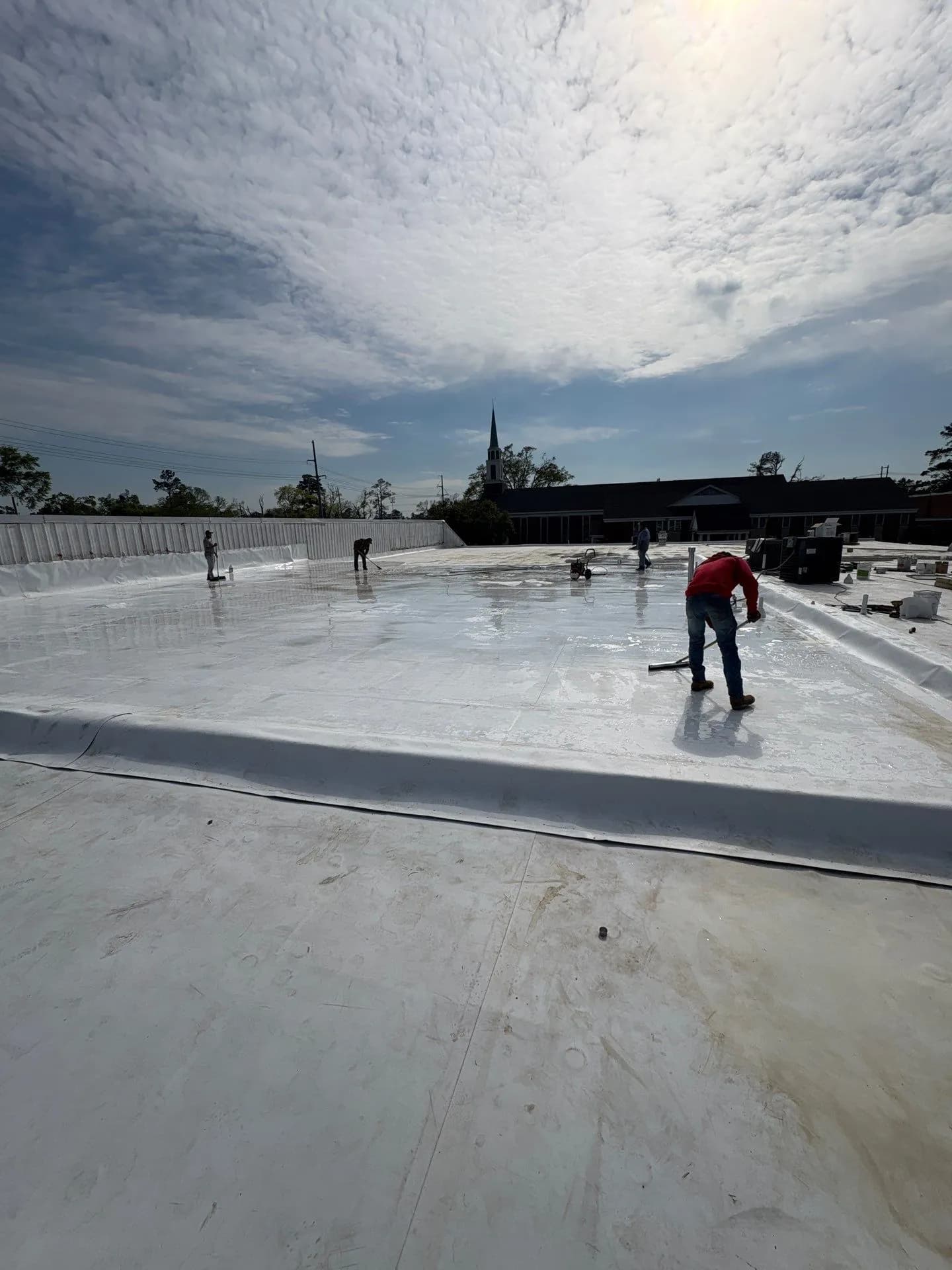
TPO Roofing
The Commercial Flat Roof Standard
Thermoplastic polyolefin (TPO) is the most widely specified single-ply roofing system for flat and low-slope commercial buildings in North America. Heat-welded seams, high reflectivity, ENERGY STAR efficiency, and 20-year manufacturer warranties make it the default choice for the majority of commercial roofing decisions.
What Is TPO Roofing?
The Membrane That Reshaped Commercial Roofing
TPO — thermoplastic polyolefin — is a single-ply roofing membrane introduced to the North American commercial market in the early 1990s. It was engineered to combine the heat-welded seam strength of PVC with the lower cost and chlorine-free chemistry of EPDM. Within two decades, it became the most-specified commercial flat roof system on the continent.
A TPO membrane is manufactured from a polypropylene and ethylene-propylene rubber polymer blend, reinforced internally with a polyester scrim for tensile strength. The reinforcement is what lets a 60-mil TPO sheet handle wind uplift, foot traffic, and equipment movement without tearing. The thermoplastic chemistry is what allows seams to be hot-air welded — creating a continuous, monolithic waterproof surface across an entire roof.
For a property manager, building owner, or facility manager, the practical translation is simple: TPO offers a 20-year warranty, ENERGY STAR-rated reflectivity, and predictable installation costs at a price point that fits virtually any commercial capital plan.
Why TPO Dominates Commercial Roofing
Heat-Welded Seams
TPO seams are hot-air welded at 1,000°F+, fusing membranes into a monolithic surface. Properly welded seams are stronger than the membrane itself — no adhesives to dry out, no tape to peel, no chemical bond to fail.
Reflective Surface
White TPO reflects 70–85% of solar radiation rather than absorbing it. In LA, AR, KS, AL, MS, TX, and FL climates, this measurably reduces cooling loads and lowers operating costs for building owners by reducing rooftop temperatures by 50–60°F on hot summer days.
Chemical Resistance
TPO resists common rooftop exposures including algae, bacteria, ozone, and moderate grease contact — making it suitable for the vast majority of commercial environments. (For heavy grease or chemical exposure, see PVC.)
Proven Track Record
Introduced in the early 1990s and now the most widely specified single-ply membrane in North America. TPO has 30+ years of field performance data, ENERGY STAR certifications, and FM Global wind-uplift ratings backing every quality installation.
Installation Versatility
Available in mechanically attached, fully adhered, induction-welded (RhinoBond), and ballasted configurations. We specify the right attachment method for your building's wind zone, deck type, and rooftop conditions.
Recyclable
TPO contains no chlorine and no plasticizers. At end of life, TPO membranes can be recycled into new membrane products — meaningful for owners pursuing LEED, ENERGY STAR Portfolio Manager, or corporate sustainability targets.
Cost of Ownership
TPO delivers single-ply performance at a competitive price point — typically 15–20% less than PVC and comparable to EPDM. With low maintenance and 20–30 year service life, lifecycle cost is among the lowest in commercial roofing.
Fire Performance
Standard TPO carries a UL Class A fire rating when installed over approved insulation and substrates. Critical for large commercial buildings, warehouses, and any insurance specification requiring Class A roof systems.
TPO System Specs
60 mil is the standard commercial specification. 80 mil is recommended for roofs with heavy foot traffic or equipment service.
TPO vs. PVC
For most commercial applications, TPO is the cost-effective choice. PVC offers superior chemical resistance for restaurants and chemical environments — but costs more.
Compare with PVC →How TPO Is Installed
Four TPO Attachment Methods
The right attachment method depends on your deck type, wind zone, building height, and budget. We specify the appropriate method during the assessment — not a one-size-fits-all default.
Mechanically Attached
Fasteners and barbed plates secure the membrane to the deck through the insulation layer at the seams. Subsequent membrane sheets overlap and are heat-welded over the fastener line. The most common method for steel decks and lower wind zones — fast to install and cost-effective.
Best For
Steel decks, large square footage, budget-conscious projects
Induction-Welded (RhinoBond)
Insulation plates are mechanically fastened to the deck. Then the TPO membrane is laid over the top, and a special induction tool electromagnetically welds the membrane directly to the plates from above — without penetrating the membrane itself. Faster than fully adhered, with cleaner aesthetics and superior wind-uplift performance.
Best For
High wind zones, recover projects, when puncture risk must be minimized
Fully Adhered
TPO is bonded to the substrate using bonding adhesive (solvent or water-based) or low-rise foam. Eliminates fastener penetrations across the field of the roof and provides the most uniform attachment. Premium method for high-end projects, hospitals, and roofs with unusual geometry.
Best For
Concrete or wood decks, complex geometry, premium specifications
Ballasted
TPO is laid loose over insulation, then weighted with rock ballast or pavers. Fastest installation method with no fasteners or adhesives required. Less common in modern commercial roofing but still appropriate for select recover projects with adequate structural capacity.
Best For
Re-cover projects with structural capacity for ballast load
Where TPO Performs Best
Building Types & Applications
TPO is specified across the full commercial spectrum. The membrane that protects a 200,000 sq ft warehouse is the same chemistry protecting a single-tenant medical office.
Warehouses & Distribution
Large flat-roof footprints on logistics, distribution, and 3PL facilities — TPO's white surface lowers cooling loads and the heat-welded seams stand up to wind events.
Retail & Shopping Centers
Big-box stores, shopping centers, strip retail, and standalone storefronts — TPO's 20-year warranty matches typical commercial property hold periods.
Manufacturing & Industrial
Light-industrial buildings, manufacturing plants, and equipment-heavy rooftops — heavier 80-mil TPO handles foot traffic from HVAC and equipment maintenance.
Healthcare & Medical
Hospitals, surgery centers, and medical office buildings — TPO's chemical and bacterial resistance combined with low fume installation (vs. torch-down) makes it well-suited for occupied medical facilities.
Schools & Universities
K–12 districts, colleges, and university facilities — Class A fire rating, ENERGY STAR efficiency credit potential, and 20-year warranties align with public-sector capital planning cycles.
Office Buildings
Multi-tenant offices, corporate campuses, and professional complexes — TPO recovers and reroofs over existing systems without forcing tenants to relocate.
Multifamily & Apartments
Apartment complexes, condominiums, and HOA-managed properties — long warranty terms and reflective performance reduce tenant complaints and HOA reserve outlay.
Religious & Institutional
Churches, schools, civic and government buildings — TPO's straightforward maintenance and predictable lifecycle costs simplify long-term facility management.
System Comparison
TPO vs. PVC vs. EPDM vs. Mod-Bit
Single-ply membranes and modified bitumen each have specific strengths. Here's how they compare on the factors that matter most for commercial decisions.
| Factor | TPO | PVC | EPDM | Mod-Bit |
|---|---|---|---|---|
| Reflectivity | High (white) | High (white) | Low (black) | Low (unless coated) |
| Seam Method | Heat-welded | Heat-welded | Adhesive / tape | Torch / cold-applied |
| Chemical Resistance | Good | Excellent | Limited | Good |
| Cost | Mid-range | Premium | Mid-range | Mid-range |
| Lifespan | 20–30 yrs | 25–30+ yrs | 20–30 yrs | 15–25 yrs |
| Best For | Most commercial | Restaurants, medical, cold storage | Cold climates | High-traffic, complex geometry |
Cost Factors
What Determines TPO Pricing
No two commercial roofs cost the same per square foot. Pricing on a TPO project is driven by ten specific variables. We give you a written, detailed estimate after a free on-site assessment — not a per-square-foot guess based on a phone call.
TPO sits in the lower-to-mid commercial roofing tier. Smaller projects trend toward the higher end of the range; large warehouse-scale projects trend lower. Recover installations are typically 20–40% less than full tear-offs. Pricing depends on roof size, attachment method, insulation spec, and warranty term — we provide a written estimate after a free on-site assessment.
Request a Written Estimate10 Variables That Drive Project Cost
- 01Roof size (square footage drives material and labor)
- 02Existing roof condition — full tear-off vs. recover
- 03Deck type (steel, wood, concrete, gypsum)
- 04Insulation specification (R-value, layers, taper)
- 05Membrane thickness (45, 60, or 80 mil)
- 06Attachment method (mechanical, adhered, induction)
- 07Penetrations, equipment, and roof complexity
- 08Site access and crane / hoist requirements
- 09Warranty term selected (15-, 20-, 25-, or 30-year)
- 10Code upgrades or wind uplift requirements
Long-Term Care
TPO Maintenance & Repair
TPO is a low-maintenance system — but not a no-maintenance system. Bi-annual inspection and prompt repair of seam, flashing, and penetration issues is what gets a TPO roof to its full warranty period and beyond.
Maintenance Programs
Bi-annual inspections, written reports, and warranty-compliant documentation for every TPO roof we install or service.
Learn more →
TPO Repair
Seam re-welding, flashing repair, ponding correction, and storm damage response on TPO systems of any age or manufacturer.
Learn more →
Coatings & Restoration
For aging TPO roofs that are still structurally sound, a silicone or acrylic coating extends life by 10–15 years without tear-off.
Learn more →
Representative Project
80,000 sq ft Distribution Facility — TPO Recover
Building Type
Distribution / 3PL
Square Footage
80,000 sq ft
System Specified
60-mil mechanically attached TPO
Warranty
20-year NDL
Aging modified bitumen roof with active leaks at multiple HVAC penetrations and seam separations. Moisture scan confirmed dry insulation across 95% of the field, qualifying the project as a recover. Polyiso cover board was installed over the existing membrane, followed by 60-mil mechanically attached TPO with welded seams. Project completed in 18 working days over phased sections. Building stayed fully operational throughout. Manufacturer NDL warranty registered, with a maintenance program established for bi-annual inspections.
FAQ
TPO Roofing FAQ
- A properly installed and maintained TPO roof typically lasts 20–30 years. Service life depends on membrane thickness (60-mil and 80-mil outlast 45-mil), attachment method, climate exposure, foot traffic, and whether the system receives scheduled bi-annual maintenance. Brown's Roofing offers maintenance programs that are designed to keep your TPO roof performing through its full warranty period and beyond.
- 60-mil TPO is the standard commercial specification and the most common choice for warehouses, retail, and office buildings. 80-mil is recommended for roofs with heavy foot traffic, frequent rooftop equipment service, or high-puncture-risk environments. 45-mil is generally specified only for budget-driven recovers or short-term applications. We recommend 60-mil at minimum for any roof intended to last 20+ years in our markets.
- It depends on your building's specific exposure conditions. TPO is the right choice for the majority of standard commercial buildings: warehouses, retail, offices, schools. PVC is preferred when your roof has grease exhaust (restaurants), chemical exposure (medical, food processing), or is a cold-storage facility — PVC handles those environments better. EPDM is a viable option in cold climates but has lost market share in the South due to TPO's superior reflectivity and welded seams. We assess the building before recommending a system.
- Often yes — recover (or 'roof-over') installations leave the existing roof in place, add cover board insulation, and install new TPO over the top. Recovers cost 20–40% less than tear-off replacements and avoid the disruption of removal. Code allows up to two roof systems on most commercial buildings before tear-off is required. We perform a moisture scan to confirm the existing insulation is dry — wet insulation must be removed before any recover.
- TPO pricing depends on size, attachment method, insulation specification, and warranty term. Smaller projects (under 10,000 sq ft) trend toward the higher end of the range; large warehouse-scale projects (over 100,000 sq ft) trend toward the lower end. Recover installations cost less than full tear-offs. Brown's Roofing provides a written, detailed estimate after a free assessment so you have actual numbers for capital planning — no per-square-foot phone quotes.
- Standard TPO warranties cover material defects for 15–20 years. Enhanced 'No Dollar Limit' (NDL) warranties — available when the system is installed by a manufacturer-certified contractor like Brown's Roofing — cover both material and labor for repairs, with no cap on the manufacturer's exposure. NDL warranties typically require periodic documented maintenance to remain valid. We pull the warranty registration paperwork as part of every TPO installation.
- A 20,000–30,000 square foot single-tenant commercial roof can typically be replaced in 1–2 weeks of working time, weather permitting. Larger projects (50,000+ sq ft) may take 3–5 weeks. We schedule around your building operations and can phase work to minimize disruption — including night, weekend, or single-section staging where the building can't be entirely worked at once.
TPO Roofing in Your Market
Commercial Roofing
Get a TPO Roofing Assessment
Free inspection, moisture scan if needed, and a written estimate. We'll scope your project and recommend the right membrane spec for your building.