
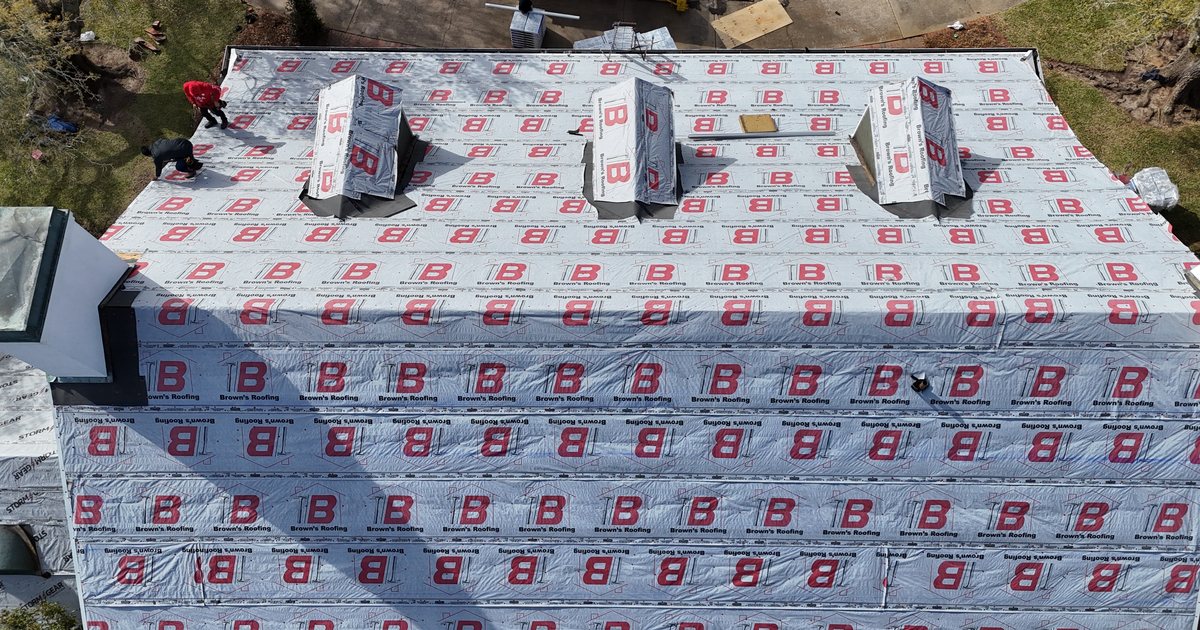
Homeowners spend a lot of time choosing shingle color and almost none thinking about what goes under it. That's understandable — once the roof is finished, the underlayment is invisible. But it's the layer that keeps water out when wind drives rain under the shingles, when a shingle blows off, or when ice backs up at the eaves.
Here's what roof underlayment does, how felt and synthetic products compare, and where self-adhered membranes belong.
What Roof Underlayment Does
Asphalt shingles aren't meant to go directly on a wood deck. According to the Asphalt Roofing Manufacturers Association, underlayment does several jobs:
- Acts as a secondary barrier against wind-driven rain that gets past the shingles
- Keeps the deck dry between tear-off and shingle installation
- Helps the roof meet building code requirements
- Forms part of fire-rated roof assemblies
- Reduces "picture framing," where deck panel edges telegraph through the shingles
- Separates shingles from resins in the wood sheathing
In hurricane country, that secondary-barrier role is the big one. When a storm strips shingles, the underlayment is often the only thing between the deck and the rain.
Asphalt-Saturated Felt
Felt was the standard underlayment for generations. It's a fiber mat saturated with asphalt, sold by weight.
Felt Types
- ASTM D226 Type I — commonly called No. 15 felt
- ASTM D226 Type II — often called No. 30 felt, heavier and more durable
- ASTM D4869 — the first standard written specifically for steep-slope underlayment, with four types distinguished mainly by weight
Where Felt Falls Short
The asphalt makes felt water-resistant, but its reinforcement allows some moisture absorption. In practice, felt can wrinkle and buckle if it gets wet before shingles cover it, and those wrinkles can show through the finished roof. It's also heavier per square than synthetic, tears more easily under foot traffic, and comes in smaller rolls, which means more seams.
Synthetic Underlayment
Synthetic underlayments are woven or spun polymer sheets, mechanically fastened to the deck. They're covered by ASTM D8257, and ARMA notes they're lighter than saturated felts and typically cover more roof area per roll.
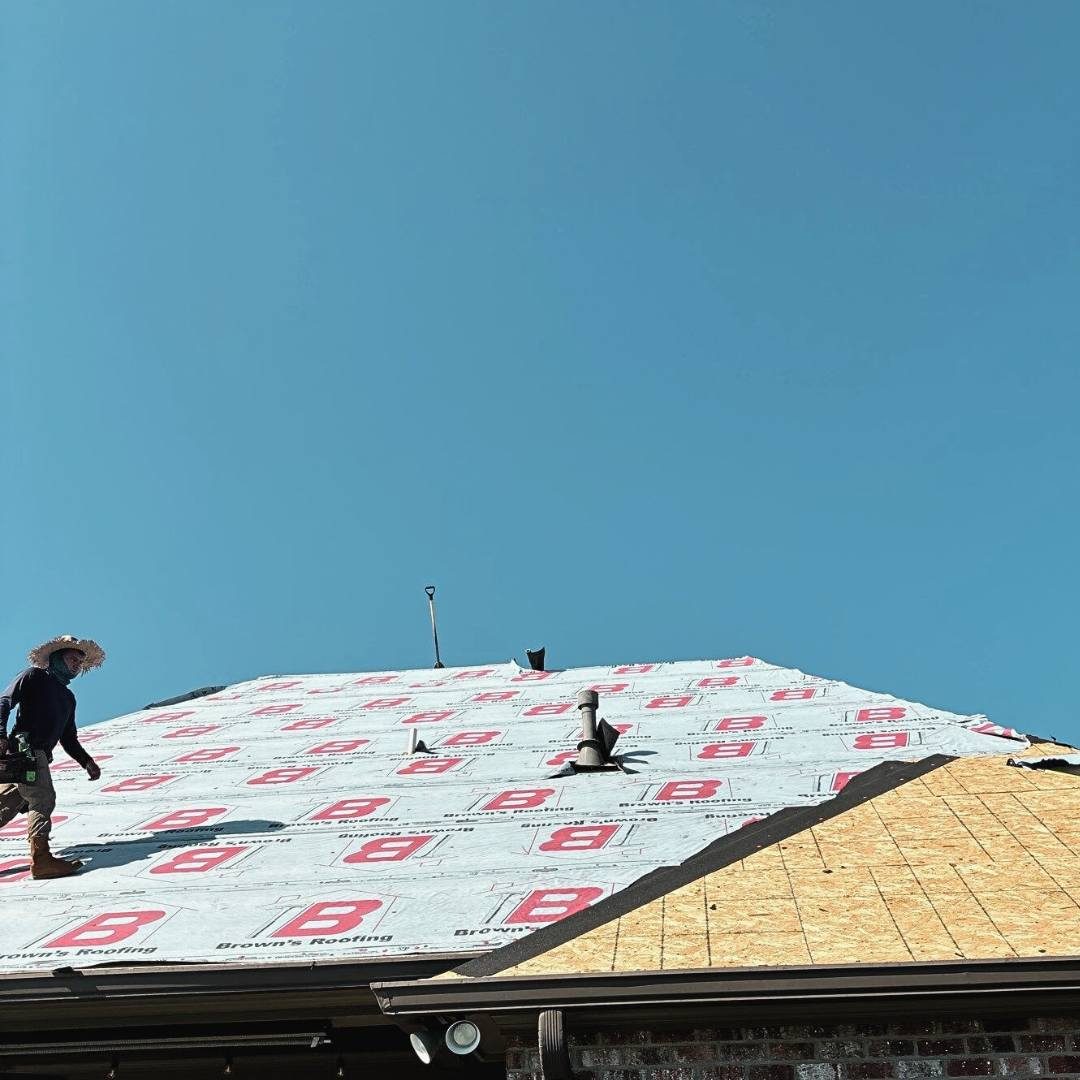
Above: shingles going down over synthetic underlayment. The printed lap lines help crews keep overlaps consistent.
Advantages of Synthetic Underlayment
- Tear resistance. Synthetics hold up to foot traffic and wind during installation far better than felt.
- Doesn't wrinkle when wet. A rain shower between dry-in and shingling doesn't leave a buckled surface.
- Lighter and larger rolls. Fewer seams and fewer trips up the ladder.
- Longer exposure tolerance. Many synthetics are rated by their manufacturers to stay exposed longer than felt before shingles go on. Ratings vary by product, so follow the specific instructions.
- Walkability. Many products have textured, slip-resistant surfaces.
The Trade-Off: Breathability
Many synthetics have very low vapor permeance. That's not a problem on a well-ventilated roof, but it makes balanced attic intake and exhaust ventilation more important. A low-perm underlayment over a poorly vented attic can trap moisture under the deck.
Self-Adhered Ice and Water Barrier
Self-adhered membranes (ASTM D1970) are polymer-modified asphalt sheets with a sticky back that bonds directly to the deck. Their key advantage is that they seal around nail shanks, so water backing up under shingles is unlikely to get through.
They're the right material for the most vulnerable parts of the roof:
- Eaves, in regions prone to ice dams, such as Wichita
- Valleys, where water from two roof planes concentrates
- Around penetrations — chimneys, skylights, pipe boots, and vents
- Hips and ridges, as secondary protection
The drawback is the same as low-perm synthetics, only more so: self-adhered membranes act as a vapor retarder. When they cover the entire deck, ventilation becomes critical to prevent condensation under the deck.
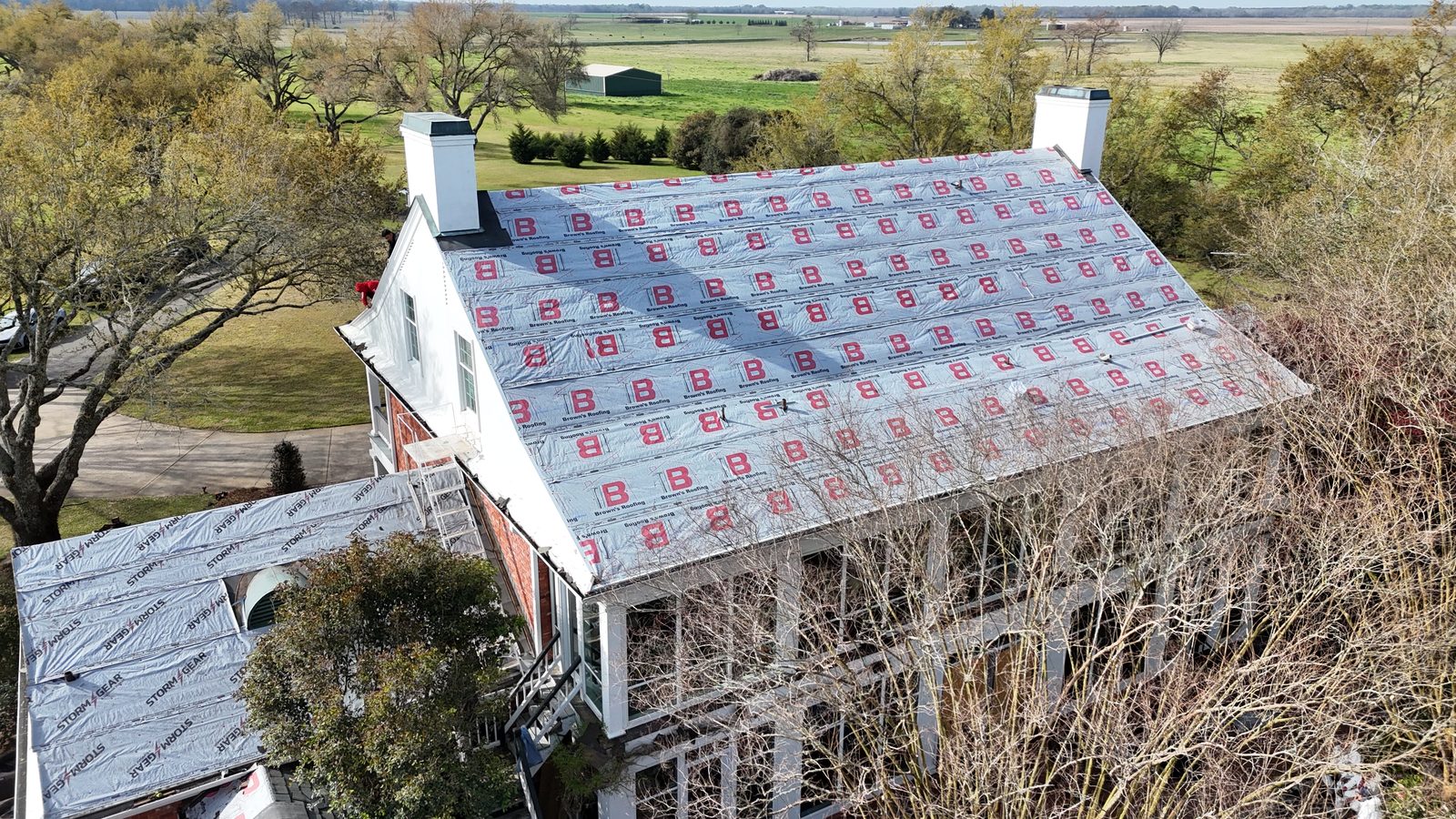
Above: a full dry-in with synthetic underlayment on a two-story home. Once this layer is down, the deck is protected even before shingles arrive.
Underlayment Comparison
| Feature | Felt (D226 / D4869) | Synthetic (D8257) | Self-Adhered (D1970) |
|---|---|---|---|
| Relative Cost | Lower-cost | Mid-tier | Higher |
| Weight | Heaviest | Lightest | Heavy |
| Tear resistance | Low | High | High |
| Behavior when wet | Can wrinkle | Stays flat | Stays flat |
| Seals around nails | No | No | Yes |
| Vapor permeance | Higher | Usually low | Very low (vapor retarder) |
| Best use | Budget installs | Field of the roof | Eaves, valleys, penetrations |
On most modern shingle roofs, the answer isn't one or the other. It's synthetic across the field of the roof, with self-adhered membrane at the eaves, valleys, and penetrations.
Low-Slope Sections and Sealed Decks
Slope changes the rules. ARMA notes that codes generally call for a double layer of mechanically fastened underlayment, or a single layer of self-adhering underlayment, on slopes from 2:12 to 4:12. Shingles on porch roofs and shallow additions need that extra protection.
For homes in hurricane country, the FORTIFIED Roof standard goes further by requiring a sealed roof deck, so water stays out even if the shingles are lost. Our article on why what's under the shingles matters explains how a FORTIFIED roof is built.
Frequently Asked Questions
Is synthetic underlayment better than felt?
For most shingle roofs, yes. Synthetic is lighter, stronger, more tear-resistant, and doesn't wrinkle when wet. Felt remains code-compliant and can work well when installed correctly.
Is roof underlayment required by code?
Yes. The International Residential Code requires underlayment beneath asphalt shingles and other common steep-slope roof coverings, with specific requirements by roof covering and slope.
How long can underlayment stay exposed before shingles go on?
It depends on the product. Felt is meant to be covered quickly. Synthetics often carry longer manufacturer exposure ratings, but the specific product's instructions control.
Do I need ice and water shield in Louisiana?
Ice dams are rare in most of Louisiana, but self-adhered membrane still belongs in valleys and around penetrations, where wind-driven rain and concentrated water flow are the bigger risks.
Can underlayment stop a leak if shingles blow off?
Temporarily, and often well. A properly lapped and fastened underlayment can keep water out after shingle loss, which is why it matters so much in storm-prone areas. It isn't designed to replace the shingles for long.
Does underlayment affect my roof warranty?
It can. Shingle manufacturers' enhanced warranties often require their own approved underlayment and accessory components as part of a complete system.
Ask What's Going Under Your New Roof
When you compare roofing estimates, ask exactly which underlayment goes on the field of the roof and where self-adhered membrane will be installed. Brown's Roofing will walk you through every layer of the system during a free, no-obligation inspection from our offices in Monroe, Shreveport, Baton Rouge, Lafayette, Little Rock, and Wichita. Pricing depends on roof size, slope, complexity, access, and material specification — we provide a written estimate after a free on-site inspection. Call (318) 329-6579.