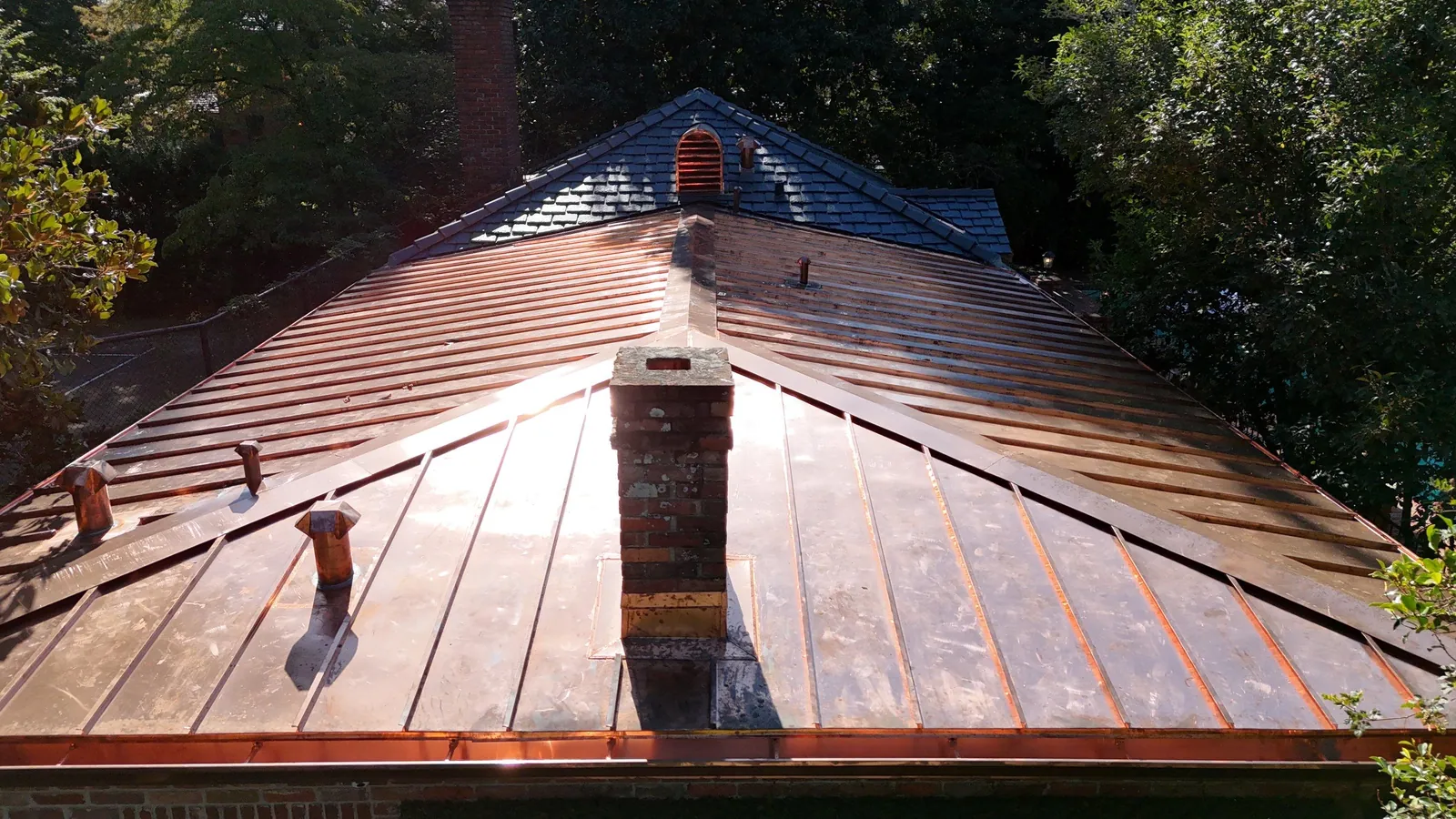
Copper flashing routinely outlives the roof it was installed under — a service life of more than 80 years is common, and properly detailed copper systems have run past a century. It costs more up front, and most of that premium is skilled labor rather than metal. On a slate or tile roof it's the only flashing that really makes sense. On a standard architectural shingle roof, it's usually money you don't need to spend.
That's the short version. Here's where it actually earns its keep — and where we'd talk a homeowner out of it.
What Copper Flashing Actually Does
Flashing is the metal that seals the transitions on a roof: where two planes meet, where the roof runs into a wall or chimney, and where pipes and vents penetrate the deck. Those joints are where roofs leak. Field shingles rarely fail on their own — the metal and sealant around them do.
Most residential flashing is galvanized steel or aluminum. Copper is the premium tier, and the difference isn't gauge. Copper doesn't rely on a sacrificial coating to resist corrosion; it forms its own protective oxide layer, and that layer re-forms if it gets scratched or dented. That single property is why a copper detail can outlast the roof above it, and often the roof after that.
Where Copper Flashing Earns Its Place
Copper doesn't belong everywhere on a roof. It belongs where water volume is highest, the detail is hardest to execute, and the roof itself is built to last.
Chimneys
A masonry chimney is one of the hardest details on any roof. It needs step flashing woven into the shingle courses up both sides, plus counter flashing set into the mortar joints to cap it off. That's a lot of individual pieces and a lot of seams.
Copper's advantage here is that it can be soldered into a continuous, watertight assembly instead of leaning on a bead of sealant to hold back water. The appearance works too — copper reads as period-correct against brick and stone in a way painted steel doesn't. A chimney is where copper craftsmanship is most visible and most worth paying for.
Open Valleys
An open valley is a river during a Gulf South downpour. Two roof planes dump their water into one channel, and that channel takes a beating for the life of the roof. Copper sheds cleanly, doesn't rust, and resists the algae and moss that colonize damp valleys everywhere from Lafayette to Baton Rouge. An open copper valley can run the full life of a slate or tile roof without a callback.
Wall-to-Roof Transitions and Dormers
Anywhere a roof plane runs into a sidewall — dormers, additions, second-story walls — you need step flashing, one piece per shingle course, plus a kickout at the bottom to throw water into the gutters instead of behind the siding. Miss the kickout and you rot the wall sheathing behind it. Copper handles these transitions for the same reason it handles chimneys: soldered joints don't dry out and crack the way a caulk bead does around year ten.
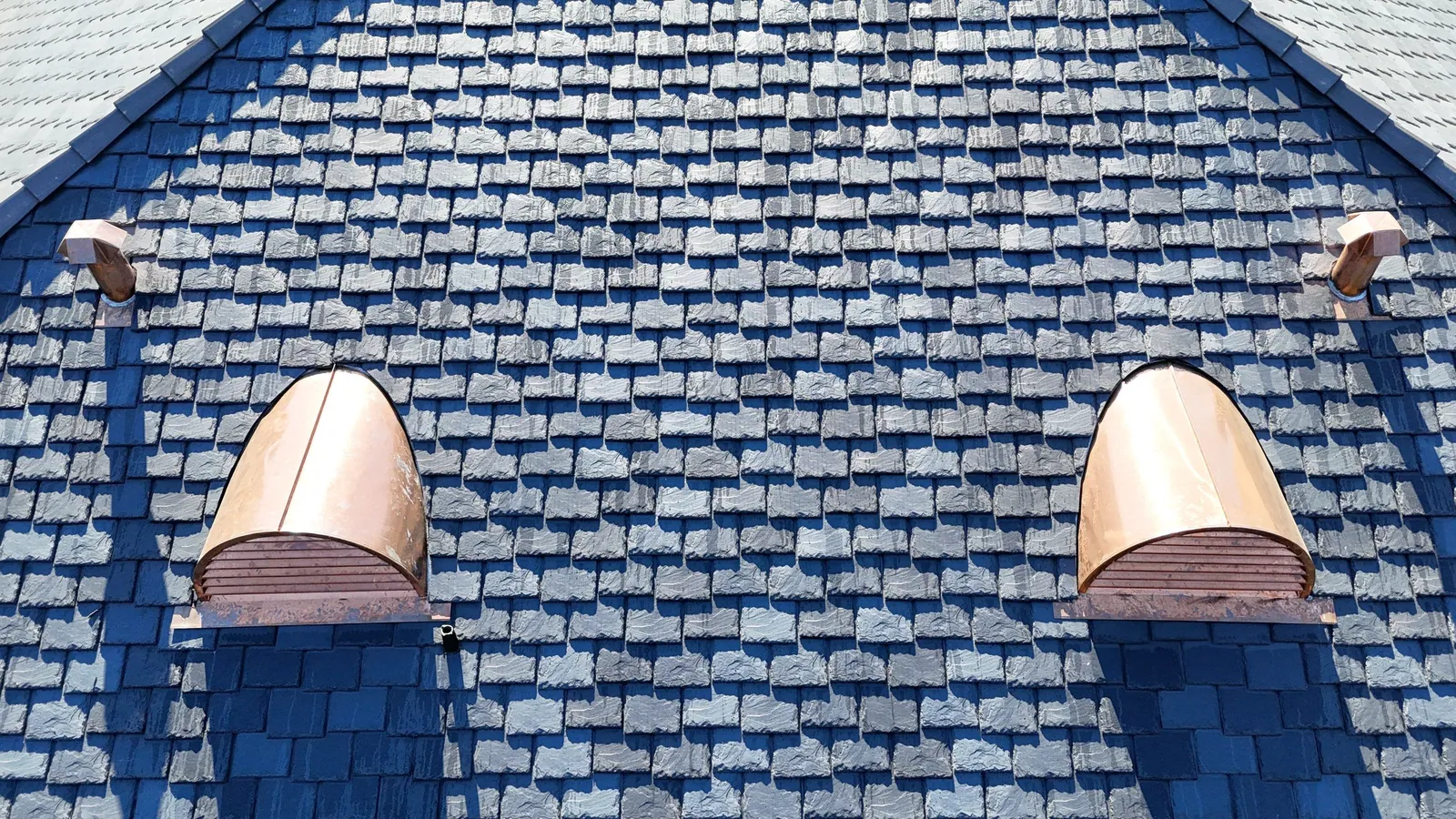
Copper barrel dormers on one of our synthetic slate jobs. Every transition where the dormer meets the field is soldered copper — no sealant holding back water.
Historic and High-End Homes
This is copper's home turf. Slate roofing, synthetic slate, cedar shake, and standing-seam metal roofing all outlive standard flashing by decades — which makes that flashing both the visual and the performance weak link.
There's also the finish. Copper starts bright, moves through russet and brown, and eventually reaches the familiar green patina — full patination on a sloped surface typically takes around 25 years of weathering. On a historic home in Monroe or Shreveport, that slow change is a feature, not a compromise.
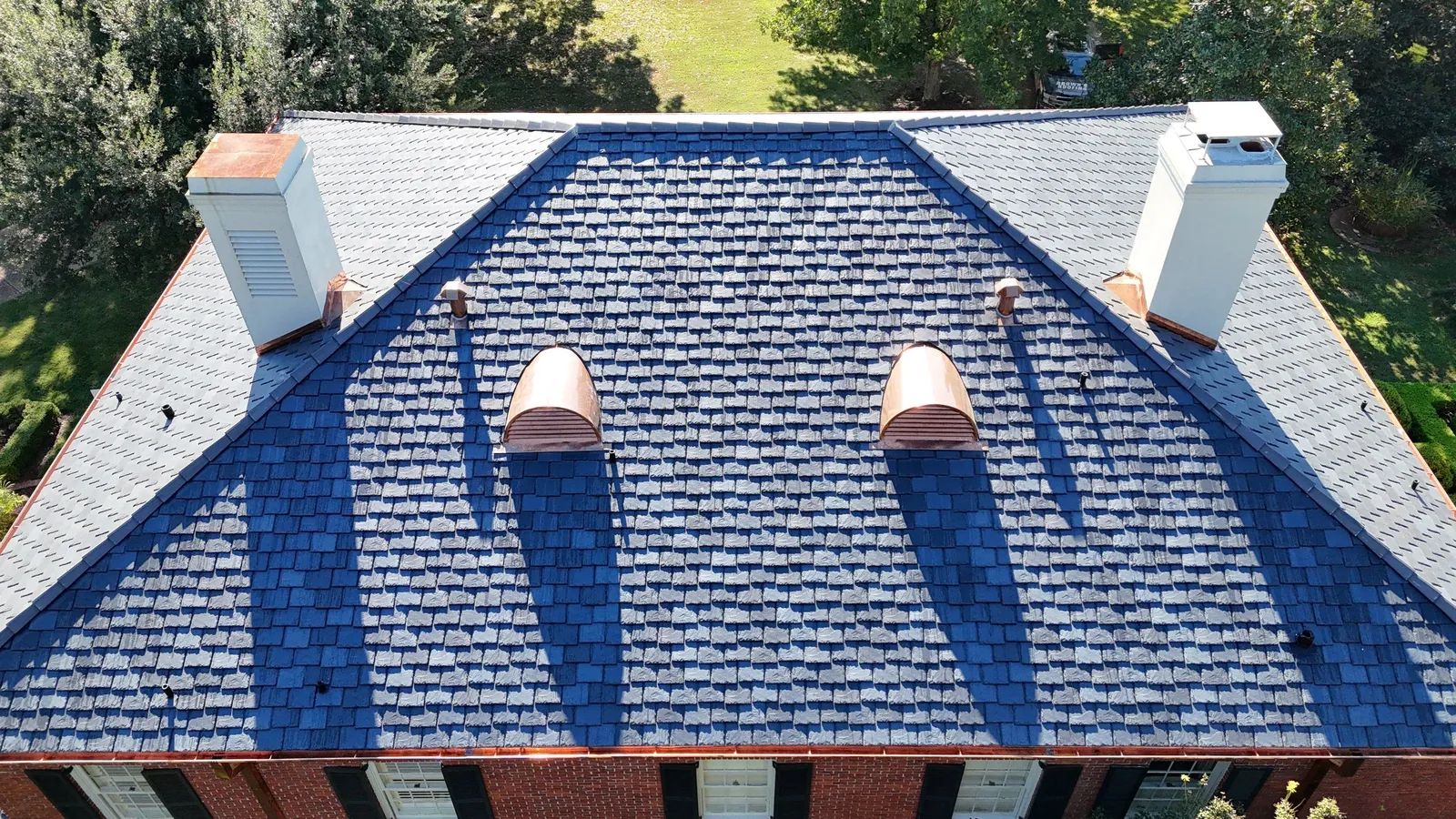
The whole assembly from above: synthetic slate field, copper dormers, copper flashing at both chimneys. Every piece of metal on this roof is copper — which is exactly the point.
Why Copper Outlasts Galvanized and Aluminum
Three reasons, all of them physical.
It doesn't depend on a coating. Galvanized steel is steel with a thin zinc layer. Once that layer wears through at a cut edge or a fastener, corrosion starts and spreads. Copper has nothing to wear off. The Copper Development Association notes that a service life of over 80 years has been common for copper flashing, and that unlike most flashing materials, it generally doesn't need to be replaced when the roof is.
It's soldered, not sealed. Standard flashing installs fast and depends on sealant at the seams. Copper gets soldered into joints that expand and contract as a single piece. In our roof repair work, the failure on an otherwise sound roof is almost never the metal — it's the sealant at an edge or a penetration. Soldering takes sealant out of the assembly entirely.
It handles this climate. Heat, humidity, and salt air are hard on coated steel and bare aluminum, and they get harder the closer you are to the coast. Copper is largely indifferent to all three. It also shrugs off hail: dents on copper are cosmetic rather than structural, which matters in the hail corridors around Wichita and Little Rock.
The Mixing-Metals Problem: Galvanic Corrosion
Copper's biggest strength — its position as a noble metal that resists corrosion — is exactly what makes it destructive to the wrong neighbors.
Put copper in contact with aluminum, galvanized steel, or plain steel in the presence of moisture and you've built a galvanic cell. Copper wins that fight every time; the other metal is what dissolves. And it isn't only direct contact. Water running off a copper flashing onto an aluminum gutter or a coated-steel component downstream can corrode that component too.
The practical rules are straightforward once you know them:
- Every metal that touches copper or drains onto it should be copper or a compatible alloy.
- Fasteners are copper or 300-series stainless steel. Standard galvanized nails driven through copper flashing corrode out and take the detail with them — IBHS guidance on copper roof systems is explicit on fastener compatibility.
- Where copper has to live near another metal, isolate the two with a non-conductive barrier or transition through stainless.
None of this is exotic. It's the kind of detail an experienced sheet-metal crew handles without thinking about it, and the kind a crew that rarely works in copper gets wrong.
What Copper Flashing Costs
Expect copper to cost several times what aluminum or galvanized does — and expect most of that gap to be labor rather than metal.
Copper sheet is a commodity, and its price moves with the market. What doesn't change is that copper has to be cut, formed, and soldered by someone who knows the metal. On a chimney or a built-in gutter, that's hours of skilled work per detail. Roof complexity, access, chimney size, and how much old material has to come off all move the number as well.
Pricing depends on roof size, slope, complexity, access, and material specification — we provide a written estimate after a free on-site inspection. Anyone quoting copper sight unseen is guessing.
Worth noting the other side of the ledger: because copper flashing generally doesn't have to come off when the roof does, its cost is spread across two or three roof cycles rather than one.
Is Copper Flashing Worth It? Our Take
Match the flashing to the roof's lifespan. That's the whole test.
If you're installing a slate or tile roof designed to run 75 years or more, wrapping it in flashing that needs replacing in 20 is a false economy — you'll be tearing into a perfectly good roof to redo metal decades before the roof is finished. That's when copper is the smart buy, not the fancy one.
Copper makes sense on slate, synthetic slate, tile, cedar, or standing-seam roofs; on homes that already have copper gutters, where you have to match; on historic properties where appearance carries weight; and for owners who plan to stay put.
We'd steer you elsewhere on a standard 25- or 30-year architectural asphalt shingle roof. There, the flashing and the shingles reach end of life in the same window, so paying a multiple for metal that would outlive three roofs doesn't pencil out. Quality coated steel or aluminum, installed correctly with proper laps and kickouts, does the job. Correct installation beats expensive material every time.
Frequently Asked Questions
How long does copper flashing last?
A service life of more than 80 years is common, and properly installed copper roof and flashing systems have gone well past 100. It routinely outlives the roof covering it was installed under.
Is copper flashing better than aluminum or galvanized?
For longevity and corrosion resistance, yes — by a wide margin. But "better" isn't the same as "right for your roof." On a standard shingle roof, coated steel or aluminum is the sensible specification.
Can I use copper flashing with aluminum gutters?
Not without isolating them. Runoff from copper corrodes aluminum downstream, so either match the metal or have the transition designed with proper separation. This is the single most common copper mistake we get called out to correct.
Why does copper flashing turn green?
That green is the patina — a protective oxide layer that forms as the copper weathers, and it's doing useful work. Don't strip or polish it. You'll only restart the process.
How much more does copper flashing cost than standard flashing?
Several times more, and most of the difference is the soldered craftsmanship rather than the metal itself. Because the figure swings so much with detail complexity and access, we quote it after seeing the roof.
Do I need copper flashing on an asphalt shingle roof?
Usually not. On a standard-lifespan shingle roof, quality aluminum or coated-steel flashing installed correctly will reach end of life right alongside the shingles. Copper earns its premium on long-life roofs — slate, tile, metal — or where you specifically want the look.
Talk to Brown's About Your Flashing
Flashing is where roofs leak, and it's the detail a rushed crew skips. Whether you're specifying copper for a slate roof, matching existing copper gutters, or just trying to figure out whether your current flashing is the reason there's a stain on the ceiling, we'll give you the straight answer — including when copper isn't worth it.
Brown's Roofing runs free, no-obligation roof inspections from permanent offices in Monroe, Baton Rouge, Shreveport, Lafayette, Little Rock, and Wichita. Call (318) 329-6579 and we'll take a look.