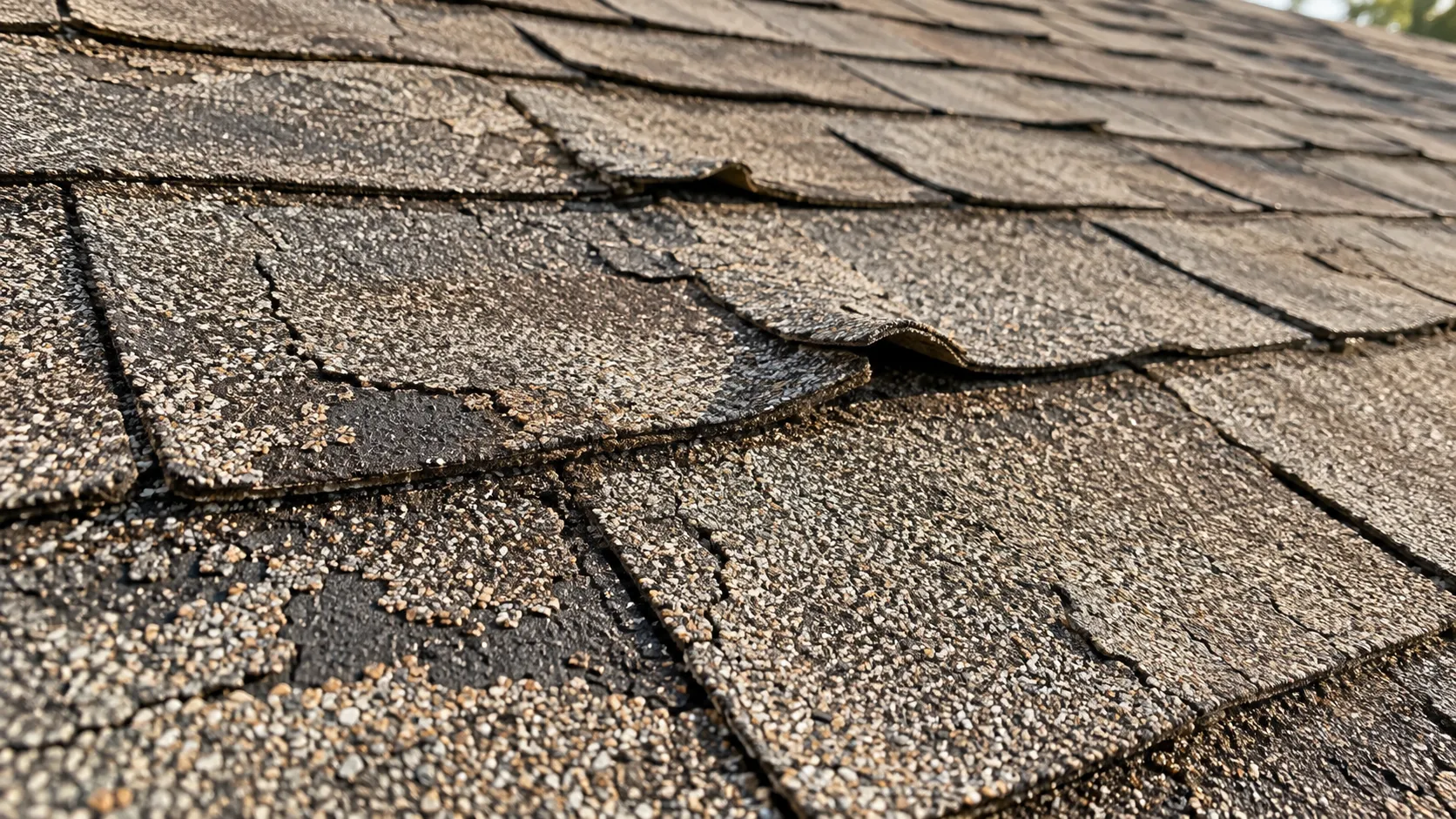
A shingle roof is usually worth repairing when it's structurally sound, under about 15 years old, and the damage is localized — a few blown-off shingles, some lifted flashing, a handful of popped nails. Once the whole field is brittle, curling, or shedding granules, or you're chasing your third leak in three different spots, a repair just buys you a season. At that point you're spending good money to delay a replacement.
That's the honest short version. Now let's unpack it, because "it depends" actually means something specific here.
Should You Repair or Replace an Asphalt Shingle Roof?
Three questions settle most of these calls.
How old is the roof? A three-tab or architectural shingle roof in the Ark-La-Tex typically gives you 15 to 25 years, and our heat and humidity push most roofs toward the lower end of that range. A 9-year-old roof with a wind-torn corner is a repair, full stop. A 19-year-old roof with the same corner damage is a different conversation.
How widespread is the damage? One or two problem areas on an otherwise healthy roof means repair. Damage scattered across multiple slopes, or wear you can see across the whole field from the ground, is a roof telling you it's near the end.
Is it a field issue or a flashing issue? This matters more than people realize. A lot of "roof leaks" aren't the shingles failing at all — they're failed flashing around a chimney, a wall, a valley, or a pipe boot. Those are targeted repairs even on an older roof. The shingle field can be fine while the flashing quietly lets water in for years.
Get those three answers straight and you're most of the way to knowing what you're dealing with.
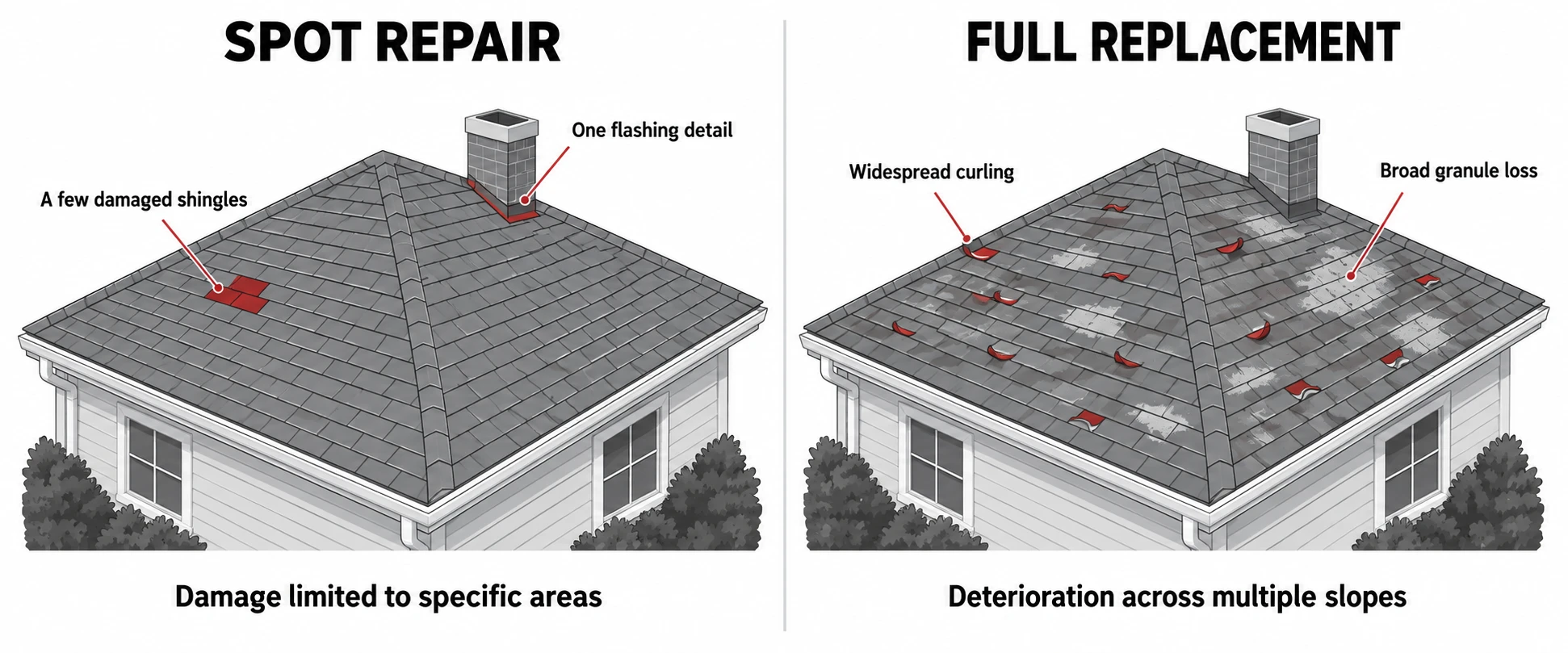
Damage confined to a few shingles and one flashing detail is a repair. Curling and granule loss spread across multiple slopes is a roof at the end of its service life.
The Most Common Asphalt Shingle Repairs
Cracked and curled shingles
This is the number-one thing we see on Gulf South roofs. Asphalt shingles live and die by their oils. Under relentless Louisiana sun the asphalt dries out, the shingle loses flexibility, and the edges start to curl or crack. Thermal cycling — hot day, cooler night, over and over — works the shingle like a paper clip you bend until it snaps.
A few curled tabs on a younger roof can be replaced or hand-sealed. When curling shows up across a whole slope, that's not a repair item — that's the roof aging out in front of you. Curling is one of the clearest end-of-life signals there is.
Lifted or failed flashing
Flashing is the metal that seals the transitions: where the roof meets a chimney, a wall, or a skylight, and where two slopes form a valley. It's also where a large share of leaks actually start. Step flashing works loose, counterflashing pulls away from the masonry, or somebody's old "fix" was a smear of roofing tar that's now cracked and useless.
The right repair is re-flashing the area properly, not caulking over it. Sealant is a band-aid and it will fail again in a couple of summers. Done right, a flashing repair can outlast the shingles around it.
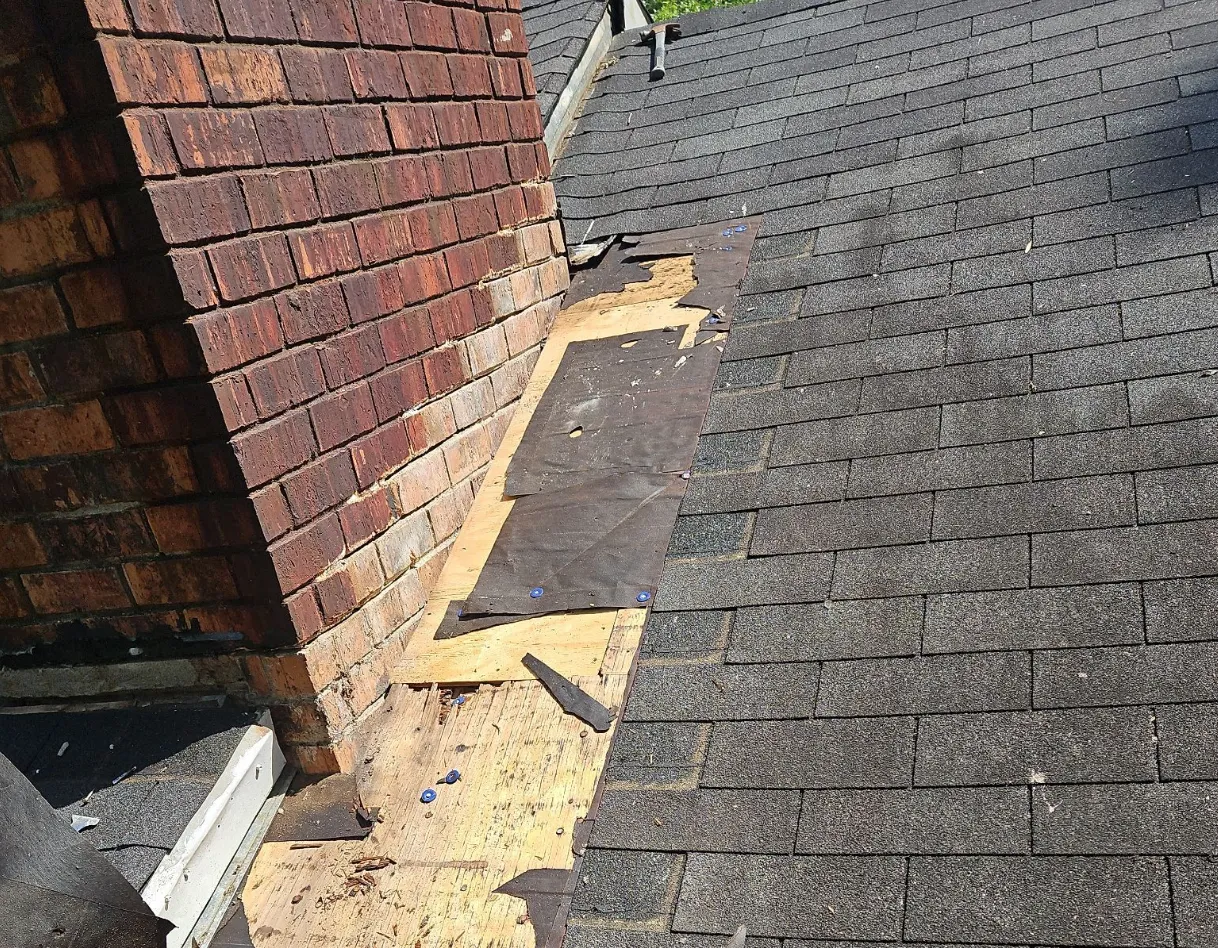
A chimney flashing repair done properly means opening the area up, replacing what's failed, and rebuilding the detail — not sealing over it.
Popped or backed-out nails
Ever notice a small raised bump in an otherwise flat shingle course? That's often a nail pop — a fastener that has backed out as the deck expands and contracts with heat and humidity. The popped nail lifts the shingle above it and leaves a pinhole path for water straight through the nail hole.
The fix is straightforward: reset or replace the fastener, seal it, and re-secure the shingle. Easy enough on its own — but nail pops scattered across the whole roof point to deck movement or an aging installation, and that's a bigger conversation.
Wind-lifted and blown-off shingles
After a hard Ark-La-Tex thunderstorm, the common damage is a tab or two torn off, or shingles whose self-sealing strip has let go so they flap and lift. Exposed nail heads and a missing tab here or there are textbook repairs — as long as the surrounding shingles are still pliable enough to lift without cracking.
The catch: on a brittle older roof, a roofer often can't lift the neighboring shingles to slide a new one in without breaking them. That's when a simple repair snowballs. Manufacturer guidance matters here too — the Asphalt Roofing Manufacturers Association's installation and maintenance resources are clear that repairs should follow the original system's instructions, not improvised shortcuts.
What Actually Drives the Cost of a Shingle Repair
Pricing depends on roof size, slope, complexity, access, and material specification — we provide a written estimate after a free on-site inspection. What we can tell you is what moves the number:
- Pitch and access. A walkable 5/12 roof is quick work. A steep two-story slope that needs extra fall protection and staging takes more crew time to do safely.
- Height and layout. A back slope behind a second story is harder to reach than a front porch.
- How much has to be opened up. If we lift shingles and find soft decking, the scope changes on the spot.
- Matching. More on that below — it's a bigger factor than it sounds.
And the reality nobody loves: there's a practical minimum for any repair call. It costs about the same to get a trained crew, a truck, and safety gear to your house whether we're replacing one shingle or ten. That's why a single-shingle repair never costs what the shingle itself costs. You're paying for qualified people working safely on your roof.
Why Matching Old Shingles Is a Real Problem
Shingle colors get discontinued. GAF, Owens Corning, CertainTeed, and IKO all revise their color lineups regularly, so a shingle installed twelve years ago may simply not exist anymore. Even when the exact product is still made, your existing shingles have weathered and faded under a decade of UV. A brand-new shingle dropped into an old field will almost always stand out.
On a side slope that's cosmetic and no big deal. On a prominent front-facing plane, some homeowners would rather redo the whole visible section. Worth talking through before we start. If you want a feel for what starting fresh involves so you can compare honestly, our breakdown of a 30-square replacement lays out the scope.
When a Repair Is Just Throwing Money at the Roof
A cheap patch on an old roof usually delays the inevitable rather than preventing it. Here's when we tell homeowners to stop repairing and start planning a replacement:
- Leaks in multiple separate areas. One leak is a repair. Leaks in three different spots means the system is failing, not one detail.
- Widespread granule loss. Gutters full of granules and bald, dark patches on the shingles mean the protective layer is gone and UV is cooking the asphalt directly.
- Brittle, curling shingles across the field. When shingles crack the moment you lift them, there's nothing to repair around.
- The roof is at or past 15 to 20 years. In our climate, that's the zone where repairs stop being economical.
- A third or fourth repair in a couple of years. Add up what you've already spent chasing leaks. It's often a meaningful share of a new roof.
- Soft or rotted decking underneath. Once the wood deck is compromised, you're past shingle repair.
If two or three of those describe your roof, a repair is money you won't get back. A replacement resets the clock — and if budget timing is the hurdle, we lay out the options in our guide to roof financing.
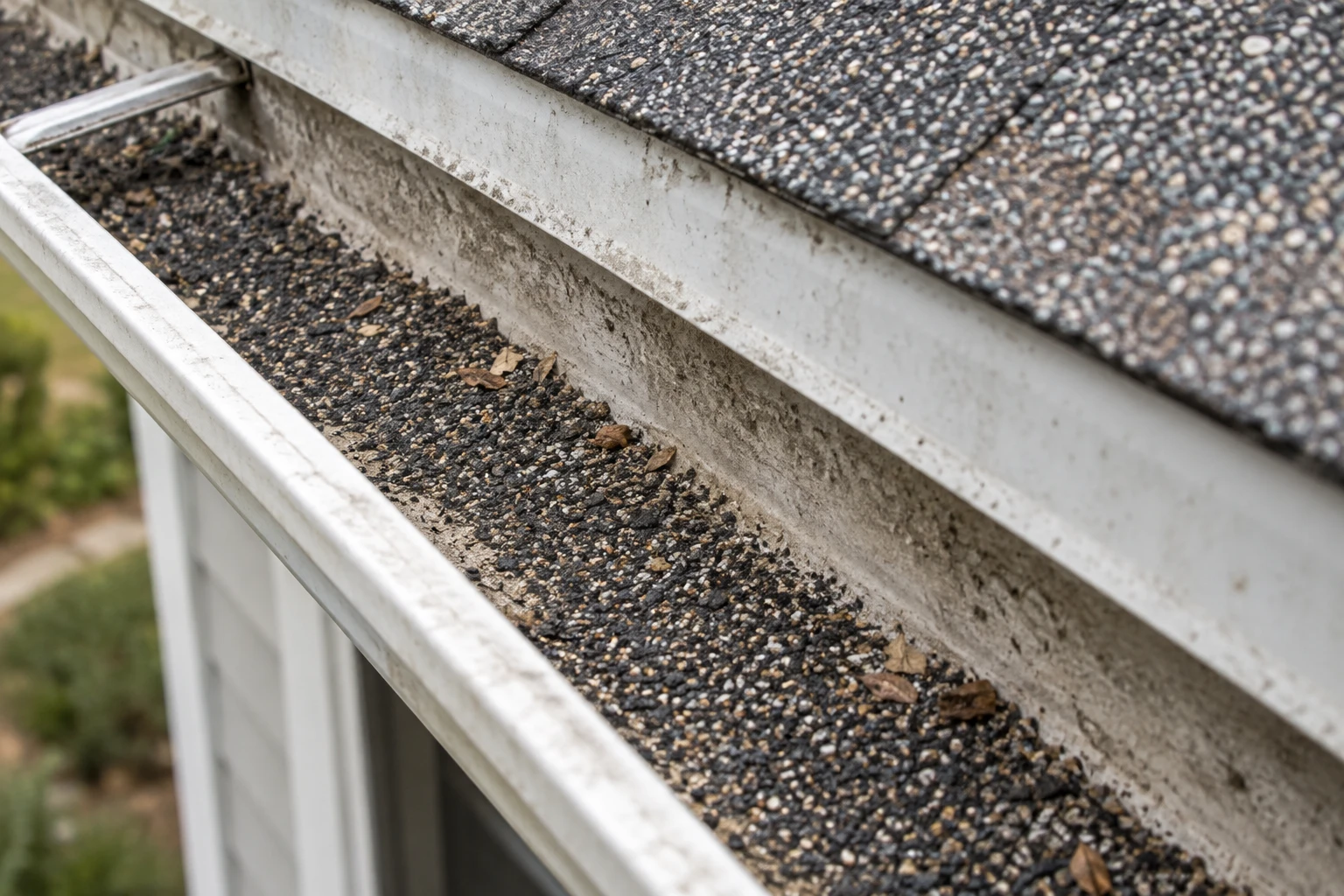
Granules piling up in the gutter on an older roof mean the protective layer is washing off faster than the shingles can spare it.
Storm Damage and Insurance: What Changes
Hail and wind flip the equation. Damage that would be an out-of-pocket repair on a normal day may become a covered replacement if a storm caused it.
Get an inspection before you file, so you know what you're actually dealing with, and document everything — dated photos, the storm date, any interior damage. If you're fresh off a hail event, our guide on what to do when hail hits your roof walks through the right order of operations. Know what your policy covers, too: wind and hail are usually covered perils, while wear and age are not. Whether a leak gets paid depends heavily on cause, which we cover in does home insurance cover roof leaks.
Work with a stable local contractor rather than a storm-chaser. After every big storm, out-of-state trucks show up promising the moon and are gone long before a warranty callback matters. We work claims honestly with your adjuster and we don't invent damage that isn't there.
And if a storm forces a full replacement anyway, that's the moment to build back stronger. A FORTIFIED roof — sealed deck, ring-shank nails, enhanced edge — is built for exactly the wind exposure we get across the Gulf South, and it can earn insurance premium credits in many cases.
How to Check Your Shingle Roof Before You Call a Roofer
You don't need to climb up there. Most of this you can check from the ground or a ladder at the eave. Please don't get on a wet, steep, or storm-damaged roof — no inspection is worth a fall.
- Look for dark streaks or stains. Often algae, which is cosmetic. Our piece on why roofs get stains explains the difference before you assume the worst.
- Check your gutters for granules. A little is normal, especially on a new roof. Piles of it on an older roof is a warning sign.
- Scan the shingle rows for curled, cupped, or cracked edges. Look across whole slopes, not just one spot.
- Count missing tabs or shingles, especially after a wind event.
- Check inside. Brown ceiling rings, bubbling paint, or a musty smell in the attic all point to active water.
- Find the roof's age and paperwork. Whether it's 8 years old or 18 tells us most of what we need before we're on the ladder. Dig up any warranty documents while you're at it.
Snap photos of anything that looks off and send them over.
Frequently Asked Questions
How is a small shingle repair priced?
By the work involved, not by the shingle. Pitch, access, height, and how much of the roof has to be opened up all factor in, and there's a practical minimum because mobilizing a trained crew and safety gear costs the same for one shingle as for ten. We give you a written estimate after a free on-site inspection.
Can you repair just one section of a shingle roof?
Yes, as long as the surrounding shingles are still flexible enough to lift without cracking and the rest of the roof is sound. Section repairs are common and sensible on younger roofs. On brittle, aged shingles, isolating one section without damaging its neighbors gets difficult fast.
How do I know if my roof needs repair or full replacement?
Weigh three things: age, how widespread the damage is, and whether it's a field problem or a flashing detail. Under about 15 years with localized damage points to repair. Past 15 to 20 years with scattered leaks, curling, or heavy granule loss points to replacement.
Will my homeowners insurance pay for shingle repair?
It depends on the cause. Sudden storm damage from wind or hail is typically covered; gradual wear, age, and neglect are not. Small repairs may also fall under your deductible, which can make filing pointless. Get an inspection and read your policy before you call the carrier.
How long does a shingle roof repair last?
A properly done repair on a sound roof can last the remaining life of the shingles around it. A patch on an old, brittle roof might hold a season before water finds the next weak spot. The repair is only as good as the roof it's attached to.
Why won't the new shingles match my old roof?
Two reasons: manufacturers discontinue colors, and your existing shingles have faded from years of UV exposure. Even the identical product installed today will look brighter than your weathered roof. On hidden slopes it doesn't matter; on a front-facing plane, some homeowners choose to redo the whole visible section.
Talk to a Local Roofer
If you're staring at a curled corner or a fresh ceiling stain and you're not sure whether it's a quick fix or a sign the roof is done, get a real set of eyes on it. Brown's Roofing offers a free, honest roof check — we'll tell you straight whether a repair makes sense or whether you'd just be delaying the inevitable. With permanent offices and local crews in Monroe, Shreveport, Baton Rouge, and Lafayette, plus Little Rock and Wichita, we serve homeowners across Louisiana, Arkansas, and Kansas. Call (318) 329-6579 for a free inspection with same-day response. No pressure, no invented damage.