
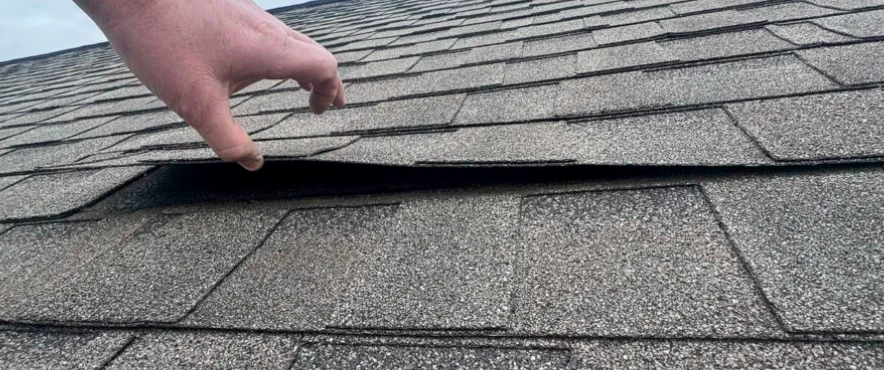
Usually yes — if the leak came from a sudden, accidental event your policy covers, like wind, hail, or a tree limb through the roof. Usually no if it came from age, wear-and-tear, rot, or neglected maintenance. Insurers draw one line: "sudden and accidental" gets paid, "gradual" doesn't. The cause of the leak decides everything, not the leak itself.
That single distinction is where almost every roof claim is won or lost. So let's unpack it the way it actually plays out on Gulf Coast and Ark-La-Tex roofs.
The Rule Insurers Actually Use: Sudden vs. Gradual
A standard homeowners policy — the HO-3 form most people carry — covers your roof against named perils that hit suddenly and by accident. Wind. Hail. Falling objects (that oak limb). The weight of ice or snow. When one of those damages your roof and water gets in, that's a covered loss.
What's not covered is the slow stuff: normal wear-and-tear, age, rot, deferred maintenance, pest damage, and manufacturing defects. Insurance is designed to protect you from sudden bad luck — not from a roof that simply wore out or one you didn't keep up.
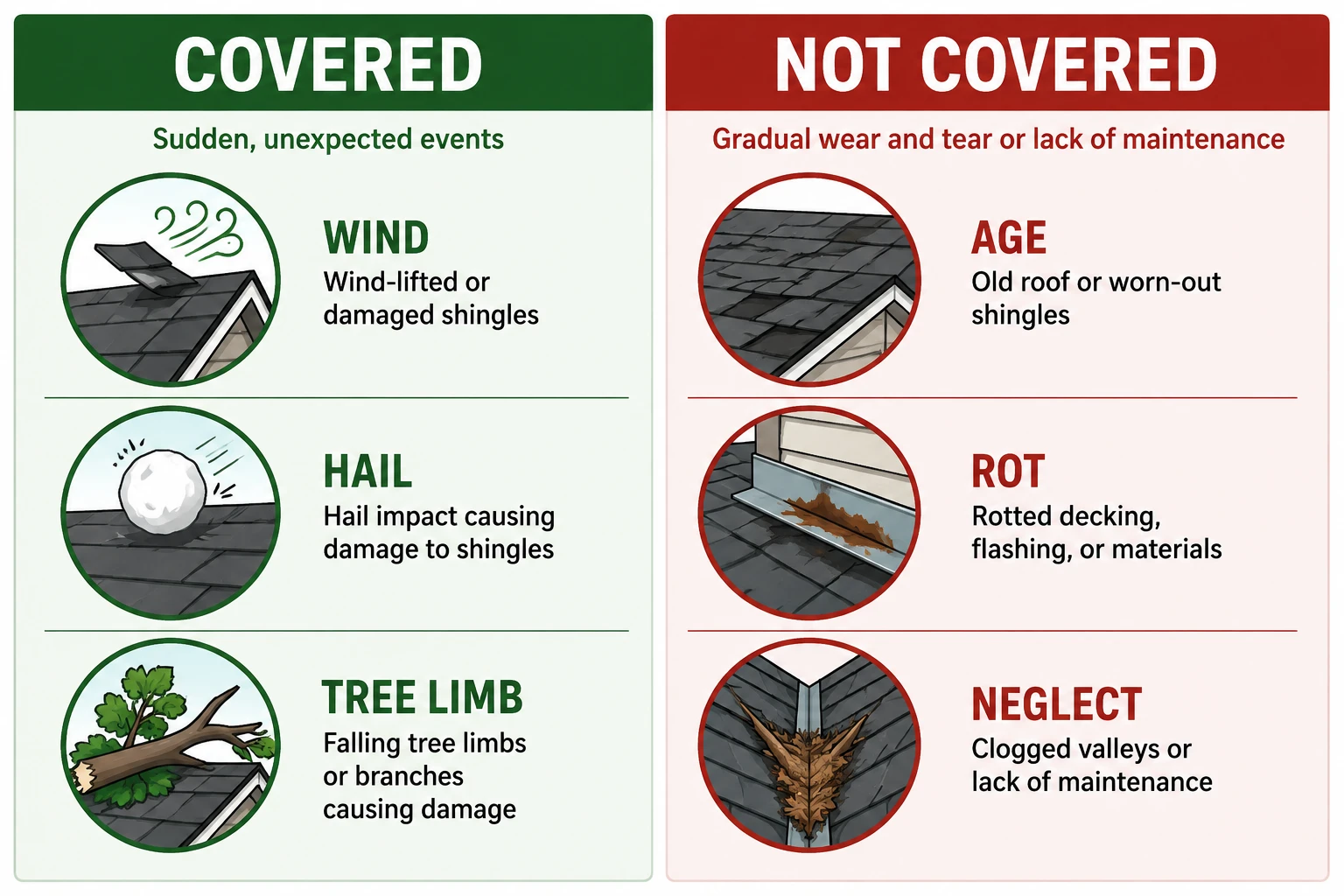 The whole game in one graphic: sudden events on the left, gradual decline on the right.
Here's the part homeowners miss: the adjuster isn't really evaluating the leak. They're evaluating what caused the leak. Two identical brown ceiling stains can get two opposite answers. One shingle field got bruised by a hailstorm last Tuesday. The other has granules washed off from fifteen years of Louisiana sun and a cracked pipe boot nobody replaced. Same water, very different cause — and the cause is what your carrier rules on.
When Home Insurance Will Cover a Roof Leak
If your leak traces back to a covered peril, you're generally in good shape. The common ones down here:
Hurricane and tropical-storm wind
This is the big one on the Gulf Coast. From Lafayette and Baton Rouge down toward the coast, high wind lifts, creases, or tears off shingles, and the next rain finds the opening. Wind-driven rain that gets in because wind damaged the roof is typically covered. Take good photos of your roof before the season starts — clean pre-storm images make it far easier to show a storm caused the damage later.
Hail
North Louisiana, Arkansas, and Kansas — from Shreveport and Monroe up through Little Rock and Wichita — sit in real hail country. Hail bruises the shingle mat, and you'll often feel those bruises underfoot before you can see them; they fail months later. That's exactly why an old stain isn't the whole story — a hail event is a covered peril even if the leak shows up weeks after the storm. If you want to understand the damage mechanism, NOAA explains how hail forms and how hard it hits. And if you've just been hit, read what to do when hail hits your roof before you do anything else.
A tree limb through the deck
Falling objects are a covered peril. If a limb punches through your decking, the roof damage and the interior damage usually get paid.
Ice and weight events
Less common, but the ice storms that roll through north Louisiana, Arkansas, and Kansas can load a roof past what it's built for. Weight of ice and snow is a named peril on most policies.
And here's the good news most folks don't expect: the interior water damage that follows a covered roof leak — ruined drywall, ceilings, insulation, sometimes flooring — is usually covered too, under a separate part of your policy. The roof gets fixed under dwelling coverage; the soggy ceiling gets fixed under the same claim.
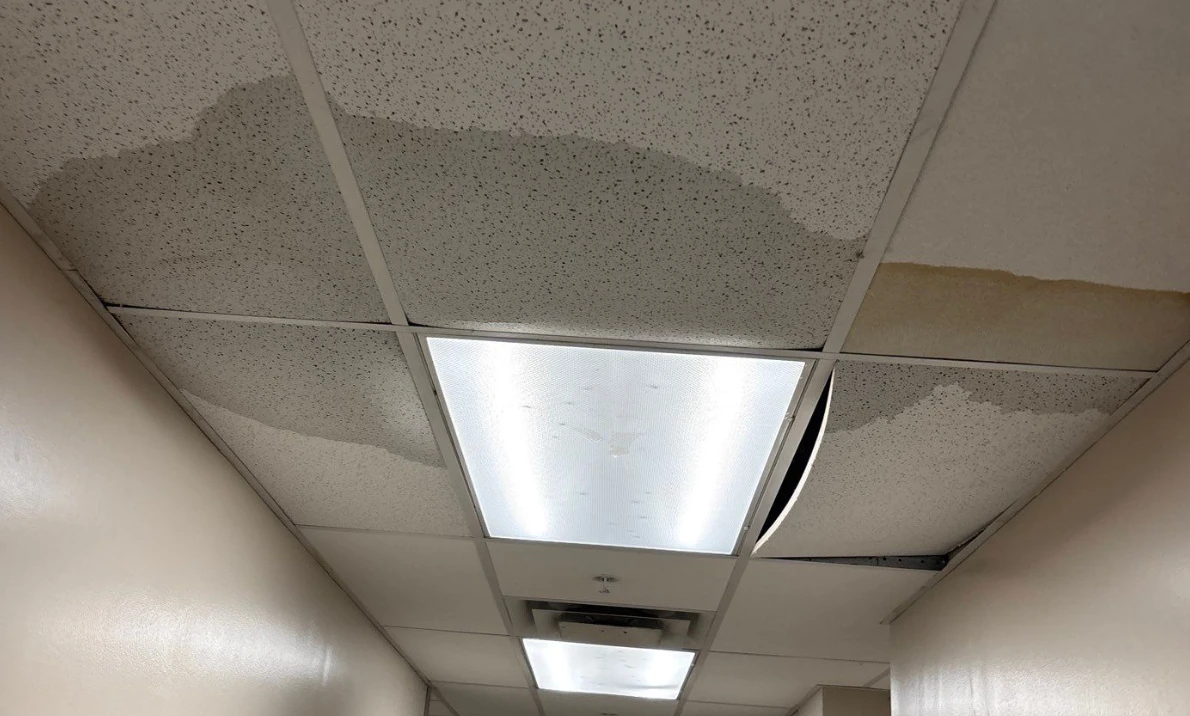 By the time the stain spreads this far, water has been finding its way in for a while. Photograph it the day you see it.
When Home Insurance Won't Cover the Leak
This is where claims get denied, and it's worth being honest about because we see it constantly.
An old roof past its service life
A 20- or 25-year-old three-tab roof that starts leaking hasn't been damaged — it's done. Insurers call that wear-and-tear, and they exclude it. Replacing a worn-out roof is a maintenance cost, not an insured loss.
Deferred maintenance
Rotted flashing, cracked pipe boots, clogged valleys full of pine straw, sealant that dried out and let go. If the adjuster can point to a maintenance problem you let slide, the carrier can deny the claim — even after a storm — on the grounds that the roof would have leaked anyway.
Improper prior installation
If the last roofer botched it — nailed shingles wrong, skipped flashing, cut corners — that's a workmanship issue, not a covered peril.
Slow leaks that went unreported
A stain that's been spreading for six months tells an adjuster the damage was gradual. Report leaks promptly. Waiting hurts you two ways: the damage worsens, and the "sudden" argument evaporates.
Depreciation on an aging roof
Even when a claim is covered, an older roof may not pay what you'd hope — more on that below.
How Louisiana, Arkansas & Kansas Policies Differ
Where you live changes the fine print more than most people realize. None of what follows is coverage advice — it's what to go look up in your own policy.
Louisiana — named-storm and hurricane deductibles
Most Louisiana policies carry a separate hurricane or named-storm deductible, and it's usually a percentage of your home's insured value, not a flat dollar amount. That's a big deal. On a $300,000 home, a 5% hurricane deductible is $15,000 out of pocket before the policy pays a dime. Know your number before a storm, not after.
Arkansas and Kansas — wind and hail deductibles
In hail country, insurers increasingly attach a separate wind/hail deductible, often 1–2% of the dwelling value. Same idea: your everyday deductible might be $1,000, but your hail deductible could be several thousand.
Roof-age caps and cosmetic exclusions
More carriers now cap roof coverage by age — dropping older roofs to actual-cash-value settlements or excluding cosmetic hail damage (dents that don't cause a leak) entirely. Read your declarations page, and call your own agent if the wording isn't clear. The surprises are always in there.
Louisiana homeowners should also know the ground shifted recently. Our breakdown of Louisiana's 2025 roofing reforms explains the new rules around contractors, claims, and what's changed for policyholders — worth a read if you're filing anything this year.
How to Handle a Roof Leak the Day You Find It
Move in this order. It protects your home and your paperwork.
- Stop the water. Get a bucket under it, move furniture, and if it's actively pouring, get a tarp on the roof or call someone who will. Fast temporary work prevents thousands in secondary damage — we cover the how-to in temporary repairs and emergency roofing services.
- Document everything. Photos and video of the roof, the ceiling, the wet insulation, any storm debris. Timestamps matter. This is your evidence that the damage was sudden.
- Get an honest roofer's eyes on it. A licensed local roofer can inspect the roof and tell you what they find — whether the damage looks storm-related or looks like age and wear. That's the fact you want in hand before you decide anything. Whether to file is your call, and the coverage determination is your carrier's.
- File promptly and keep every receipt. Emergency tarping, water extraction — save it all. Reimbursement for reasonable emergency repairs is standard on most policies.
- Ask your roofer to attend the adjuster's inspection. Two sets of trained eyes on the same roof beats one. We'll meet your adjuster up there and point out the damage we documented, slope by slope, so nothing we found goes unseen. We don't file, negotiate, or interpret your policy — that stays between you and your carrier — but we make sure our documentation is on the table.
How Deductibles and Depreciation Affect Your Payout
Two things quietly shrink a "covered" claim: your deductible and depreciation. Both live in your policy, so this is a read-your-own-paperwork exercise — but here's what you're looking for.
Deductibles
A flat deductible ($1,000, say) comes off the top. A percentage deductible — common for wind and hurricane in our region — scales with your home's value and can be far larger. Check whether your storm deductible is separate from your all-perils deductible.
ACV vs. RCV
This is the one that stings. Replacement Cost Value (RCV) pays what it costs to replace the roof today. Actual Cash Value (ACV) pays that amount minus depreciation for the age and wear of the old roof. A 20-year-old roof on an ACV settlement may have almost nothing left after depreciation — even when the claim is approved. You might see a covered loss pay out a few hundred dollars because the policy only owed the depreciated value of a roof that was nearly used up.
The lesson: know whether your policy is RCV or ACV, and know your roof's age. Those two facts predict your check better than the damage itself. If you can't tell which one you have, your agent can.
Frequently Asked Questions
Does homeowners insurance cover roof leaks from old age?
No. Age and wear-and-tear are excluded on standard policies. A roof that simply wore out is a maintenance expense, not an insured loss — even if the failure feels sudden to you.
Will insurance cover water damage inside my house from a roof leak?
Usually yes, if the roof leak itself came from a covered peril. Damaged drywall, ceilings, and insulation are typically paid under the same claim. If the leak was from wear or neglect, the interior damage generally isn't covered either.
Should I call a roofer or my insurance company first when my roof leaks?
Call a licensed roofer first for an honest look at the roof. Knowing whether you're looking at storm damage or a worn-out roof puts you in a much better position to decide what to do next — and the filing decision is yours to make with your carrier. A good roofer will tell you straight which one it looks like.
Does insurance cover a roof leak from a hurricane in Louisiana?
Generally yes — hurricane wind is a covered peril. But most Louisiana policies carry a separate percentage-based hurricane deductible, often 2–5% of your home's value, that you pay before coverage kicks in. Check that number now, not during a storm.
What is a wind and hail deductible?
It's a separate deductible that applies only to wind and hail claims, common in Arkansas and Kansas. It's often a percentage of your dwelling value (1–2%) rather than a flat dollar amount, so it can be much higher than your standard deductible.
Can insurance deny my roof leak claim for lack of maintenance?
Yes. If an adjuster finds rotted flashing, cracked boots, clogged valleys, or other neglect, the carrier can take the position that the roof would have leaked regardless of any storm and deny the claim. Keeping your roof maintained — and documented — protects your coverage.
Get an Honest Roof Inspection
If you've got a leak and you're not sure whether it's storm damage or just a tired roof, get someone up there who'll tell you the truth. Brown's Roofing does free roof inspections across Louisiana, Arkansas, and Kansas. If we find storm damage, we'll document it slope by slope and meet your adjuster on the roof to point out what we found — you handle the claim with your carrier, and we repair to the approved scope. We're a stable local contractor, not a storm-chaser passing through. If your roof has years left, we'll say so. Call us at (318) 329-6579 and we'll take a look.