
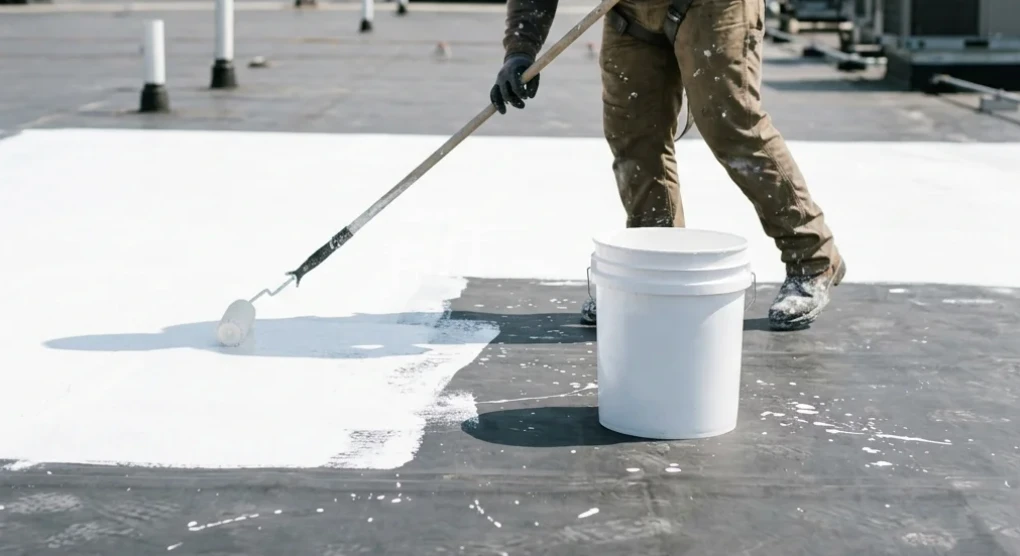
Acrylic roof coatings are the cheapest, most reflective, easiest-to-apply option in commercial roof restoration — and they're a smart move on a sound, well-draining roof. But they have one hard limit that matters a lot in Louisiana: standing water softens the film over time, so a ponding roof is the wrong roof for acrylic. Here's the straight-talk version, from people who've been on the roof.
What Is an Acrylic Roof Coating?
An acrylic roof coating is a liquid-applied, water-based elastomeric coating that cures into a seamless, flexible membrane over your existing roof. You put it down as a liquid — brushed, squeegeed, rolled, or sprayed — and as the water carrier evaporates, the acrylic latex knits into a continuous white skin. It's built to flex. The governing standard, ASTM D6083, sets minimums for exactly the properties that keep a coating alive on a moving roof: tensile strength, elongation, water-swelling resistance, tear resistance, and low-temperature flexibility, measured both before and after accelerated weathering.
Acrylics bond to a wide range of substrates, including modified bitumen, built-up roofing, EPDM, TPO, and properly prepared metal. That adhesion, plus a low price and a bright white finish, is why acrylic has become the most widely used coating type in commercial restoration — it balances performance, cost, and ease of application better than almost anything else on the shelf.
It's worth knowing where acrylics came from. They were originally developed in the 1970s to restore sloped metal roofs. Over time, manufacturers and contractors learned they worked on other commercial substrates too, with one caveat: the roof has to drain well. Keep that caveat in your back pocket — on a Louisiana flat roof, it's the whole story.
The Pros of Acrylic Roof Coatings
They're the least expensive coating per square
If budget is driving the decision, acrylic usually wins. It's meaningfully more affordable than silicone, which makes it an attractive choice when you're working within a tight budget but still want a durable, protective system. Part of that is history and chemistry — acrylics are water-based and have been around longer, so they cost a bit less than silicone.
High reflectivity — a real cool-roof benefit in Gulf-Coast heat
This is where acrylic earns its keep in our climate. A quality acrylic reflects roughly 85–90% of solar radiation when first applied, so the white surface bounces sunlight away and the building stays cooler — real relief for your cooling bill through a Gulf-Coast summer. Even a few years down the road it holds up well, with aged reflectance typically staying around 75–80% after several seasons of exposure. That kind of cool-roof reflectivity is the reason building owners spec white coatings in the first place.
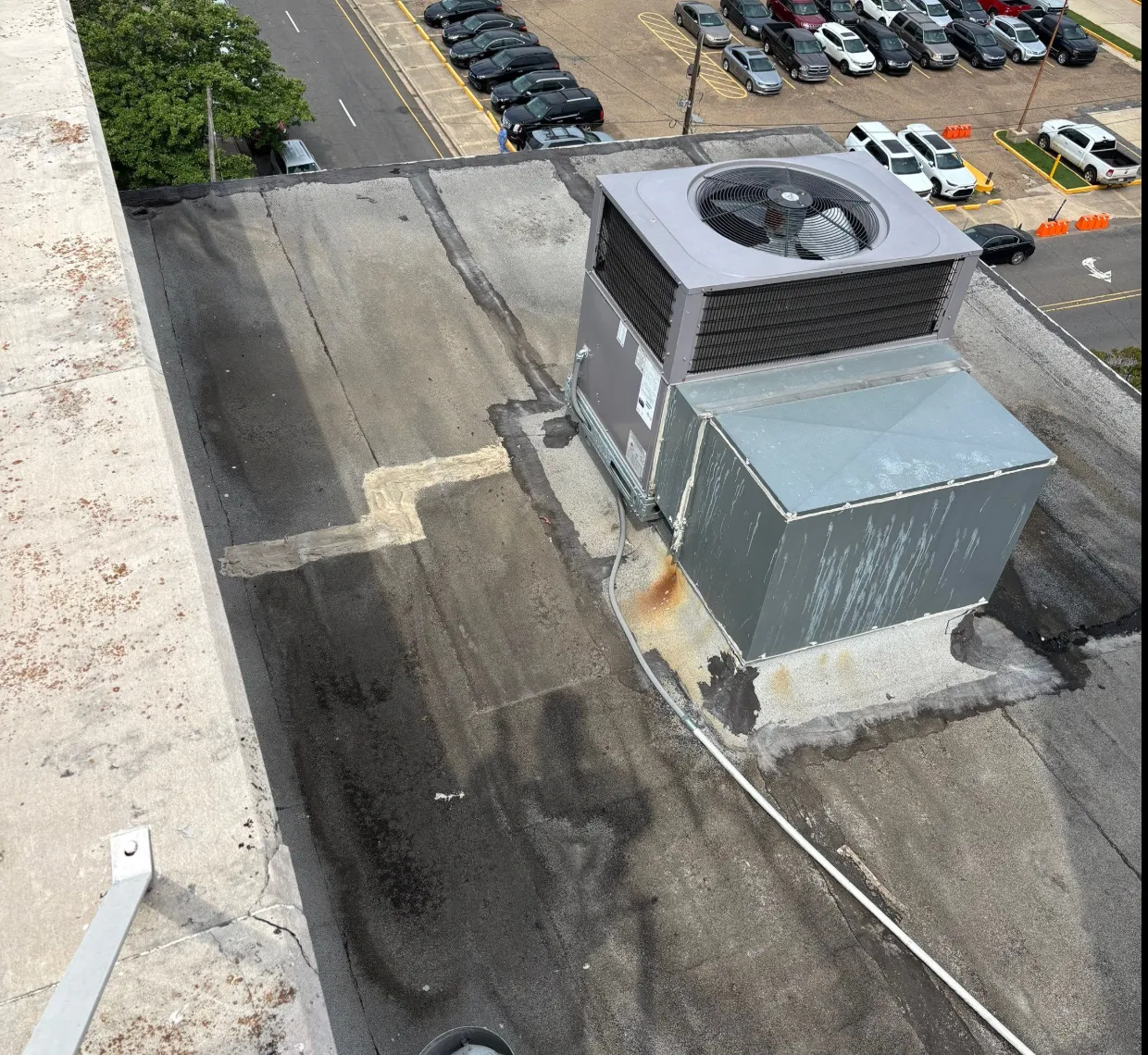 Before: an aged, heat-absorbing membrane with old patchwork around the curb.
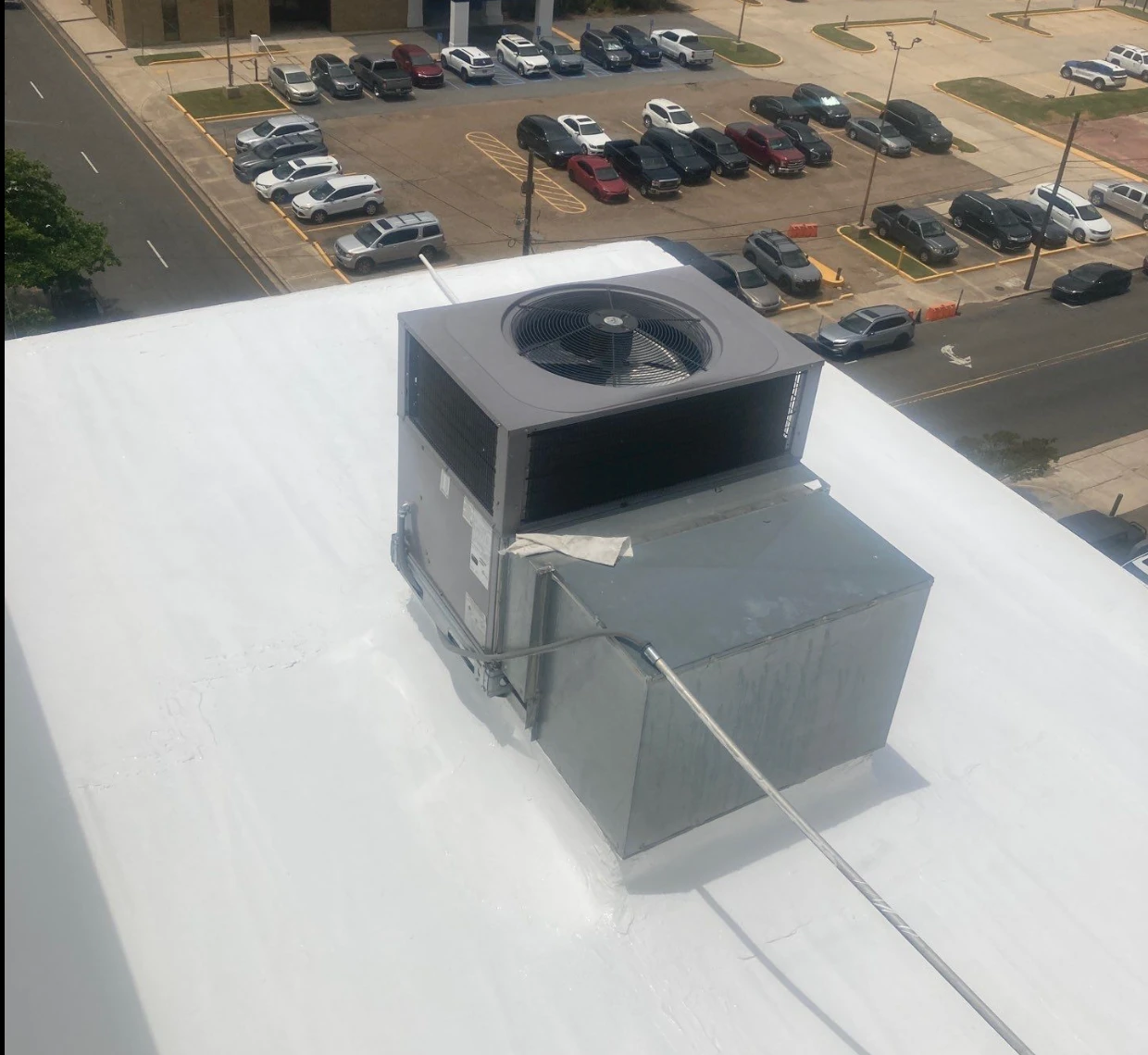 After: the same roof under a bright white reflective coating. Same deck, dramatically less absorbed heat.
Acrylic can actually edge out silicone on long-term reflectivity for a simple reason: silicone tends to get dirty within 6–12 months of application, which dulls its reflectance, while acrylic stays cleaner and holds its bright finish longer. On a big commercial box in Baton Rouge or Shreveport, that reflected heat translates to real load off your HVAC in July and August.
Easy to apply, easy to clean up
Because it's water-based, acrylic is forgiving to work with. It goes down with a brush, roller, or spray, cleans up with water, and has low odor and few solvent-handling headaches — which makes it a straightforward install on an occupied building you can't shut down.
It breathes
Acrylics let trapped moisture vapor escape instead of blistering off. That controlled permeance lets substrate moisture work its way out while still blocking liquid water from getting in. It's by design: water-borne coatings are inherently "breathers," with a water-vapor permeance above 1.0. Ironically, if the film had an extremely low permeance, it would act as a vapor retarder and probably never fully cure. On an aged, slightly damp substrate, that breathability is a feature, not a flaw.
UV resistance and an easy recoat at end of life
When an acrylic finally wears thin, you don't tear it off — you wash it and add another coat. Acrylics clean, spot-repair, and recoat easily, which keeps long-term maintenance simple and affordable. That renewable lifecycle is one of the genuinely best things about the chemistry, and it's what keeps the long-run cost down.
The Cons of Acrylic Roof Coatings
Ponding water is the deal-breaker
This is the one that matters most in Louisiana. Acrylic is water-based, and if water sits on it long enough, the cured film starts turning back into liquid. Read the fine print on a bucket of standard acrylic elastomeric coating and you'll usually find an exclusion for ponding water — because a water-based film can re-emulsify. When water stands on it for extended periods, which is common on flat roofs, it breaks the coating down, turning it back into a liquid or causing it to bubble and delaminate.
How long is "long enough"? The industry uses a 48-hour rule. Standing water for more than 48 hours over an acrylic coating will eventually cause the system to fail. It won't happen overnight, but a full system failure is likely within a couple of years. And those ponding exclusions in the warranty aren't accidental — many acrylic warranties spell them out precisely because the manufacturer knows the product can't handle it.
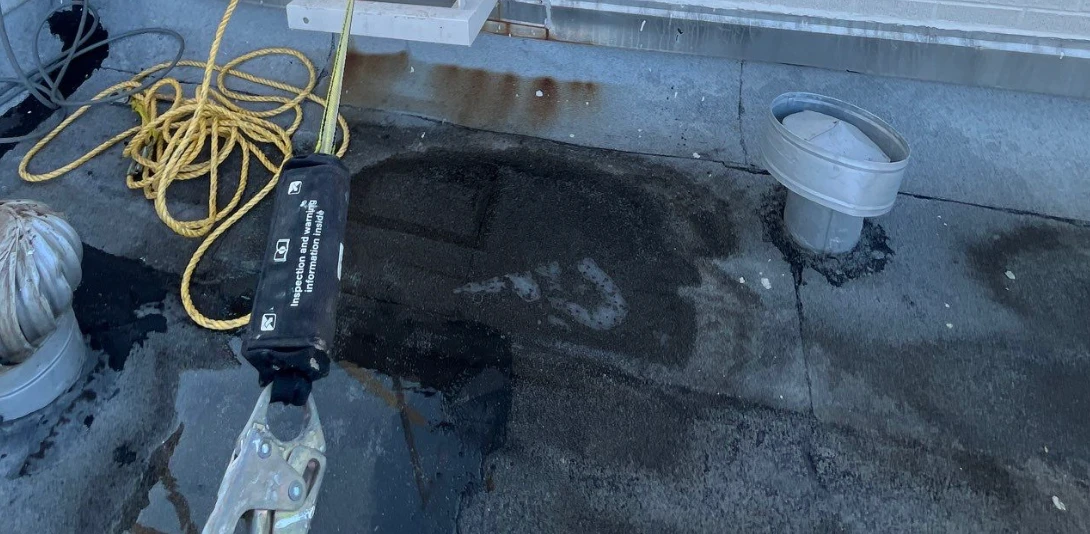 The tell-tale dark ring: water sat here long enough to stain the membrane. That's the exact condition acrylic can't survive.
If you've ever seen a coated roof after a rain and noticed what looks like milky runoff, that's the failure mode in action: acrylic can lose a few thousandths of an inch of thickness a year, and on a ponding roof you may see it dissolving into pools of what looks like watered-down skim milk. A sloped metal roof mitigates that risk almost entirely, but a flat roof prone to ponding is the wrong candidate for acrylic in the long run.
If you're already fighting puddles, read Why Is Water Pooling on Your Flat Roof? before you spend a dime on any coating.
It thins out over time and needs recoating
Acrylics wear by design. As UV breaks the film down, you get chalking — a powdery white residue on the surface after several years. That chalking actually helps maintain reflectivity by exposing a fresh white surface, but it also means the coating gradually wears away. That's not a defect; it's the trade for the low price. You just have to plan for a maintenance recoat instead of treating it as set-it-and-forget-it.
It won't fix a failing roof
A coating is a restoration tool, not a rebuild. It restores a sound roof; it does not resurrect a failing one. The substrate has to be structurally sound, the seams and flashings repaired, and the deck dry before any acrylic goes down. Skip the prep and you're just painting over a problem — and a coating installed over a wet or failing assembly can fail prematurely, leaving you with a roof that has to be torn off and replaced, plus water damage underneath.
Cure sensitivity in our humid stretches
Acrylic needs dry, warm-enough weather to cure. The water has to evaporate out of the film before the next rain hits it, and in a Louisiana summer an afternoon thunderstorm rolling in before the coating flashes off can ruin a fresh application. Acrylics typically run 50–60% solids, so lower-solids products need more coats to reach the same dry thickness as silicone, and each coat has to dry completely before the next goes on. Cold and constant moisture hurt it too — freezing temperatures and standing damp shorten its lifespan and degrade performance over time. Timing the job to the weather is part of doing it right down here.
Acrylic vs. Silicone: Which Handles Ponding Water?
Short version: if your roof holds water, go silicone. Silicone polymers are inherently hydrophobic — water doesn't make them swell, soften, or degrade — so a silicone coating shrugs off standing water indefinitely, right where acrylic re-emulsifies. Silicone also wins on UV performance over the long haul.
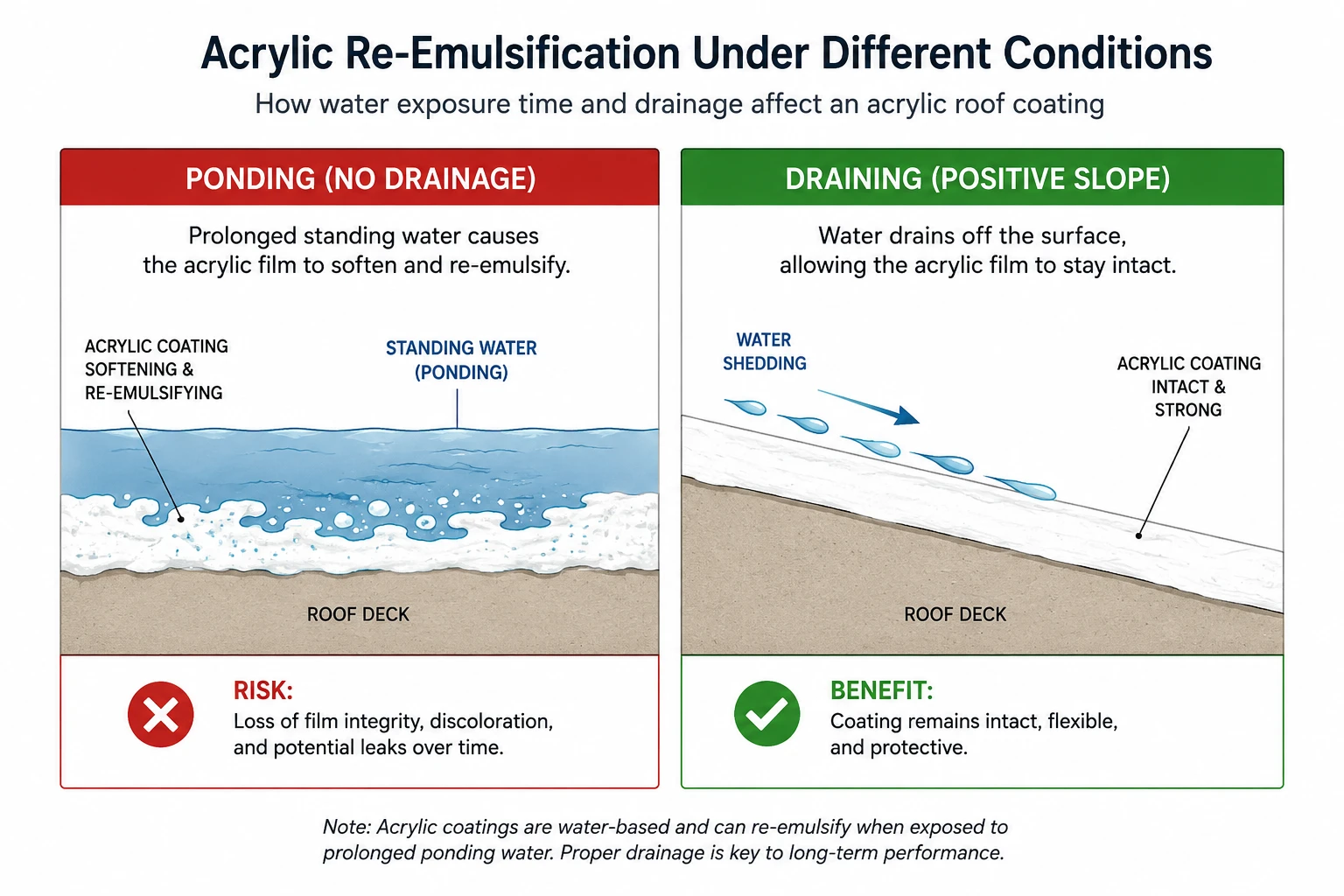 Same coating, two roofs. Drainage is the variable that decides whether acrylic lasts a decade or fails in two years.
It isn't a clean sweep, though. Out of the gate, reflectance is close: both chemistries land around 80–90% thermal reflectance, so they perform similarly on day one. Where acrylic pulls ahead is cost and the recoat path — and that recoat path is bigger than most building owners hear about until it's too late. Silicone locks you in. Neither acrylic nor polyurethane reliably adheres to cured silicone, and acrylic over silicone is one of the most common recoat failures in the industry. Once a roof is silicone, every future recoat is silicone unless you strip it back to the substrate. Acrylic keeps your future options open and cheaper.
Bottom line: for roofs prone to ponding water, silicone is clearly the better option, while acrylic works well where runoff is efficient and standing water is rare. We break the whole comparison down in Acrylic vs. Silicone Roof Coating: Which Is Best for Louisiana Roofs.
Is an Acrylic Coating Right for Your Building?
Here's how we sort it on a walk-through. Acrylic is a strong choice when the roof drains, the budget is tight, you want the cool-roof reflectivity, and the substrate is sound. It's the wrong choice when you've got chronic ponding, drainage problems you're not going to fix, or a roof that's genuinely at the end of its structural life. Before you spec acrylic, answer one question: does this roof drain? On a roof with positive drainage, acrylic is a strong, cheap, reflective coating. On a roof that ponds, it's the wrong product — and no amount of extra mils fixes that.
That's also why we don't quote a coating off a phone call. A real assessment tells us whether the deck is dry, whether the insulation underneath is wet, and whether the roof is even a candidate. The tool for that is a core sample — we cut a small plug through the roof assembly to see what's actually going on inside. If you're curious what that involves, we explain it in What Is a Core Sample in Commercial Roofing? Get that step right and a coating buys you years. Skip it and you're gambling.
Frequently Asked Questions
How long does an acrylic roof coating last?
Figure roughly 10 years on a well-draining roof applied at proper thickness, though it depends heavily on your roof and climate. In practice most acrylic systems last somewhere in the 5–10 year range and may need a maintenance recoat along the way to keep performing. The good news is that recoat is cheap and easy compared to a tear-off.
Can you put acrylic coating on a flat roof with ponding water?
We don't recommend it. Acrylic is water-based and re-emulsifies under standing water — more than 48 hours of ponding will eventually cause the system to fail, most likely within a couple of years. On a roof that ponds, silicone is the better chemistry, or you fix the drainage first.
Is acrylic or silicone better for a Louisiana commercial roof?
It depends on drainage. If the roof drains well, acrylic gives you great reflectivity at a lower price with an easy recoat path. If it ponds — common on flat Louisiana roofs — go silicone, because its superior water resistance holds up where acrylic breaks down.
How thick should an acrylic roof coating be applied?
Thicker than most people think. ASTM D6083 is tested at a 20-dry-mil film thickness, and field studies have found that coatings applied at around 30 dry mils — about the thickness of a credit card — deliver the best performance and longevity. Because acrylics run 50–60% solids, hitting that dry thickness takes more wet material and usually more than one coat.
Can acrylic roof coating be recoated when it wears down?
Yes — this is one of acrylic's best traits. You wash the roof, spot-repair any trouble areas, and roll or spray on a fresh coat, restoring both the waterproofing and the reflective white surface. That easy, affordable recoat cycle is a big part of why the long-run cost stays low.
Does an acrylic coating actually lower energy costs?
It genuinely can, especially in our heat. A high-reflectivity elastomeric acrylic cuts how much solar heat the roof absorbs, which keeps the building cooler, eases the strain on your HVAC, and improves overall energy efficiency. The savings scale with roof size and how hard your AC runs — bigger, cooling-heavy buildings see the most.
Get a Straight Answer From Brown's Roofing
Acrylic is a great product on the right roof and the wrong one on a ponding roof — and the only way to know which you've got is to look. If you're weighing a coating for your commercial building anywhere across Louisiana, Arkansas, or Kansas, we'll come out, check the drainage, and tell you honestly whether acrylic, silicone, or something else makes sense for your roof and your budget. No pressure, no scare tactics — just a practitioner's read on what your roof actually needs. Call us at (318) 329-6579 for a free, no-obligation roof inspection whenever you're ready.