Most buildings make this decision the wrong way.
The roof leaks. Somebody gets a number for a full replacement, the number is large, and the conversation becomes about whether the budget can absorb it this year. If it can't, the answer defaults to patching, and the building patches its way through another two or three years until the decision gets made by a failure instead of by a person.
The problem is that "how bad does it look" and "how much can we spend" are not the inputs that should be driving this. There are four questions that actually determine the right answer, and none of them can be answered from the parking lot.
Here is the framework, and the counterintuitive part first: a roof with wet insulation needs replacement even if the membrane looks fine, and a roof with a sound substrate needs nothing more than restoration even if the surface looks terrible. Most people have that exactly backwards, because the membrane is the part you can see.
You Cannot Make This Call From a Visual Inspection
A walk-over survey tells you where the obvious problems are. It does not tell you what condition the roof system is in, because a commercial roof is an assembly — membrane, insulation, deck — and two of those three are invisible from above.
Three things produce the data:
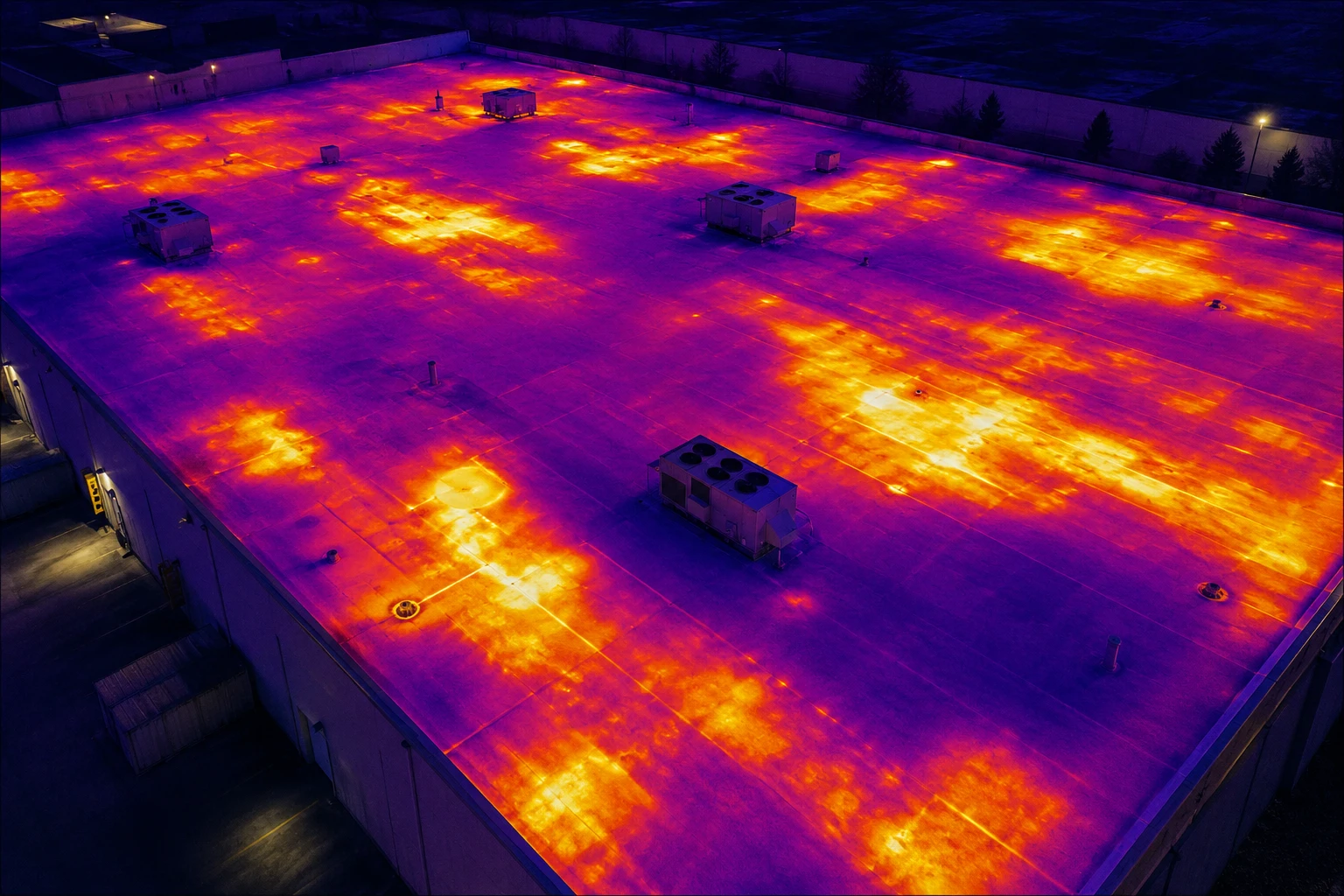
Infrared or thermal scanning. Wet insulation holds heat longer than dry insulation. Scanned at the right time, usually after sunset on a clear evening, saturated areas show up as thermal anomalies. This maps where moisture is and roughly how much of the roof is affected, which is the single most important number in the decision.
Moisture surveys. Capacitance or nuclear meters confirm and quantify what the scan suggests.
Core cuts. This is the definitive test and the one that gets skipped most often. A core cut is a small sample taken through the entire assembly and then properly patched. In about ten minutes it tells you: how many roof systems are already up there, what the membrane actually is and how much of it is left, whether the insulation is dry or saturated, what type and thickness the insulation is, and what condition the deck is in.
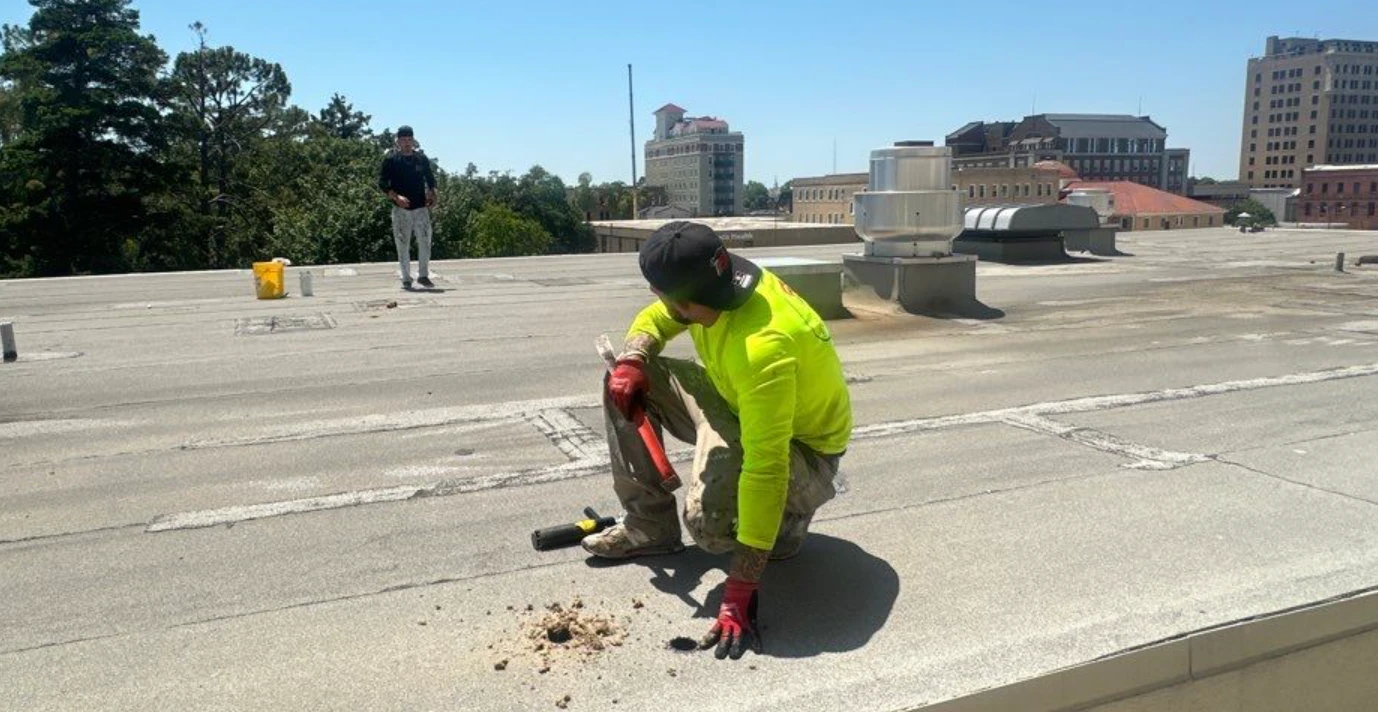
If a contractor is proposing a six-figure replacement and has not taken core cuts, they are guessing, and so are you.
The Four Questions
1. How much of the insulation is wet?
Wet insulation does not dry out. It is sandwiched between a membrane above and a deck below, with nowhere to go. It loses most of its R-value, it adds significant dead load, and it holds moisture directly against the deck, which is how a membrane problem becomes a structural problem.
You also cannot coat over it. Any restoration system applied over saturated insulation seals the water in permanently.
The rough thresholds most commercial roofing professionals work from:
- Under 10 to 15 percent saturated — the wet areas can be cut out and replaced as part of a repair or restoration scope.
- 15 to 25 percent — a judgment call. Depends on whether the wet areas are clustered or scattered, and on how much life the rest of the assembly has.
- Over 25 percent — you are replacing the roof. Spot-replacing that much insulation costs more than a tear-off and leaves you with a patchwork assembly and no clean warranty.
2. How much membrane is left?
Membranes wear from the top down. On TPO and PVC, the top ply sits above a reinforcing scrim. Once weathering has taken you down to that scrim, the material can no longer be reliably heat-welded, which means seams and repairs will not hold. On modified bitumen and built-up roofs, the equivalent question is whether the surfacing and granules are gone and the asphalt below is alligatored and brittle.
Age is a proxy, not an answer. Typical service life runs roughly 20 to 30 years for TPO, EPDM, PVC, and built-up, and 15 to 25 for modified bitumen — but a light-colored membrane on a shaded northern exposure and a dark one baking on a Louisiana or Kansas rooftop will not arrive at the same place in the same year. UV exposure across our markets is aggressive enough that the low end of those ranges is the realistic planning assumption.
3. Is the deck sound?
If steel decking has corroded, if a wood deck has rotted, or if fasteners no longer hold, nothing you do to the surface matters. Deck condition also constrains your options: gypsum and lightweight concrete decks, which show up in a lot of older commercial buildings, generally will not hold mechanical fasteners, which means an adhered system and a different cost structure.
This is the answer that only comes from core cuts.
4. Are the leaks localized or systemic?
Pull the service history. Then look at the pattern.
Localized means leaks cluster around specific details — a curb, a drain, a pipe penetration, a wall flashing, a rooftop unit that was set without proper flashing. Flashings and penetrations fail long before fields do. A roof with three leaks all at HVAC curbs has a flashing problem, not a roof problem.
Systemic means leaks appear in the open field of the roof, in multiple unrelated locations, with no common detail connecting them. That is the membrane telling you it is finished.
The Decision
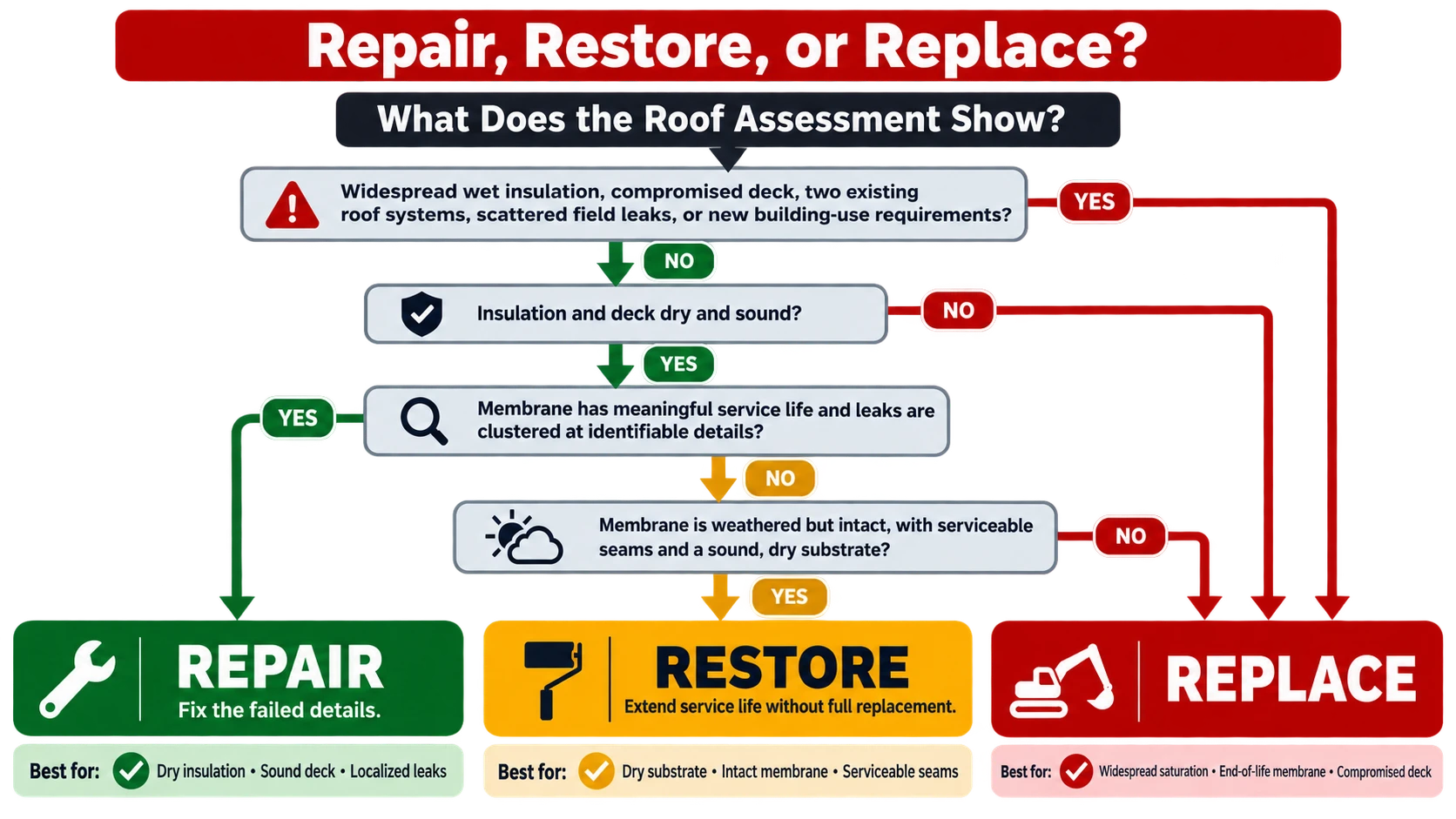
Repair when: the membrane has meaningful life left, the insulation is dry, the deck is sound, and the leaks are clustered at identifiable details. Fix the details — often a modest cost set against a problem that felt like a full replacement.
Restore when: the substrate is sound and dry, the membrane is weathered but intact, seams are still serviceable, and you want to extend service life without a capital replacement.
Replace when: saturation is widespread, the membrane is at end of life, the deck is compromised, there are already two roof systems in place, or leaks are scattered through the field. Also replace when the building's use is changing in a way the current assembly can't support — added rooftop equipment, a tenant with different requirements, a new insulation target.
What Restoration Actually Is, and What It Isn't
Restoration means cleaning and preparing the existing roof, repairing or reinforcing seams and details, replacing any wet insulation, and applying a fluid-applied coating system — usually silicone, acrylic, or polyurethane — over the top.
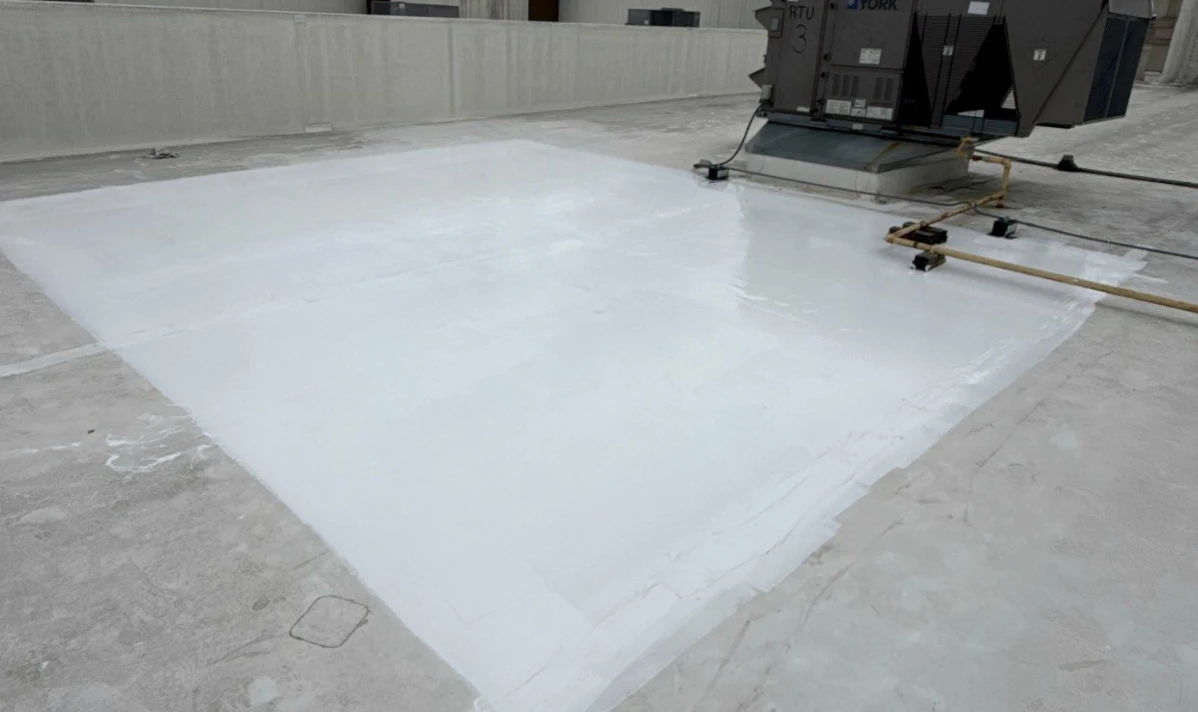
What it genuinely delivers: 10 to 20 years of additional service life, at meaningfully less than a replacement, with no tear-off, no disposal, and no disruption to operations below. Manufacturers offer renewable warranties on qualifying systems. Silicone in particular handles ponding water better than the alternatives, which matters on the low-slope roofs with marginal drainage that are common in this region.
What it is not: a fix for a roof that needs replacing. Coating over a saturated assembly buys eighteen months and makes the eventual tear-off more expensive. Any contractor proposing a coating without having taken moisture readings first is selling a product, not solving a problem.
One thing worth raising with your accountant rather than your roofer: replacement and restoration are frequently treated differently for tax purposes, since one is typically a capital improvement and the other may qualify as maintenance. Depending on how your entity is structured, that difference can be large enough to change which option is actually cheaper. We are not qualified to advise on it, but it is a question worth asking before you decide.
Two Code Realities That Catch People
The two-layer limit. Building codes generally cap a building at two roof systems. If two are already up there, a re-cover is off the table and you are looking at a full tear-off. Core cuts tell you where you stand.
Energy code triggers. Re-covering or replacing a roof frequently triggers current energy code insulation requirements, which on an older building can mean adding insulation thickness you had not budgeted for. This affects parapet heights, edge details, curb heights, and door thresholds. It should appear in a bid, not in a change order.
What to Ask Anyone Bidding This Work
- Did you take core cuts, how many, and can I see the photos and what each one showed?
- What percentage of the roof area is saturated, and how was that measured?
- How many roof systems are currently on this building?
- What is the deck type and condition?
- If you are proposing restoration, what specifically disqualifies replacement — and vice versa?
- What warranty is being offered, is it manufacturer-backed or contractor-backed, and what does it exclude?
- Will this trigger energy code insulation requirements, and is that in the number?
A contractor who can answer all seven has done the work. One who cannot is quoting a square-foot price against a roof they have not actually evaluated.
How We Approach It
Brown's Roofing performs commercial roof assessments across Monroe, Shreveport, Baton Rouge, Lafayette, Little Rock, and Wichita. An assessment includes a full survey, moisture evaluation, core cuts with documentation, and a written report with the condition data and the options it supports — including the option to do nothing yet, when that is the correct answer.
The report is yours regardless of who does the work. Call (318) 329-6579 to schedule a commercial roof assessment.