
After the adjuster inspects your storm-damaged roof, your insurance company sends a document called a scope — sometimes called an estimate. It lists every item they agreed to pay for and how much, and it quietly answers the three questions that matter most: what you get paid now, what you get paid later, and what you won't get paid at all. Most homeowners skim to the bottom number and stop. This guide walks through a scope page by page, using real roof-claim scopes with personal details and insurer names removed.
The Five Parts of Every Insurance Scope
Every insurance company formats its scope a little differently, but nearly all of them contain the same five parts:
- Intro page — your claim number, deductible, adjuster contacts, and the insurer's notes.
- Roof — every roof item they approved, line by line.
- Elevations — the walls of your home: gutters, siding, windows, shutters.
- Other items and subtotal — fences, AC units, and other items beyond the roof and walls, plus the running total.
- Summary — the totals: what's paid now and what's held back until the work is done.
Once you know where those five parts are, a 20-page scope stops looking like a wall of numbers.
Insurance Scope Terms in Plain English
You'll see the same handful of terms on every scope. Here's what they actually mean:
| Term | What it means |
|---|---|
| RCV — Replacement Cost Value | The full cost to replace what was approved. |
| Depreciation | Value taken off for the age and wear of what was damaged. |
| Recoverable depreciation (RD) | Depreciation held back now and paid after the work is done. |
| Nonrecoverable depreciation | Depreciation that will not be paid later. |
| ACV — Actual Cash Value | RCV minus depreciation. Usually your first payment. |
| Deductible | Your share of the claim, set by your policy. |
| Coverage A — Dwelling | Your house and anything attached to it. |
| Coverage B — Other Structures | Detached buildings like a garage, shop, or shed. |
| PWI — Paid When Incurred | Costs paid only after the work is done and billed. |
| Supplement | A request to add items the first scope missed. |
| ACV-only policy | A policy that never pays back depreciation — only the ACV. |
The Louisiana Department of Insurance's homeowners insurance guide uses the same definitions: actual cash value is replacement cost minus depreciation, and replacement cost policies generally require you to actually make the repair to collect the full amount.
Part 1: The Intro Page — Who, What, and When
The first page is your claim's ID card. Find these six things and keep them handy:
- Claim number — use it every time you call your insurance company.
- Date of loss and type of claim — wind, hail, or both.
- Your deductible — your share of the claim.
- Adjuster and estimator contacts — the people who wrote the scope.
- Dates — when the claim was assigned, inspected, and estimated.
- Policy information — including your policy type.
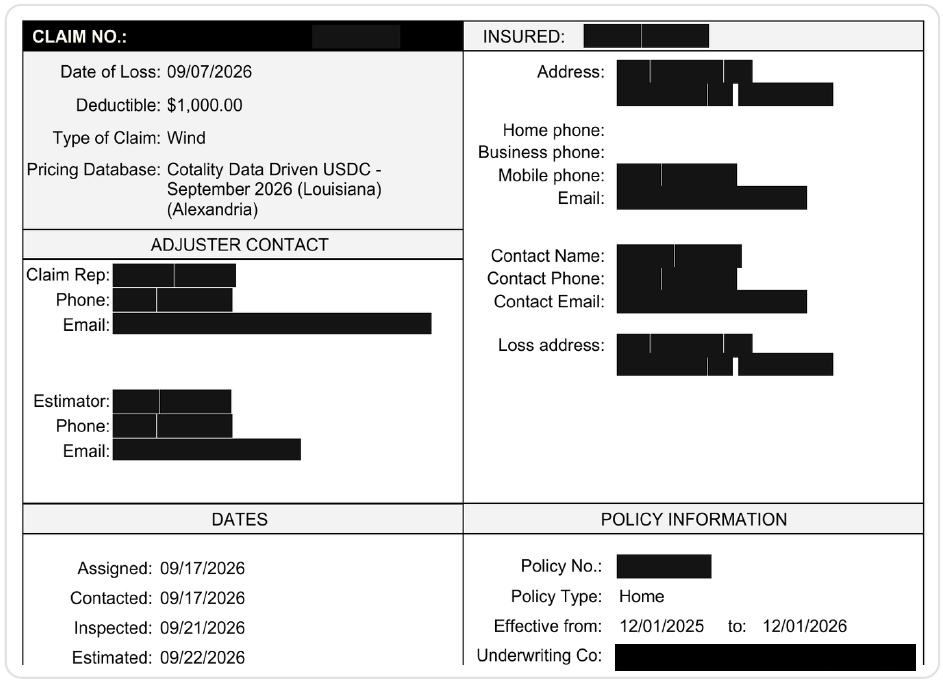
Above: the intro page from a real Louisiana wind claim. Personal information and the insurer's name are blacked out.
Check your deductible here, too. Many Louisiana policies carry a separate named-storm, hurricane, or wind/hail deductible calculated as a percentage of the home's insured value rather than a flat dollar amount — so the number on this page may be larger than you expect.
Read the insurer's closing notes
Every scope also includes the insurance company's own notes, usually at the start or end. The wording varies, but they typically tell you how the estimate was figured (replacement cost, less your deductible and depreciation), whether depreciation may be paid back, that your mortgage company may be named on the check, that scope changes must be approved first, and whether there's a deadline to finish repairs. Read them. That deadline matters later.
Part 2: The Roof — How to Read One Line
Each numbered line is one item the insurance company approved. Read it left to right: description, quantity, unit price, tax, RCV, depreciation, and ACV. The box at the top of the roof section shows your roof's measurements — total area, squares, eaves, and ridge length — which drive every quantity below it.
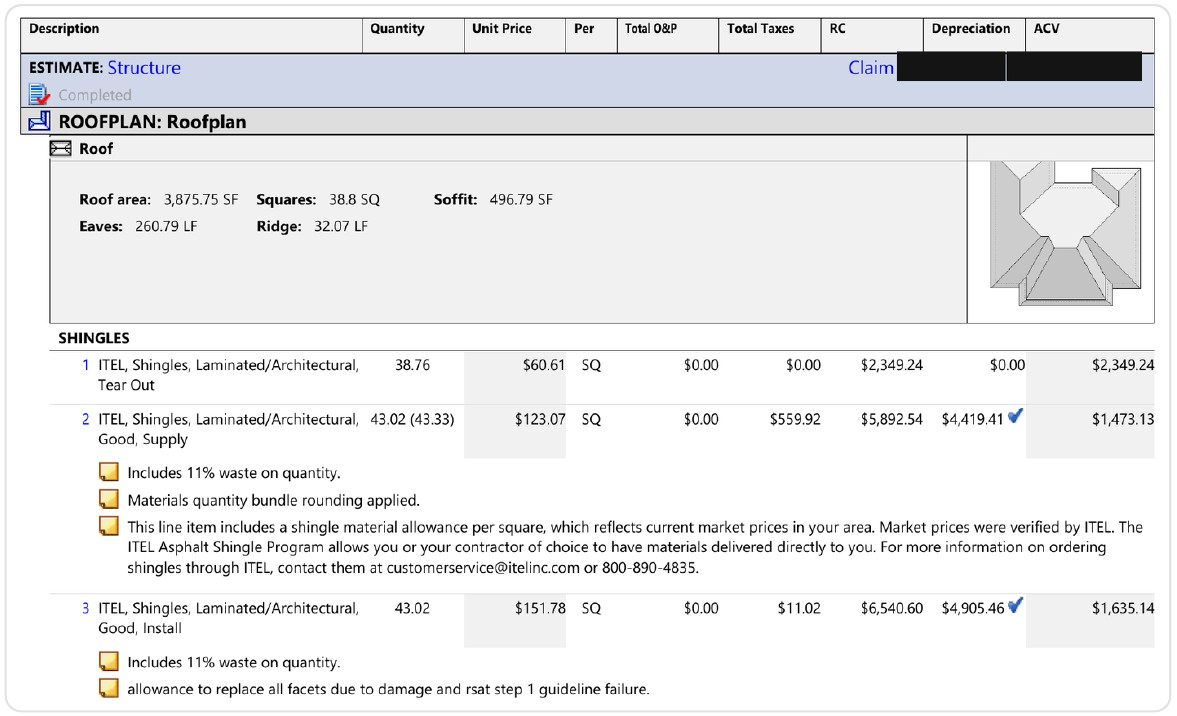
Above: the roof section of a real scope. The measurement box at top drives every quantity below it.
On line 3 of this scope (shingle installation), the RCV is $6,540.60. The insurer took $4,905.46 off for depreciation, leaving an ACV of $1,635.14. That gap is normal — the question is whether you get it back, which we'll cover in Part 5.
Don't skip the small notes under each line. They explain things like the waste factor added to the quantity (11% on this scope) or why an item was approved. Here, a note confirms the allowance is to replace all facets of the roof — which tells you the insurer approved a full replacement, not a patch.
Part 3: Elevations — The Walls of Your Home
"Elevation" means one side of your house: front, left, rear, or right. These pages list approved items on the walls, such as gutters and downspouts, gutter guards, siding, windows, shutters, fascia, soffit, and garage doors.
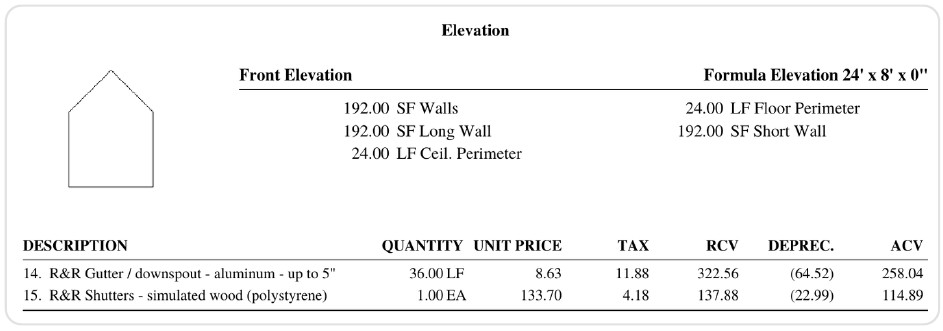
Above: a front elevation listing gutters, downspouts, and shutters.
If your gutters took hail damage and they're not listed on any elevation, that's a conversation to have before work starts.
Part 4: Other Items and Coverage A vs. Coverage B
Some scopes include fences, pool liners, AC units, or personal property. Not every roofing contractor does that work, so ask up front which items your contractor will handle and which ones you'll need someone else for. Each section ends with a subtotal, and the scope ends with one overall subtotal.
While you're here, look for Coverage A (the house and anything attached) and Coverage B (detached buildings like a shop or shed). If Coverage B isn't listed, nothing detached was paid on this scope.
Part 5: The Summary Page — What's Paid Now and What's Paid Later
This is the page that tells you how the money actually moves.
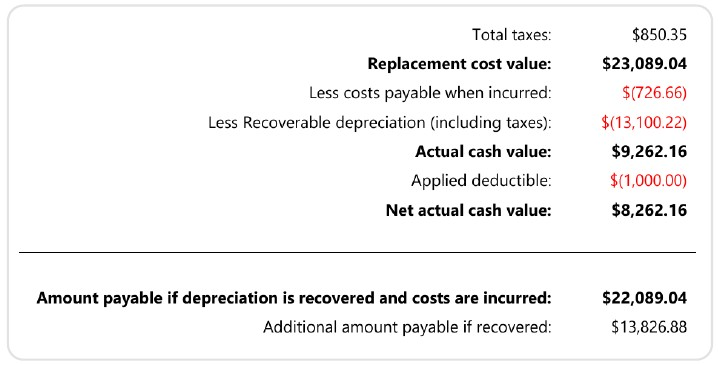
Above: the summary page from the same Louisiana wind claim.
Here's how this one breaks down:
| Line | Amount |
|---|---|
| Replacement Cost Value | $23,089.04 |
| − Paid When Incurred (debris removal) | $726.66 |
| − Recoverable depreciation | $13,100.22 |
| = Actual Cash Value | $9,262.16 |
| − Deductible | $1,000.00 |
| = Net ACV (first payment) | $8,262.16 |
On this claim, the $13,100.22 in recoverable depreciation and the $726.66 paid-when-incurred item are held back. They get released after the work is done and billed — more than half the claim, waiting on proof of completion.
Watch For This: Nonrecoverable Depreciation
Not all depreciation comes back. On many scopes, the symbols around the depreciation amount tell you which is which:
- ( 918.67 ) — parentheses: recoverable. It can be paid after the work is done.
- < 3,708.63 > — angle brackets: nonrecoverable. It will not be paid later.
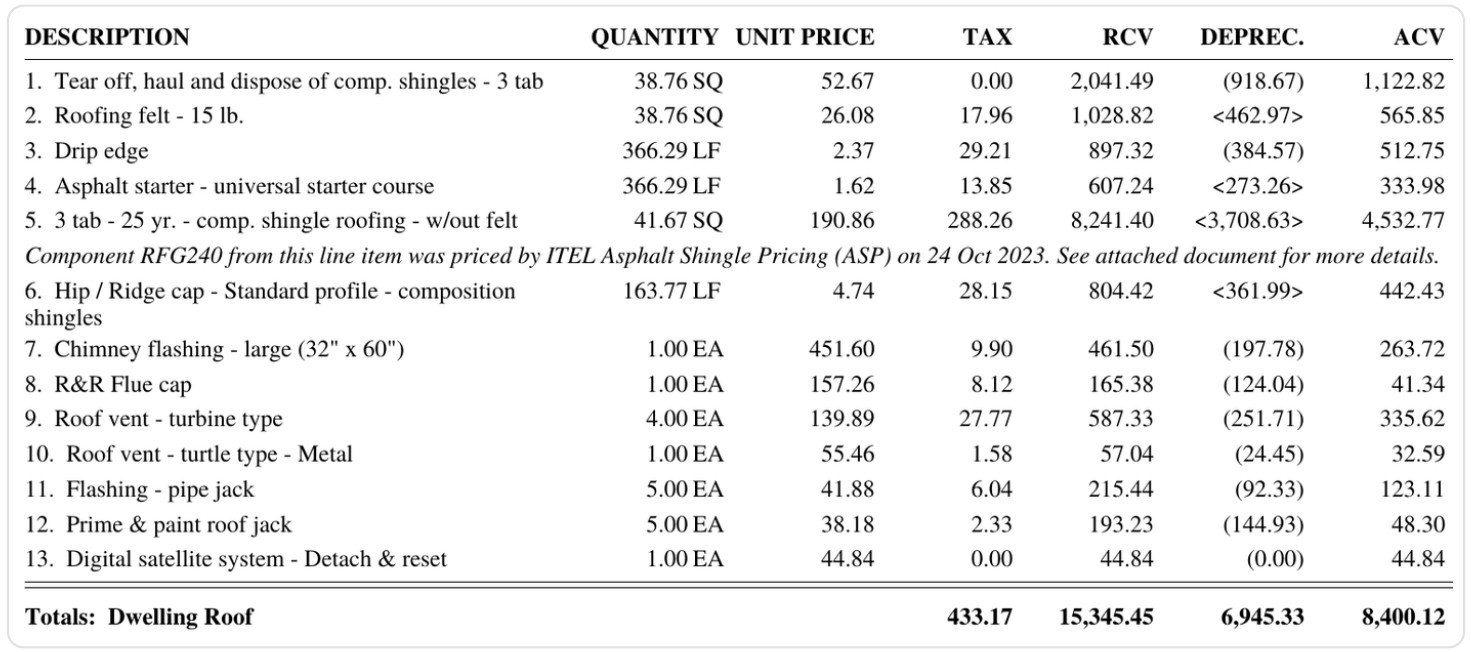
Above: a different claim. Felt, starter, shingles, and ridge cap show depreciation in angle brackets.
Add up the angle-bracket amounts on this scope — 462.97 + 273.26 + 3,708.63 + 361.99 — and you get $4,806.85. That matches the "Less Non-Recoverable Depreciation" line on its summary page. On this claim, $4,806.85 is not coming back, no matter when the work gets done.
On an ACV-only policy, none of the depreciation is paid back. Know which policy you have before work starts.
How to Collect Your Recoverable Depreciation
Getting the held-back money is a straightforward sequence:
- Complete the work. The insurer won't release recoverable depreciation until the repair or replacement is done.
- Send the final invoice. Send your contractor's final invoice to your insurance company as proof of completion, including any approved supplements.
- Receive the release. The insurer releases the recoverable depreciation and any paid-when-incurred items.
- Endorse the check. If your mortgage company is named on the check, everyone named must sign it.
Watch the clock. One sample scope we reviewed gave 180 days to finish repairs, and the Arkansas Insurance Department's post-storm guidance notes that replacement cost policies may require work to be completed within six months of the date of loss to collect withheld payments. Check your own closing notes for the exact deadline.
What This Means for You
Your deductible is yours to pay. The insurer subtracts it from your payment, so the insurance money doesn't cover it — you pay it to your contractor. Be cautious of anyone who offers to "waive" or "cover" your deductible. Arkansas regulators specifically warn homeowners to avoid contractors who make that offer. We cover the honest way to work a claim in what to do when hail hits your roof.
The final invoice is proof, not paperwork. At Brown's, the invoice to your insurance company and your invoice are the same number. We only invoice for work we do — no inflated scopes, no Assignment of Benefits.
Use a licensed and insured contractor. Licensed means the contractor meets your state's requirements to do the work. Insured means that if a worker is hurt or your property is damaged during the job, the contractor's insurance responds — not yours. Ask for proof of both before work starts.
Frequently Asked Questions
What is an insurance scope for a roof claim?
A scope is the insurance company's itemized list of what it will pay for on your claim — every roof, wall, and other item it approved, with quantities, prices, depreciation, and totals. It's sometimes called an estimate.
What's the difference between RCV and ACV?
RCV (replacement cost value) is the full cost to replace what was approved. ACV (actual cash value) is RCV minus depreciation, and it's usually your first payment. On a replacement cost policy, recoverable depreciation closes the gap after the work is done.
How do I know if depreciation is recoverable?
Check the symbols on the scope. On many scopes, depreciation in parentheses is recoverable and depreciation in angle brackets is nonrecoverable. The summary page also lists total recoverable and nonrecoverable depreciation separately — the line items should add up to match.
When do I get my recoverable depreciation?
After the work is complete and your contractor sends the final invoice to your insurance company. The insurer then releases the recoverable depreciation and any paid-when-incurred items. Check your scope's closing notes for a completion deadline.
Why is my mortgage company on the insurance check?
If your mortgage company is listed as a payee on your policy, it's named on claim checks for covered repairs. Everyone named has to endorse the check, so contact your lender early to learn its process.
What is a supplement on an insurance claim?
A supplement is a request to add items the original scope missed — damage found during tear-off, code-required components, or measurements that came up short. Approved supplements show up on the final invoice.
Got Storm Damage? Start With a Free Inspection.
Your scope is between you and your insurance company — questions about your coverage or payments belong with your insurer or agent, and disputes belong with a licensed public adjuster or attorney. What we do is the roof. A Brown's project manager will document the damage slope by slope, walk you through the repair work the job involves, and attend your adjuster's inspection at no cost to point out the documented damage. With local crews in Monroe, Shreveport, Baton Rouge, Lafayette, Little Rock, and Wichita, we're here before the storm and long after the repair. Call (318) 329-6579 for a free roof inspection with same-day response.