The Louisiana Fortify Homes Program (LFHP) opens its next grant lottery at 8 a.m. on Monday, June 1, 2026, with registration running through 5 p.m. on Friday, June 19. This round offers 3,000 grants of up to $10,000 each to help homeowners rebuild their roofs to the FORTIFIED standard — the same wind-resistant construction method that has made Louisiana the fastest-growing state in the country for fortified roofs. If you live in an eligible parish and want a stronger roof and a path toward lower insurance premiums, the steps below explain how the program works, what changed this year, and how to be ready when the window opens.
What the Fortify Homes Program Actually Pays For
LFHP grants are tied to a specific construction standard, not a general roof allowance. The money funds upgrading an existing roof to the FORTIFIED Roof standard developed by the Insurance Institute for Business & Home Safety (IBHS). FORTIFIED is a re-roofing method engineered to keep the roof attached and the water out during hurricane-force winds — the two failures that drive the majority of catastrophic storm losses in the Gulf South.
A FORTIFIED roof differs from a standard re-roof in several measurable ways: a sealed roof deck that acts as a secondary water barrier if shingles blow off, ring-shank nails installed on a tighter schedule to resist uplift, and edge detailing engineered for high wind. The grant covers up to $10,000 toward bringing your roof to that standard. It does not cover the full cost of every project, and it is not a blank check for any roof work you want done.
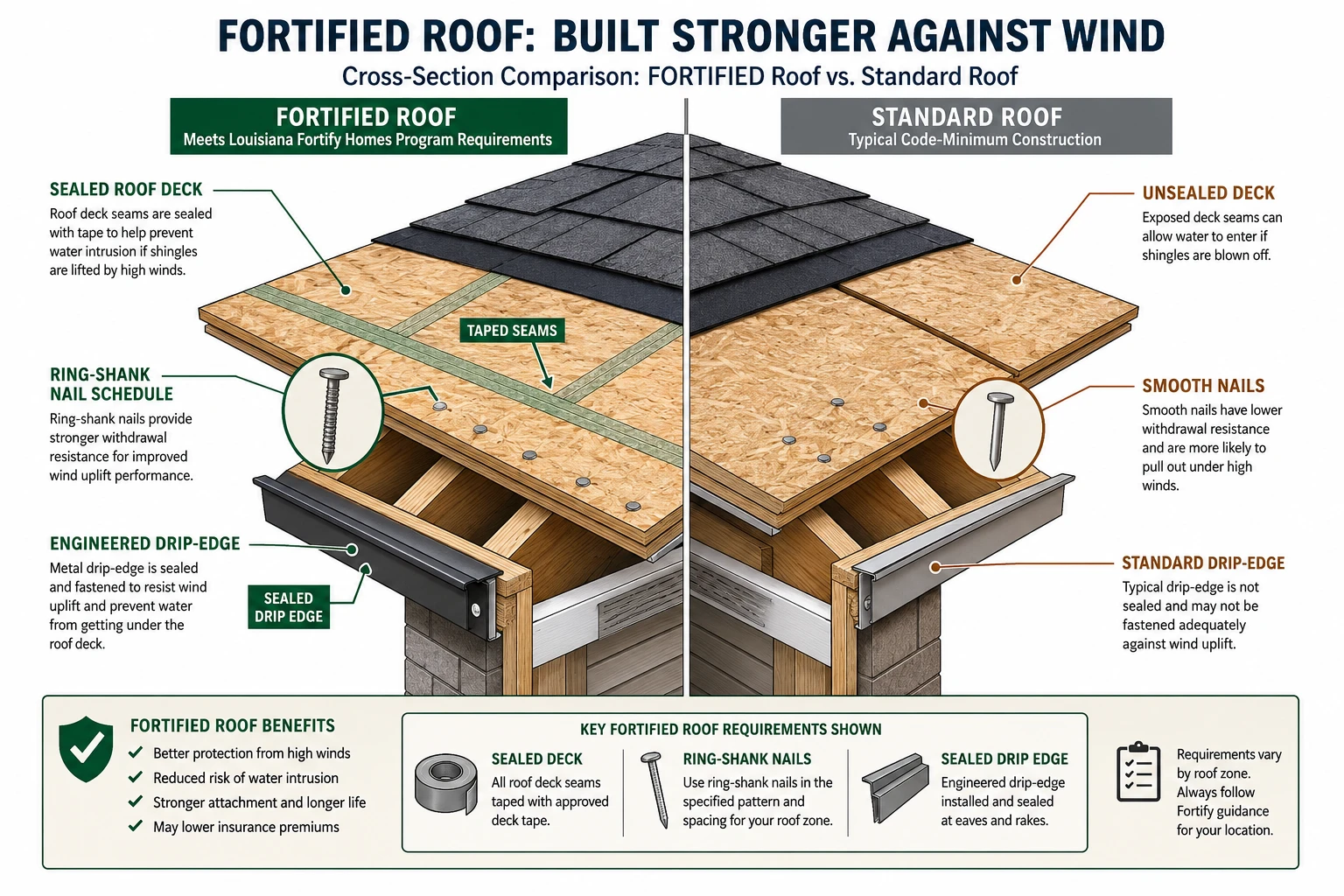
Above: how a FORTIFIED roof differs from a standard re-roof — sealed deck, ring-shank nailing, and engineered drip-edge are the three changes that drive the wind performance.
Brown's Roofing is an IBHS FORTIFIED Certified Contractor, which means our crews are trained and credentialed to install roofs to this standard. One clarification that trips up a lot of homeowners: certification and evaluation are two different roles. We install FORTIFIED roofs; the program requires that an independent, third-party FORTIFIED Evaluator inspect and certify the finished work. That separation is built into the standard on purpose, and the evaluation fee is the homeowner's responsibility.
What Changed in 2026
The state added significant funding this cycle. Governor Jeff Landry signed legislation transferring $50 million in additional Katrina and Rita bond assessment funds into the program; combined with $30 million from taxes and fees on insurance entities, LFHP will receive $80 million this year. That funding boost is why this round can offer 3,000 grants instead of a smaller allotment.
Eligibility also expanded. Acadia, Jefferson Davis, and Lafayette parishes are now included for the first time, and homeowners in previously excluded portions of Ascension, Calcasieu, Iberia, Livingston, St. Martin, St. Tammany, Tangipahoa, and Vermilion parishes are now eligible. For homeowners in and around Lafayette, this is the first cycle in which the program is open to them — worth noting if you've been watching it from the sidelines. The full, current parish map lives on the program's official site at FortifyHomes.La.Gov, and you should confirm your address against it before registering.
How the Lottery Works
Demand for these grants consistently exceeds available funding, so the state uses a random lottery rather than first-come, first-served. A few realities follow from that design:
- Registering early does not improve your odds. Someone who registers on June 19 has exactly the same chance as someone who registers on June 1. There's no advantage to racing the clock at 8 a.m.
- A profile is not a lottery entry. You must create a profile in the LFHP system and actively register during the open window. Having an account from a prior round doesn't auto-enter you.
- Previous applicants must re-register. If you registered in an earlier round and weren't selected, you have to register again for this one. Past entries don't roll over.
After registration closes on June 19, the program randomly selects 3,000 participants. Selection notices go out by email beginning Monday, June 22.
How to Prepare Before June 1
You can't control the draw, but you can make sure a slow paperwork hunt doesn't cost you the window. Here's how to get ready.
- Create your LFHP profile now. Visit the program website and click Login to set up a profile. If you created one for a previous round, reuse it. Profile setup is the single best head start because it's the one task you can complete before the window opens.
- Pull your homestead exemption. You'll need to upload proof of your homestead exemption. If you can't locate it, your parish tax assessor's office can provide a copy.
- Locate your insurance declarations page showing wind coverage. The program requires your homeowners policy declarations page that specifically includes wind coverage. Your insurer or agent can send this if you don't have it on hand.
- Add your flood declarations page if you're in a flood zone. If your residence sits in a Special Flood Hazard Area, you'll also need your flood insurance declarations page.
- Save everything as clean PDFs in one folder. Clear, properly named files make the upload fast when the window is open. Don't plan to scan documents the morning registration opens.
- Hold off on starting any roof work. Do not begin a FORTIFIED upgrade before you're approved through the program. Work started ahead of approval can disqualify the project.
The Costs the Grant Doesn't Cover
The $10,000 grant is meaningful, but it's a contribution toward the upgrade, not the whole bill. If you're selected, you remain financially responsible for the independent FORTIFIED Evaluator's fee, permits, inspections, and any construction cost beyond the grant amount. On a typical 1,800–2,400 sq ft Southern home, whether $10,000 covers most of the project or a portion of it depends on roof size, slope, complexity, access, and the material you choose.
Pricing depends on roof size, slope, complexity, access, and material specification — we provide a written estimate after a free on-site inspection. Getting that estimate before you're selected is smart: it tells you what your out-of-pocket share will likely be, so a selection email becomes good news instead of a budgeting scramble. The grant is generally paid directly to your approved FORTIFIED contractor after the final inspection passes, which means you don't front the full grant amount and wait for reimbursement.
Why a FORTIFIED Roof Pays Off Beyond the Grant
The grant is the entry point, but the longer-term value is in what a FORTIFIED roof does to your insurance and your risk. Louisiana insurers offer premium discounts for FORTIFIED designation, and depending on your carrier and policy, wind-mitigation credits in the 15–30% range are common for qualifying construction. Over the life of the roof, those annual savings stack up alongside the obvious benefit: a roof engineered to stay on the house when a hurricane comes through.
The state's own logic backs this up. As more homes in a given area earn FORTIFIED designation, regional losses fall, and lower losses are what eventually pull property insurance rates down across the market. That's the mechanism behind the program — strengthening individual roofs to reduce the statewide loss picture that drives everyone's premiums.
A FORTIFIED upgrade is also a natural fit with storm-resilient material choices. Whether you re-roof in architectural asphalt shingles or step up to metal roofing for maximum wind performance, the FORTIFIED method applies to the installation either way. The standard is about how the roof is built and attached, not a single product.
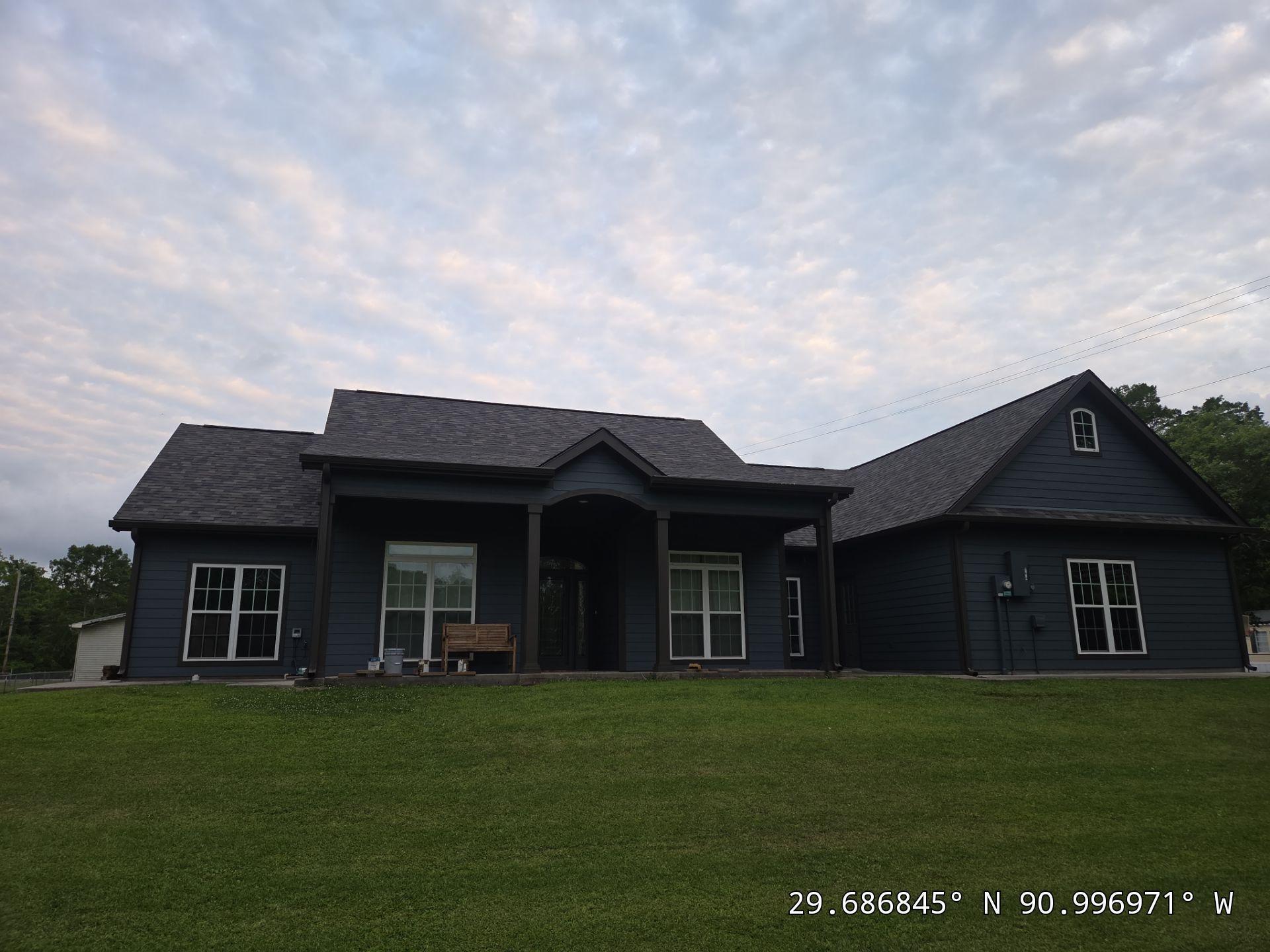
Above: a finished re-roof in South Louisiana — a clean architectural-shingle install on the kind of home the Fortify Homes Program is designed to protect.
Frequently Asked Questions
Do I have to use a specific contractor?
You choose an approved FORTIFIED contractor for the work. Brown's Roofing is an IBHS FORTIFIED Certified Contractor with crews trained to install to the standard. The separate, required FORTIFIED Evaluation is performed by an independent third party — not by your contractor.
Does registering on June 1 give me better odds than June 19?
No. Selection is random across everyone who registers during the window. There's no benefit to registering the moment it opens, as long as you register before it closes on June 19.
I applied last year and wasn't selected. Am I automatically in this round?
No. You must register again during this round's window. Prior entries don't carry over, though you can reuse your existing profile login.
What if I'm not in an eligible parish?
The program covers a defined list of coastal-zone parishes that expanded in 2026. Confirm your address on the official map at FortifyHomes.La.Gov before registering. Even outside the program, a FORTIFIED roof can still earn insurance discounts — it's the grant funding, not the construction standard, that's geographically limited.
Is the Mississippi or Alabama program the same?
No. LFHP is a Louisiana program administered through the Louisiana Department of Insurance. Strengthen Alabama Homes and Strengthen Mississippi Homes are separate state programs with their own rules and windows.
Get Your Roof Assessed Before the Window Opens
The homeowners who do best in this program are the ones who walk in prepared: profile created, documents saved, and a clear understanding of their roof's condition and what an upgrade will cost. A free, no-obligation inspection from Brown's Roofing gives you that picture before June 1 — so if a selection email lands on June 22, you already know your scope and your out-of-pocket share. We serve homeowners across South Louisiana from permanent offices in Lafayette, Baton Rouge, Monroe, Shreveport, and beyond, with same-day response. Call (318) 329-6579 to schedule a free roof inspection and written estimate.
You can review the official rules, eligibility map, and FAQs directly at the IBHS FORTIFIED program and on FortifyHomes.La.Gov before you register.