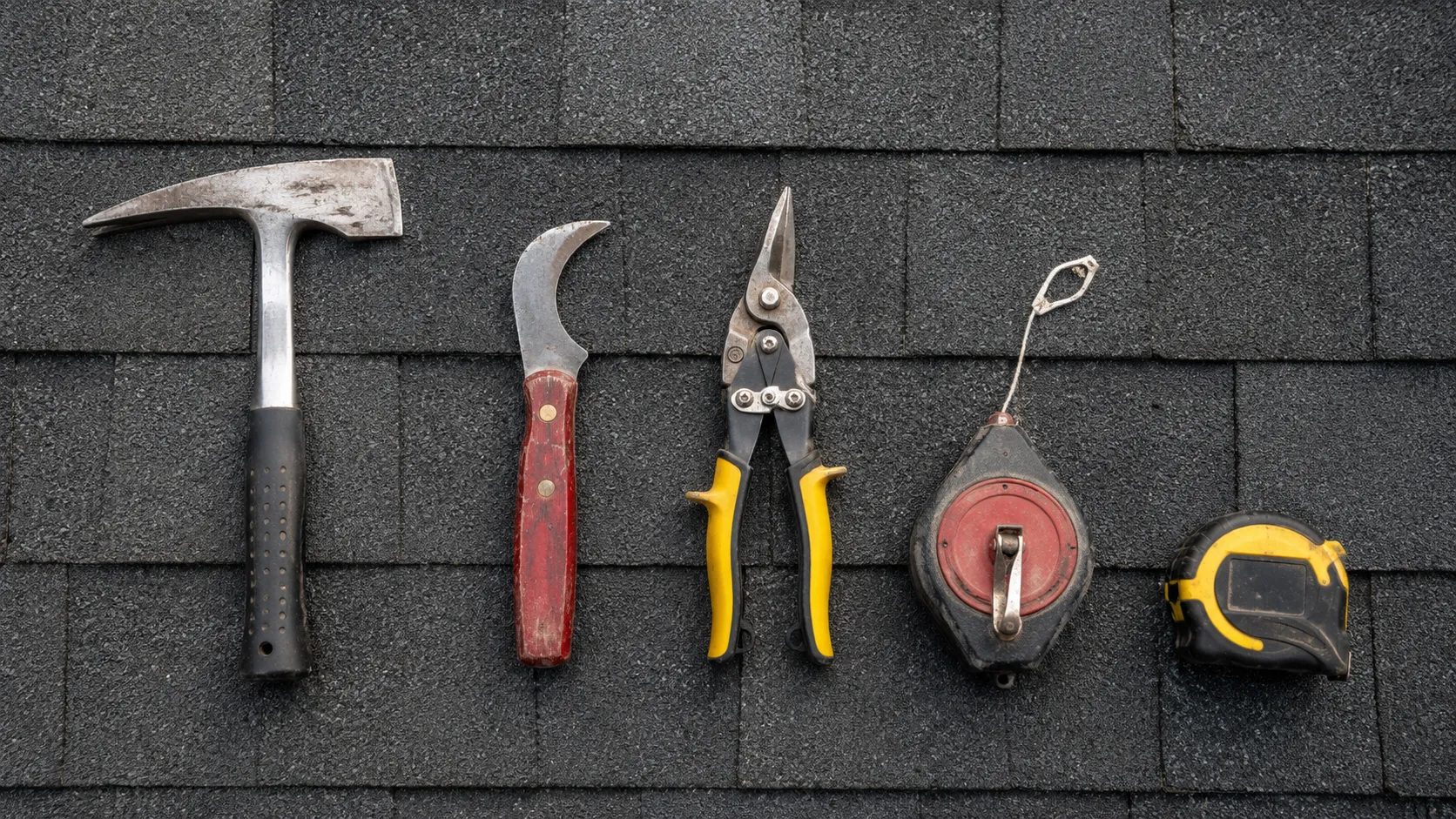
Every working roofer needs a core kit: a roofing hatchet or hammer, a utility knife with hook blades, a chalk line, tin snips, a pry bar and tear-off shovel, a pneumatic coil nailer with a compressor, and — non-negotiable — a harness with proper fall protection and a solid ladder. Everything past that is job-specific.
This isn't a hardware-store dump of every gadget with "roofing" printed on the box. It's what actually rides up the ladder on a real crew, why each piece earns its spot, and where a cheap version costs you more than it saves. We run residential and commercial work across Louisiana, Arkansas, and Kansas, and these are the tools that hold up to Gulf-Coast heat, hail season, and the occasional ice storm.
Hand Tools Every Roofer Carries
Power tools get the attention, but a roofer lives and dies by hand tools. These are the things clipped to your bags all day.
Roofing hatchet (or hammer). A hammer face on one side, a hatchet blade on the other, and usually an adjustable gauge to set shingle exposure. Even in a nail-gun world, a good hatchet earns its keep for detail work, starter courses, and any spot the gun can't reach clean. A magnetic face saves you fumbling nails on a 7/12.
Utility and hook knives. You'll go through blades. Hook blades cut shingles from the back without chewing up the surface below; straight blades handle underlayment, flashing membrane, and trimming. Keep them sharp — a dull blade tears asphalt instead of cutting it, and that's how people slip and open a thumb.
Tin snips — left, right, and straight. For drip edge, valley metal, and step flashing you want all three cuts: red-handled (left), green (right), yellow (straight). Cheap snips flex and leave a ragged edge; good aviation snips cut like scissors through 26-gauge and last years.
Chalk line and tape measure. Straight courses come from a snapped line, not a good eye. Blue or permanent chalk for layout — never red on a finished roof, since it stains and won't wash off. A 25-foot tape covers most residential work; go longer for commercial layout.
Pry bars and a tear-off shovel. Tear-off is brutal on tools. A flat bar pulls trim and stubborn flashing. A dedicated tear-off shovel or roofing fork — the serrated ones with a fulcrum built into the head — pops shingles and nails in one motion and saves your back over a full day.
Hand seamer. If you touch metal roofing, you need one for bending and locking panel edges.
If you're still learning the vocabulary behind half these parts, Basic Roof Terms 101 for Homeowners breaks down drip edge, valleys, and flashing in plain English.
Power Tools That Earn Their Place on the Roof
Pneumatic coil nailer and compressor
A coil nailer and compressor are the backbone of a production shingle crew. One roofer with a well-set gun lays shingles far faster than hand-nailing, and speed matters when an afternoon storm is building on the radar.
The catch is setup, and nail depth is everything. Per the Asphalt Roofing Manufacturers Association's nailing guidance, the entire nail head should bear tightly against the shingle — not underdriven, not overdriven into the mat, not crooked. Overdrive it and you cut the shingle, which hurts wind performance and can cost you the manufacturer's warranty. Underdrive it and the head sits proud, telegraphs through the next course, and keeps the sealant strip from bonding. Depth gets dialed in for the shingle at hand and re-checked as the day heats up, because air pressure and asphalt softness both move.
Cordless drills, impact drivers, and metal tools
For standing seam, exposed-fastener panels, and structural fastening, cordless impact drivers and drills do the work. A cordless nibbler cuts panels clean without the heat discoloration a cut-off wheel leaves behind — and that discoloration can rust later, so it matters. Electric or pneumatic shears handle longer straight runs.
Hoses, cords, and staging
The stuff nobody photographs. Enough air hose to reach the far ridge, cords rated for the run, and a plan for where the compressor sits so nobody trips on a coil of hose twenty feet up. Staging is a tool decision as much as a safety one.
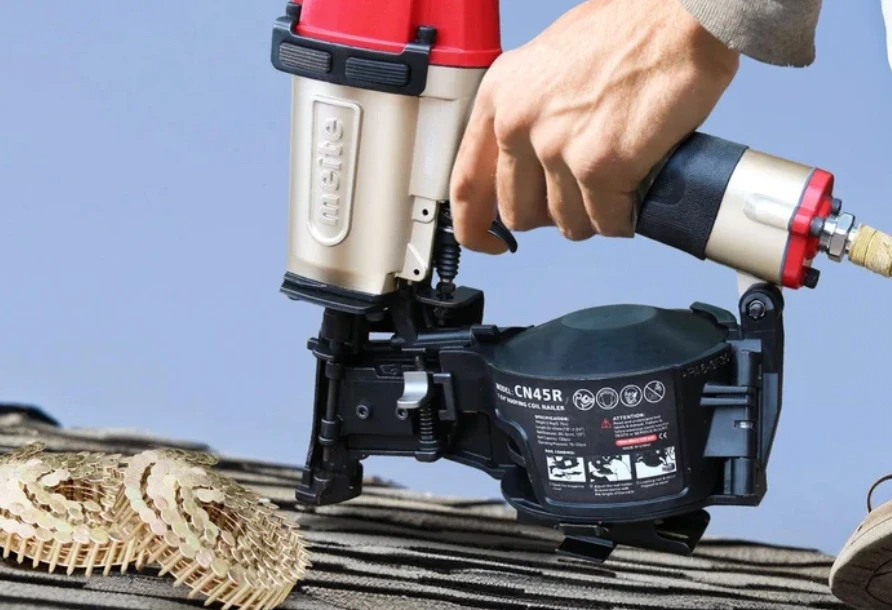 The gun sets the pace of a shingle job — but depth setting is what decides whether the work holds up in wind.
Roofing Safety Equipment You Can't Skip
This is the section we won't soften. Under OSHA's fall protection standard for construction (29 CFR 1926.501), workers on a steep roof with unprotected edges six feet or more above a lower level have to be protected by guardrails with toeboards, safety nets, or a personal fall arrest system. Low-slope roofing work has its own set of options, including warning-line and safety-monitoring combinations. On a real jobsite, it's the difference between a bad day and a funeral.
Personal fall arrest system. A full-body harness, a lanyard, a rope grab, and a properly installed roof anchor. The anchor ties into structure — rafters or trusses, not just decking. The rope grab lets you move while staying tied off. A harness hanging in the truck protects nobody.
Ladders and ladder hooks. A ladder rated for the load, set at roughly a 4:1 angle — one foot out at the base for every four feet of height — footed and secured at the top. Ladder hooks let you work a steep pitch off the ladder itself.
Roof jacks and toe boards. On steep-slope work, jacks with a plank give you a stable platform and a place for materials to sit instead of sliding into the gutter — or off the edge onto whatever's below.
Footwear. Soft-soled roofing boots with real grip. Worn-smooth soles on hot, gritty shingles are an accident waiting to happen.
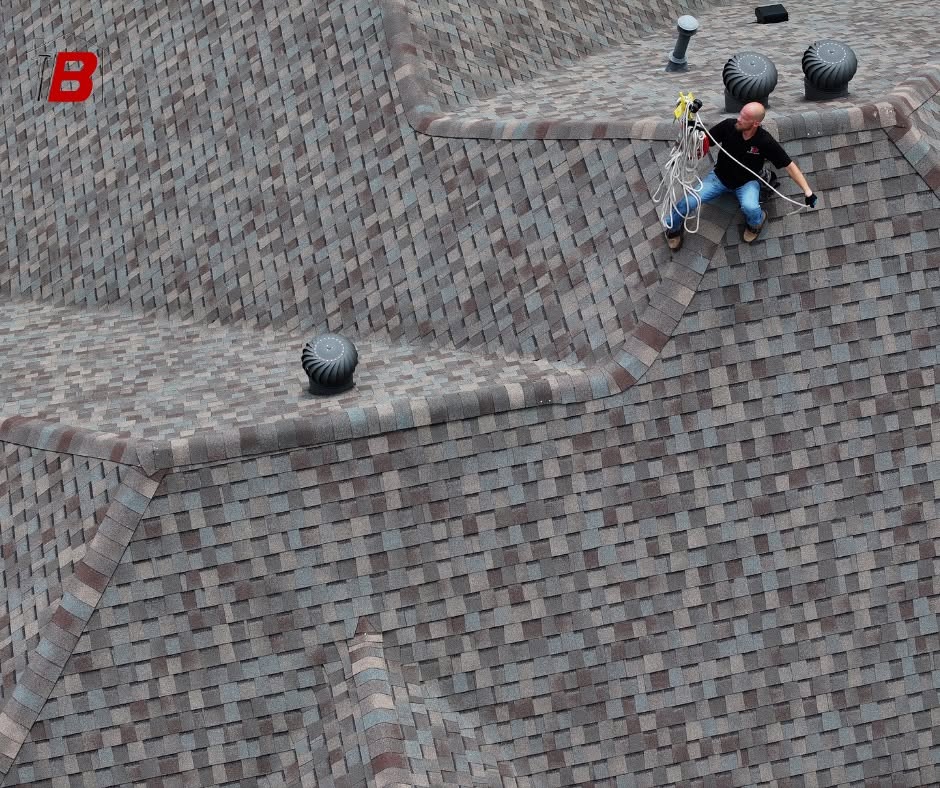 Rope, rope grab, and anchor line go up with the crew. Gear left in the truck protects nobody.
Safety isn't a box we check; it's how we run every crew, and our OSHA 10 and 30 certified crews are part of why. We wrote up the whole approach in Brown's Roofing's commitment to safety, and it's a fair question to ask any contractor before you hire them.
Measuring, Layout, and Diagnostic Tools
Good roofing starts before the first nail.
Pitch and slope finder. Pitch drives material choice, underlayment requirements, and whether the roof can be walked safely at all. A pitch gauge, a smartphone level app, or the old level-and-ruler method all work. We cover every method in Roof Pitch Explained: Common Pitches and How to Measure.
Moisture meters and core sampling. On low-slope commercial work you can't judge a roof by its surface. A moisture meter finds saturated insulation; a core sample tells you what's really in the assembly — how many layers, what kind, and whether water is sitting in there. That process is broken down in What Is a Core Sample in Commercial Roofing?
Thermal imaging and drones. Infrared scans reveal wet insulation you can't see from the surface. Drones let us inspect a steep or storm-damaged roof safely before anyone climbs on it — useful after hail, when the entire point is documenting damage without risking a fall.
Cleanup and Site Protection Tools
Cleanup is part of roofing, not an afterthought. A roofing nail in a driveway or a pasture is a problem waiting to happen — flat tires, injured pets, injured kids.
The kit: a rolling magnetic sweeper (plus a handheld for tight spots), tarps to protect landscaping and siding during tear-off, catch systems or plywood chutes to funnel debris, and a dump trailer or roll-off staged where it won't tear up the yard. We treat the final magnet pass as seriously as the roof itself — the details are in Nail Cleanup: Why Brown's Roofing Sets the Standard. A homeowner remembers whether the yard was left clean long after they've forgotten the shingle color.
What's a Waste of Money: An Honest Take
Not every tool with "roofing" on the label is worth buying.
Bargain snips and utility knives. The wrong place to save. Cheap snips flex and give you ragged flashing; cheap knives break under load.
Gimmick shingle-removal gadgets. A good tear-off fork and a pry bar do the job. The infomercial tools rarely survive one real Louisiana tear-off.
Plastic-bodied tools left in the truck. A closed truck bed in July runs far past 130°F, and cheap plastic gets brittle and cracks. Buy tools built to live in that heat.
Over-featured lasers. For most residential layout, a chalk line and a tape beat a laser you'll drop off a roof by month two.
The rule: spend on the tools your hands touch all day and the gear that keeps you alive. Save on the novelties.
How to Build a Roofing Tool Kit in the Right Order
Stocking a truck from scratch? Buy in this sequence.
- Fall protection first. Harness, lanyard, rope grab, anchors, and a properly rated ladder. Nothing else goes on the truck until this does.
- Core hand tools. Roofing hatchet, hook and straight knives with plenty of blades, aviation snips in all three cuts, chalk line, tape.
- Tear-off gear. Roofing fork or tear-off shovel, flat bar, and a debris plan — chute, trailer, or roll-off.
- Fastening. Coil nailer and a compressor sized for the crew, plus cordless impacts and drills for metal and structural work.
- Layout and diagnostics. Pitch gauge, moisture meter, and a camera or drone for documentation.
- Cleanup. Rolling magnet, handheld magnet, and tarps for landscaping and siding protection.
Tools for Louisiana, Arkansas, and Kansas Conditions
Regional conditions change the kit.
Heat and humidity. Around Monroe, Baton Rouge, and Lafayette, asphalt goes soft in the afternoon, which changes how a nail sets — gun depth gets re-checked more than once a day. Humidity and grit dull and gum up blades fast. Hydration gear counts as a tool when the heat index hits 105.
Storm response. Hail and hurricane country means a rapid-response kit stays ready: tarps, 1×4 battens, cap nails, and enough fasteners to dry a damaged roof in fast before the next round of weather. On our crews, temporary tarping is nail-and-batten — battens nailed through the tarp into the deck, which holds in wind far better than a weighted tarp. Documentation tools matter as much as repair tools when there's a storm damage claim in play.
Cold and ice. In Wichita and north of Little Rock, cold makes shingles brittle, and cutting or bending metal in the cold demands sharp tools and patience so you don't crack a panel. Traction gear earns its keep when frost lingers.
Metal versus shingle by region. The more metal roofing in the mix — common on commercial and rural buildings around Shreveport, across the Ark-La-Tex, and throughout Kansas — the more the kit shifts toward seamers, nibblers, shears, and impact drivers, and away from the coil nailer.
Frequently Asked Questions
What is the most important tool a roofer uses?
Fall protection — a harness and a properly installed anchor system. Nothing else matters if you don't come home. On the production side, the coil nailer sets the pace of a shingle job, but safety gear is the one you never skip.
Do professional roofers hand-nail or use nail guns?
Most production crews use pneumatic coil nailers because they're faster, and speed matters when weather is closing in. Hand-nailing still has its place for detail work, tight spots, and jobs where the spec calls for it. Either way, the nail head has to seat flush — over- or under-driven nails hurt wind performance and can void a warranty.
What safety equipment is required for roofing work?
OSHA's construction standard requires fall protection at six feet or more above a lower level. On steep roofs that means guardrails with toeboards, safety nets, or a personal fall arrest system — harness, lanyard, rope grab, and an anchor tied into structure. Add secured ladders, roof jacks and toe boards on steep pitches, and grippy footwear.
What tools do I need to replace a few shingles myself?
A flat pry bar, a hammer, a utility knife with hook blades, matching replacement shingles, roofing nails, and a dab of sealant. The real requirement is a safe way to work — a solid ladder and honest judgment about the pitch. If the roof is steep or the damage is widespread, it's worth a call before you climb.
What's the difference between a roofing hatchet and a regular hammer?
A roofing hatchet has a hammer face on one end and a hatchet blade on the other for cutting shingles, plus an adjustable gauge to set exposure. A regular hammer only drives nails. The hatchet is purpose-built for laying shingles by hand.
How do roofers measure roof pitch?
Pitch is vertical rise over 12 inches of horizontal run — a 6/12 rises six inches every foot. You can measure it with a level and a ruler, a pitch gauge, or a phone level app.
Ask a Crew What They Carry
The tools tell you a lot about the outfit. A crew that shows up tied off, with sharp blades, a dialed-in nailer, and a magnet in the truck is a crew that takes the rest of the job just as seriously. If you're in Louisiana, Arkansas, or Kansas and want a straight, no-pressure read on your roof's condition, we're glad to come take a look and tell you honestly what it needs — and what it doesn't. Call Brown's Roofing at (318) 329-6579 for a free inspection with same-day response.