Most roof leaks don't start with a big storm. They start with a worn pipe boot, a lifted piece of flashing, or a clogged valley that went unnoticed through a dry summer — and then a run of rainy weeks finds it. With a strong El Niño building, the next three months are the right window to fix what's already wrong, get drainage working, and plan any roof work around the weather instead of against it.
Here's what the current outlook actually says, what it can't tell you, and how we'd prepare a home or commercial building for it.
What Is El Niño, and What Does the Current Outlook Say?
El Niño is a climate pattern marked by unusually warm water in the eastern and central tropical Pacific, along with shifts in atmospheric circulation. Those shifts change where the jet stream steers storms across the United States, which is why a Pacific Ocean pattern matters to a roof in Louisiana or Arkansas.
In its September 10, 2026 ENSO diagnostic discussion, NOAA's Climate Prediction Center reported that El Niño is strengthening, with a greater than 90% chance of a very strong event through fall and winter 2026–27. The same update put a 75% chance on October–December reaching historic strength — stronger than any El Niño in records going back to 1950.
Two things to keep straight about those numbers:
- They describe El Niño's strength, not your roof's odds. A 90% chance of a very strong event is not a 90% chance of damage at your property.
- A stronger event raises the odds of typical El Niño weather — it doesn't guarantee it. NOAA says exactly that in its own discussion.
NOAA's three-month seasonal outlook for October–December favors above-normal precipitation across a broad area that includes much of the Great Plains, the Mississippi and Tennessee valleys, and the Southeast. That footprint covers the Lower Mississippi Valley, where our crews in Monroe, Shreveport, Baton Rouge, Lafayette, and Little Rock work every day. Wichita-area owners should check the map for their specific county — seasonal outlooks are drawn in broad strokes.
This is a seasonal probability forecast. It speaks to total rainfall across three months, not to rain every week or to any individual storm. NOAA updates the ENSO discussion on October 8 and the seasonal outlook on October 15, so the picture can shift. For scheduling actual roof work, local short-range forecasts are what count.
How Could El Niño Affect Your Roof?
El Niño doesn't damage roofing materials. What matters is how a wet stretch interacts with the condition your roof is already in.
Repeated Rain Exposes Existing Weak Points
A roof can look fine through dry weather and still have a failing connection. Rain that comes back day after day gives water more chances to find it. These are the spots we check first:
- Flashing at chimneys, sidewalls, and skylights
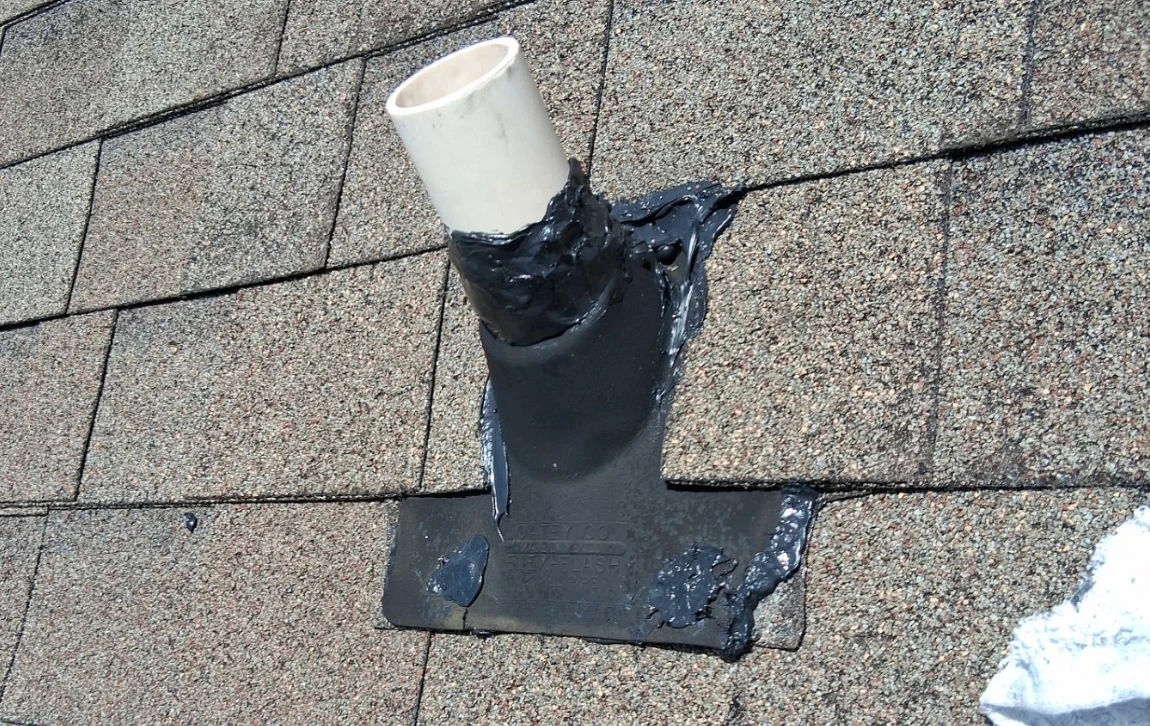
- Rubber pipe boots around plumbing vents, which crack and shrink with age and sun exposure
- Missing, cracked, or displaced asphalt shingles
- Roof valleys, where debris collects and water concentrates
- Seams, curbs, and penetrations on low-slope TPO, PVC, and modified bitumen roofs
A ceiling stain that shows up and dries between storms still deserves a look. Water often travels along decking or framing before it shows, so the stain marks where moisture became visible — not necessarily where it got in.
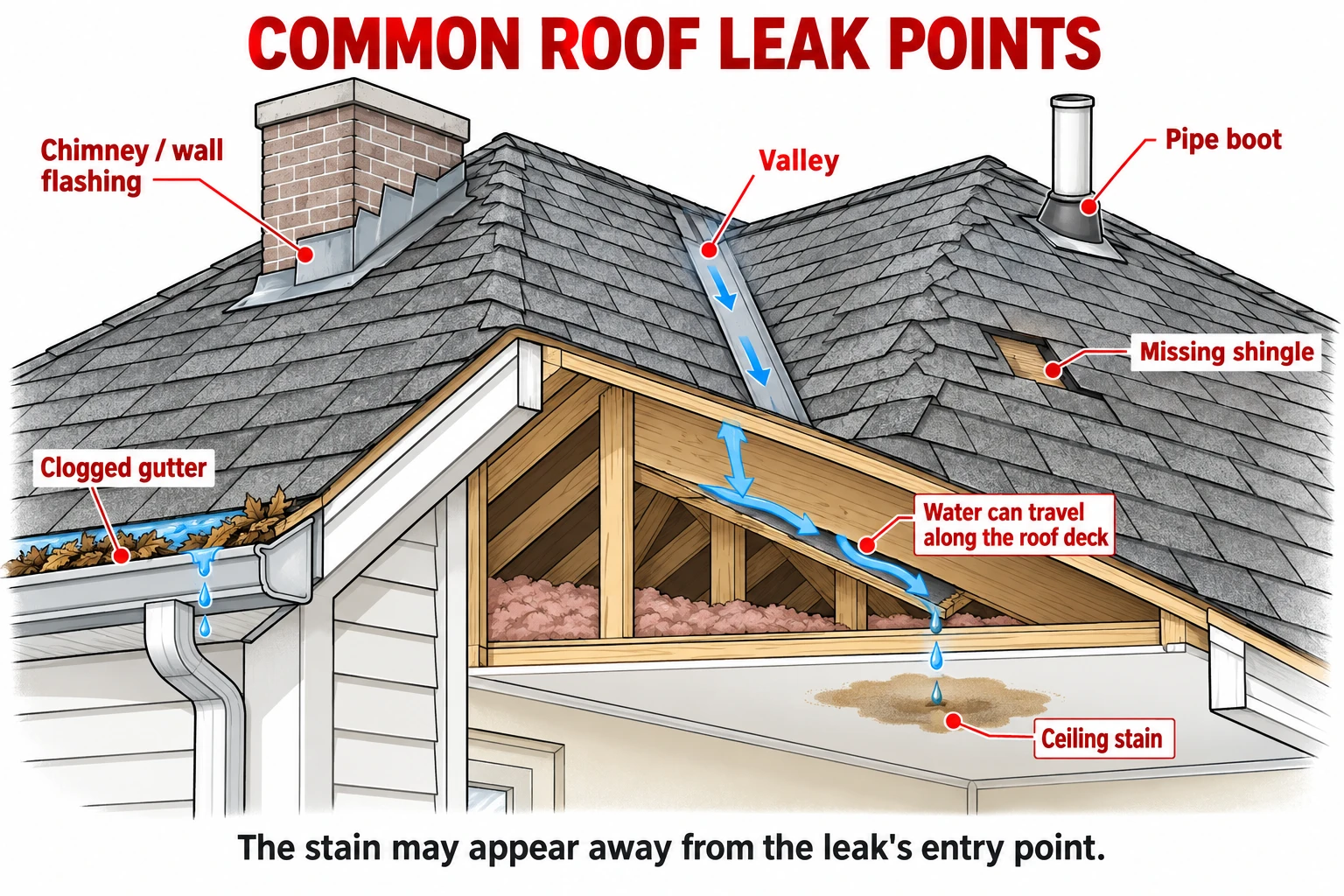
Water that gets past flashing, a pipe boot, or a valley can run along the roof deck before it shows up as a ceiling stain.
Fall Debris Chokes Drainage
Leaves and pine needles pile up in gutters, valleys, and roof drains through October and November. When drainage backs up, water sits on the roof or spills behind the gutter and fascia instead of leaving the building.
Homeowners should watch for gutters overflowing in moderate rain and downspouts that barely trickle. Commercial property managers should have primary drains, scuppers, and overflow drains checked. Clearing a blockage often solves the problem. Ponding that persists after drains are clear usually points to a slope or drainage-design issue that needs a closer evaluation.
Wet Weather Tightens Roofing Schedules
Roofing products come with manufacturer requirements for surface moisture, temperature, and cure time. Adhesives, sealants, and roof coatings in particular need dry conditions to perform as designed. When wet periods stack up, installation and repair dates move.
The takeaway for property owners: if you already know something needs attention, get it assessed early. That leaves room to schedule the work on suitable days rather than scrambling after the first leak. A seasonal outlook alone can't tell anyone how many workable roofing days your area will get.
What Homeowners Should Do Before the Next Wet Stretch
Start with what you can observe safely from the ground and from inside the house:
- Missing or shifted shingles visible from the yard
- Gutters overflowing or pulling away from the fascia
- New discoloration on ceilings or around attic penetrations
- Damp insulation or daylight around vent pipes in the attic
Photograph anything you find and note when it shows up — during rain, right after, or at unrelated times. That timing helps a roofer trace the source.
A professional inspection covers what's hard to see from below: flashing connections, pipe boots, valleys, and roof-to-wall transitions. The point is to find out what the roof actually needs. Depending on its condition, that might be routine maintenance, a targeted repair, or a conversation about roof replacement. A strong El Niño forecast, by itself, is not a reason to replace a roof.
And don't climb onto a wet roof to chase a leak. Wet shingles and metal are slick, and that's how a leak turns into an injury.
What Commercial Property Owners Should Prioritize
On a commercial building, roof prep has to account for the people, inventory, and equipment underneath it. Have your roofing contractor walk the roof and review:
- Drainage: primary drains, scuppers, overflows, and gutters
- Membrane seams and previous repair areas
- Curbs around rooftop HVAC and other equipment
- Pipe, conduit, and vent penetrations
Keep a log of recurring leaks and exactly where they show up inside. A good maintenance visit should leave you with a clear picture of which issues need prompt attention, which areas to monitor, whether drainage is working, and what repairs are recommended and why.
If your roof holds standing water, find the cause before choosing a fix. A coating won't correct insufficient slope or a blocked drain.
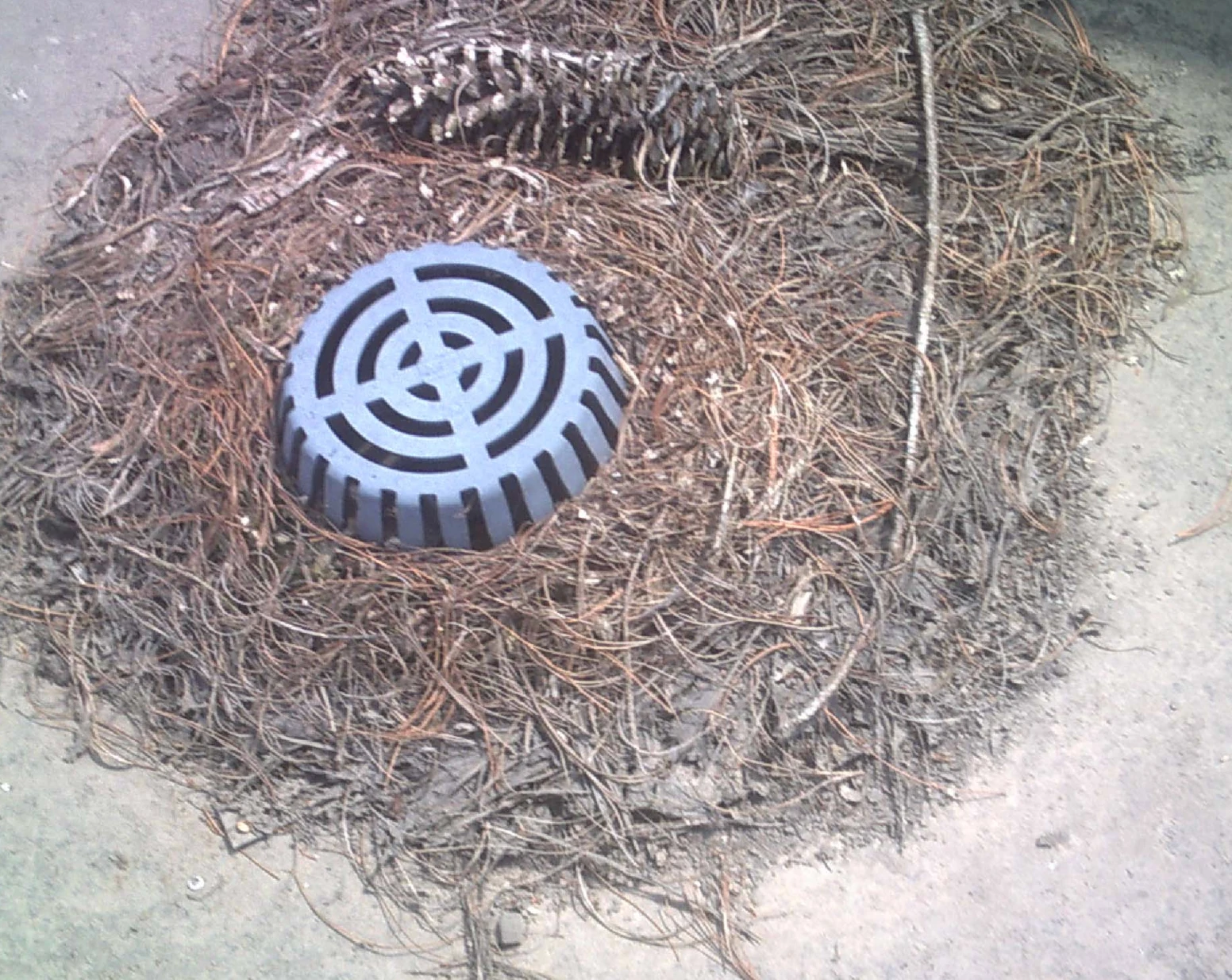
A drain strainer buried in pine needles can slow runoff to a trickle — clear it before the rain, not after water starts ponding.
How to Prepare Your Roof for El Niño: An October–December Plan
This is a maintenance schedule, not a month-by-month weather prediction.
- October — Inspect and address known problems. Schedule an evaluation, document existing conditions, and prioritize active leaks and damaged components while there's still room in the calendar.
- November — Recheck drainage as leaves pile up. Gutters, valleys, and roof drains often need a second cleaning after the first fall visit, especially under oaks and pines.
- December — Monitor performance after rain. Watch for returning stains, slow drainage, or signs that earlier repairs need follow-up. Keep any planned work aligned with local forecasts and product requirements.
Frequently Asked Questions
Does a strong El Niño mean my roof will be damaged?
No. El Niño strength describes an ocean-atmosphere pattern. Whether an individual property sees damage depends on the weather that actually arrives, the roof's condition, and site-specific factors like tree cover and drainage.
Does above-normal precipitation mean more severe storms?
Not necessarily. The seasonal outlook addresses total precipitation over three months. It doesn't forecast how many damaging wind or hail events will reach your area.
Should I wait until spring to fix a small leak?
An active leak should be evaluated promptly. Even a small opening lets more moisture into the decking, insulation, and building with every rain, and that hidden damage is what turns a repair into a bigger project.
Can roof work still happen during fall and winter?
Often, yes. Timing depends on local weather, the roofing system, and the installation requirements of the specific products being used. Booking an assessment early gives you the most flexibility.
How often should gutters be cleaned during the fall?
At least once after most leaves have dropped, and a second time if you're under heavy tree cover. Overflowing gutters during moderate rain are the clearest sign they need attention.
Will NOAA's outlook change before December?
It can. NOAA updates its ENSO discussion monthly — the next one is October 8 — and issues a new three-month outlook each month, with the next on October 15. Use the seasonal outlook for general planning and local forecasts for scheduling.
Get Your Roof Ready Before the Rain
The most useful response to this El Niño outlook is simple: fix the problems your roof already has and make sure water can get off it. Brown's Roofing offers free roof inspections with same-day response across our six offices — Monroe, Shreveport, Baton Rouge, Lafayette, Little Rock, and Wichita. We'll tell you what we find and what it needs, whether that's a quick repair, gutter work, or nothing at all. Call (318) 329-6579 to schedule an inspection before the next wet stretch turns a small issue into an active leak.