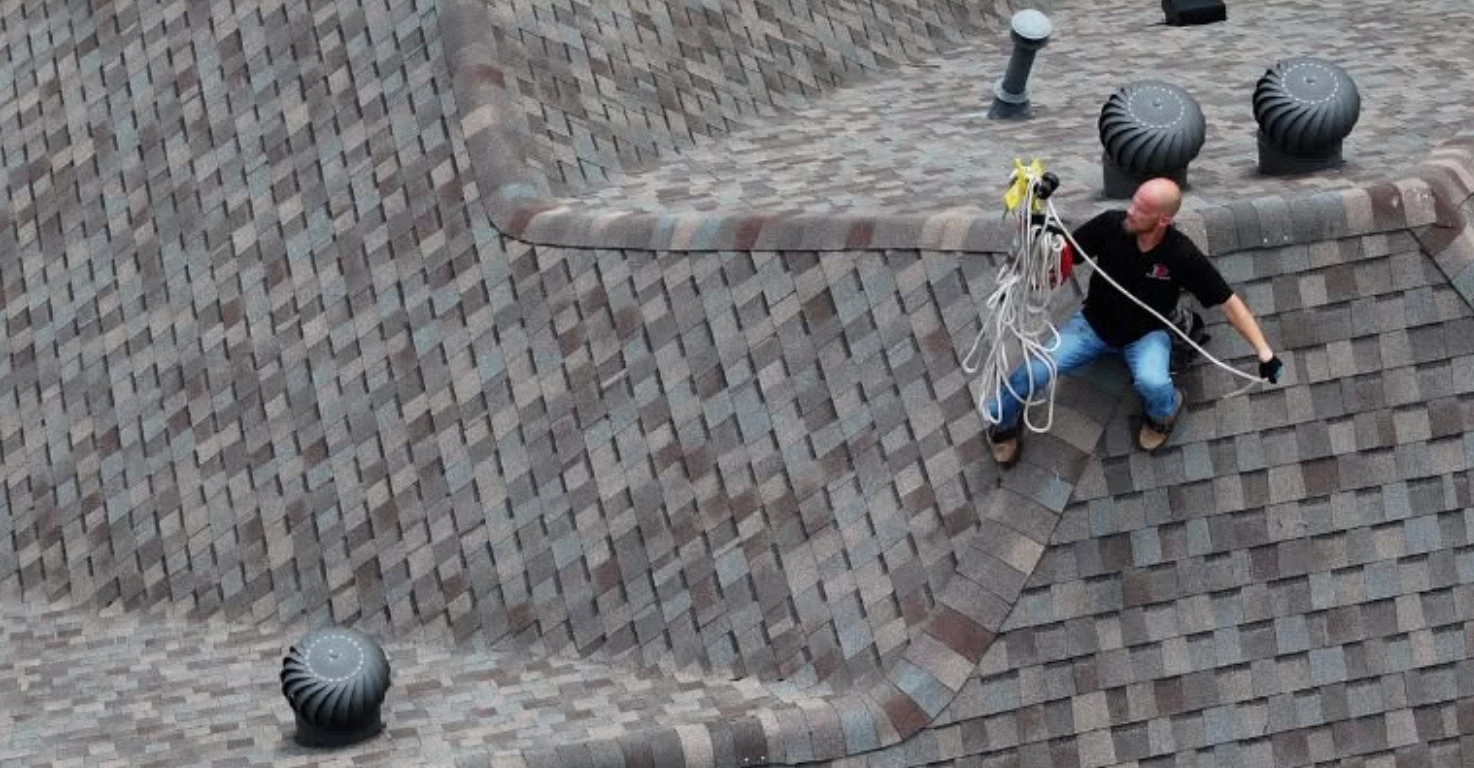
The best roofing contractors in Little Rock share five things you can actually verify: a valid Arkansas contractor's license, current workers' comp and general liability insurance, manufacturer certifications (GAF, Owens Corning, CertainTeed, IKO), a real local address and phone number, and reviews that name specific neighborhoods and jobs. A good roofer passes every one of those checks without getting defensive. A storm chaser starts making excuses.
That's the whole game. If you remember nothing else from this article, remember that the contractor who's proud of their credentials will hand them over before you finish asking. The one who dodges is telling you something. Let's break down how to run those checks yourself — because after a hail storm rolls through central Arkansas, the trucks with out-of-state plates show up fast, and knowing what to look for is the difference between a roof that lasts 25 years and one that leaks the next spring.
What Makes a Roofing Contractor Trustworthy in Little Rock?
Trust in this trade isn't a feeling — it's a paper trail. A contractor worth hiring will have:
- A verifiable Arkansas license for the size of your job
- A certificate of insurance you can call the carrier to confirm
- Manufacturer certifications that make the strongest warranties possible
- A stable local presence — an office, a phone number, and a name people in Little Rock and Hot Springs recognize
- Honest reviews that mention real streets, real crews, and real cleanup
None of this is hard to check. It just takes fifteen minutes and the willingness to ask direct questions. The good news: a trustworthy roofer wants you to ask. We do. When homeowners on jobs we're running right now — over on Overby Circle and 18th Street — asked for our license and insurance up front, that was a green flag for us. Informed customers make better decisions and fewer disputes.
Is a Roofing License Required in Arkansas?
Yes — and the threshold is low enough that most roof replacements require one. Arkansas contractors are regulated by the Arkansas Contractors Licensing Board (ACLB). Any commercial project of $50,000 or more requires a commercial contractor's license. On the residential side, work over $2,000 requires a license or registration through the board — a residential builder license for new construction, or a residential remodeler / home-improvement credential for improvement work like a re-roof.
A full roof replacement in Little Rock runs well past $2,000, so if a roofer tells you they don't need a license for your job, they're either wrong or hoping you are.
How to verify a license
Go to the ACLB website and search the contractor's name or license number. You're checking three things: that the license exists, that it's active (not expired or suspended), and that it covers the type of work — residential improvement, residential building, or commercial. A commercial-only outfit doing your house re-roof under the wrong classification is a problem if anything goes sideways.
Don't stop at the license — check insurance
Licensing and insurance are two different animals. Ask for a certificate of insurance (COI) showing both general liability and workers' compensation, then actually call the carrier or agent listed on it to confirm it's current. This matters more than people think: if an uninsured roofer's worker gets hurt on your property, or a crew puts a ladder through your neighbor's window, the liability can land on you. A real contractor carries this coverage as a cost of doing business and won't blink when you ask to verify it.
Manufacturer Certifications — Why They Separate the Pros
Anybody can buy a bundle of shingles at a supply house. Not everybody can install them under a manufacturer's certified program — and that distinction controls what warranty you're actually able to get.
When a contractor is certified by GAF, Owens Corning, CertainTeed, or IKO, it means the manufacturer has vetted them, the crews have completed training on that manufacturer's system, and the company carries enough standing to offer the enhanced system warranties that ordinary installers simply can't. These aren't the basic shingle-only warranties — they cover the whole system, including workmanship, for far longer, and in some cases they're transferable when you sell the house.
Here's the part homeowners miss: a manufacturer's strongest warranty is only valid when the entire system — shingles, underlayment, starter, ridge, ventilation — is installed to spec by a certified contractor. An uncertified crew that mixes components or skips a step can void coverage before the first rain. You paid for a 50-year system and got a 10-year one on paper.
Brown's is certified with GAF, Owens Corning, CertainTeed, and IKO — and holds GAF's Gold Elite tier on the commercial side — which is exactly why we can stand behind the systems we install.
IBHS FORTIFIED — the storm-serious mark
There's one more credential that separates roofers who take Gulf-Coast and Ark-La-Tex weather seriously: IBHS FORTIFIED. Developed by the Insurance Institute for Business & Home Safety, FORTIFIED is a construction standard built to keep roofs on houses during high winds and hail. Getting a roof FORTIFIED requires specific installation methods and an inspection by an independent third-party evaluator — it's not a sticker you buy. If a contractor knows FORTIFIED and can build to it, they're thinking about your roof surviving the next storm, not just cashing this insurance check. If you're weighing your options, our guide to the best impact-resistant shingles in Arkansas walks through what actually holds up to hail.
Storm-Chaser Red Flags After Hail Season
Central Arkansas gets hit. When a real hail event moves across Pulaski County, the out-of-state crews follow the radar. Some do acceptable work. Many don't — and the ones who don't are gone long before your warranty matters. Here's how to spot them.
Out-of-state plates and a door-knocking blitz. A convoy of trucks canvassing your subdivision the day after a storm, all from three states away, is the classic tell. They're not from here and they won't be here next year.
Pressure to sign right now. "This price is only good today." "We can start tomorrow if you sign." A legitimate contractor gives you a written scope and lets you think it over. Urgency is a sales tactic, not a roofing requirement.
"We'll waive your deductible." This is the big one. In Arkansas, as in most states, having a contractor absorb or "eat" your insurance deductible is insurance fraud — and it puts you at risk, not just them. Any roofer who offers it is telling you they're comfortable committing fraud on your behalf. Walk away. (We break down the honest way to handle a claim in our guide on what to do when hail hits your roof.)
No local address, no local landline. If the only contact is a cell number and a magnetic sign, there's nothing to come back to. Ask where their office is. Drive by it if you want.
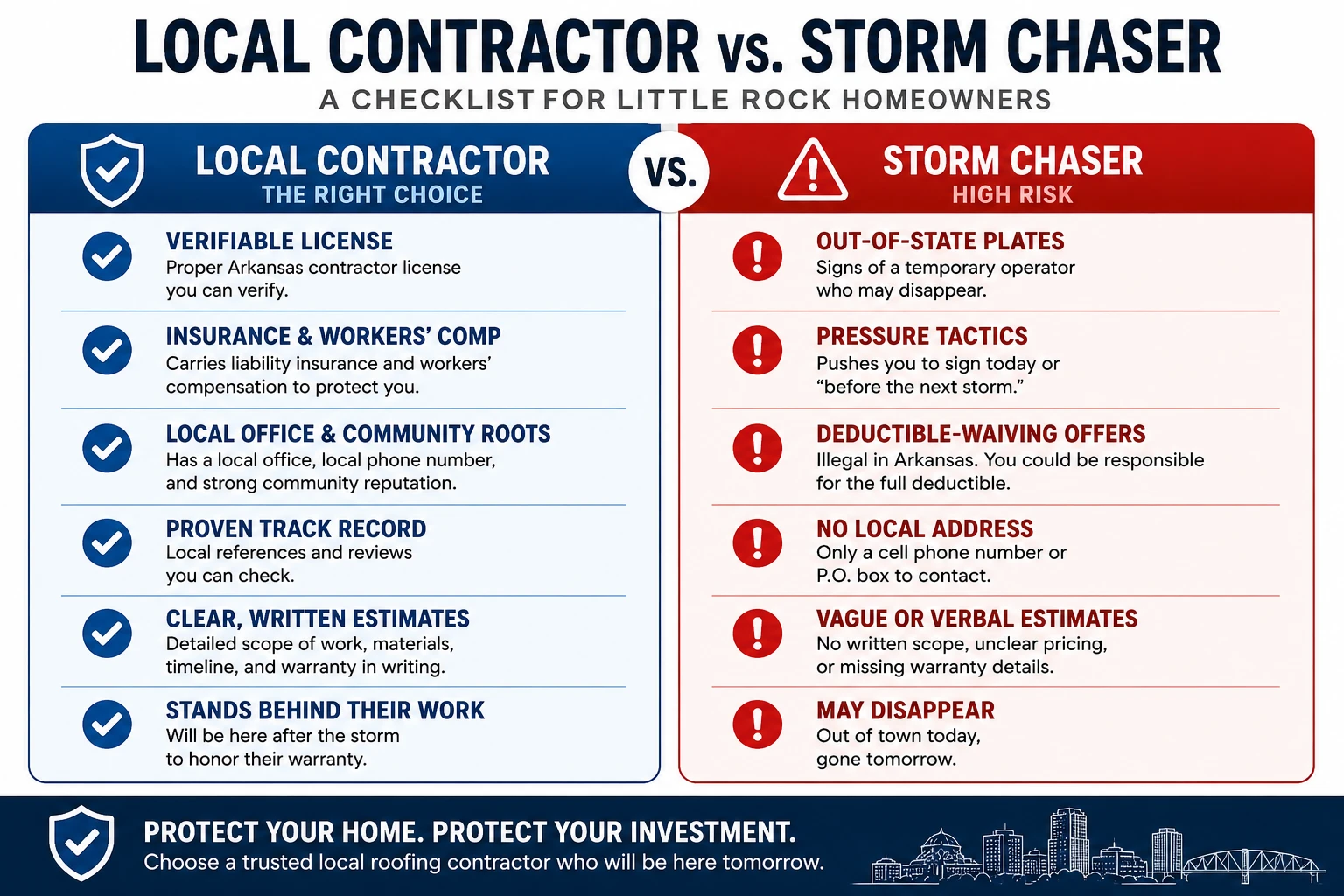 Six things a local contractor can prove — and six warning signs that follow a storm into town.
The contrast: a stable local contractor is the opposite of all of that. We answer the phone with a real office, we're licensed and insured in Arkansas, and we're still going to be in Little Rock and Hot Springs when your roof needs a warranty callback in year eight. That's not a marketing line — it's the entire difference between a business and a traveling sales operation. We wrote more about that stability in why Brown's Roofing is a trusted roofer in Little Rock and Hot Springs.
What Real Local Reviews Look Like
Star ratings are easy to game. Depth isn't. When you read reviews for a Little Rock roofer, look past the number and read the words.
Real reviews name things. A genuine customer mentions the neighborhood, the type of roof, how the crew handled cleanup, whether the timeline held. "They replaced our roof in the Heights and hauled off every scrap — my kids play barefoot in that yard and I've found zero nails" tells you far more than "Great service, 5 stars."
Check more than one source. Google reviews, the Better Business Bureau, and old-fashioned word of mouth around Little Rock and Hot Springs. A contractor with a real local history shows up in all three.
Watch for the fake-review pattern. A burst of a dozen 5-star reviews in the same week, all short, none naming a specific job or place, is a manufactured reputation. Real reviews trickle in over years and read like actual people wrote them.
Cleanup shows up in honest reviews more than you'd think, because it's the thing homeowners remember. A tear-off drops thousands of nails, and whether a crew runs a magnet over your lawn and drive is a small window into how they do everything else. We take it seriously enough that we wrote a whole piece on why nail cleanup sets the standard for our work.
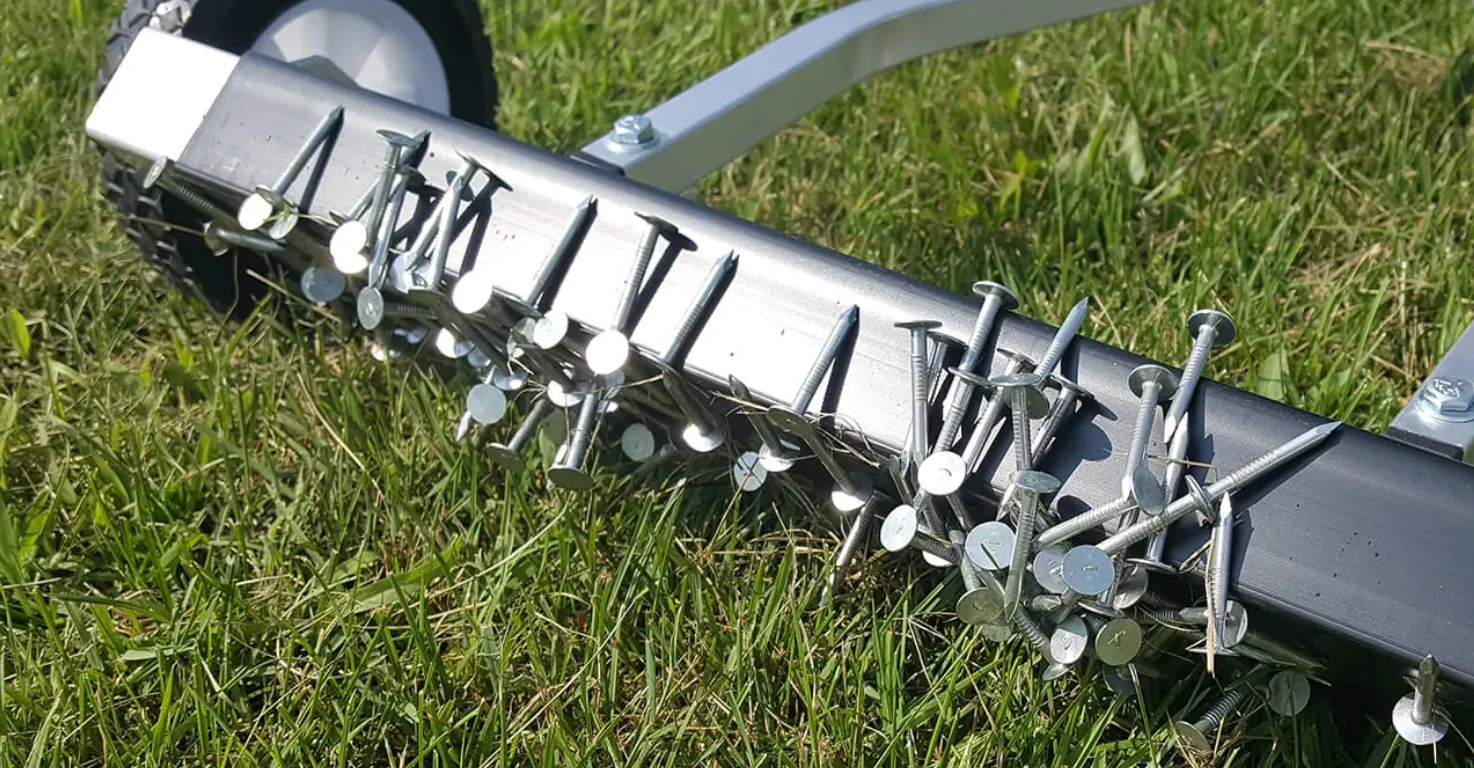 One pass of the magnet after a tear-off. Every nail on that bar is one that didn't end up in a tire or a bare foot.
Brown's Roofing in Little Rock Right Now
We're not describing a hypothetical local contractor — we're describing what we do. As this is being written, our crews are running residential jobs across Little Rock, including projects on Overby Circle and 18th Street. That's a genuine, current local presence, not a truck passing through after the last hail cell.
We're licensed and insured in Arkansas, manufacturer-certified with GAF, Owens Corning, CertainTeed, and IKO, and an IBHS FORTIFIED Certified Contractor. We're storm-damage specialists, not storm chasers — there's a difference. We know how to document hail damage and work an insurance claim honestly, and we're still here when the claim is settled and the crews have moved on. Compliance and doing it right isn't a burden to us; it's the business. (For a sense of where the industry is heading on that front, see our take on Louisiana's 2025 roofing reforms.)
How to Vet a Roofing Contractor Before You Sign: A 6-Point Checklist
Run any roofer — us included — through this before you sign anything.
- License number — verify it's active and correct for your job type on the ACLB site.
- Certificate of insurance — general liability and workers' comp; call the carrier to confirm.
- Manufacturer certifications — ask which ones, and what warranty you actually qualify for.
- Local references — recent jobs in your area you can look at or ask about.
- Written scope of work — every component, not just "replace roof." Underlayment, ventilation, flashing, the works.
- Warranty terms in writing — what's covered, for how long, and whether it transfers.
If a contractor clears all six, you're in good hands. If they stall on any of them, that's your answer.
Frequently Asked Questions
Do roofers have to be licensed in Arkansas?
Yes. In Arkansas, residential work over $2,000 requires a license or registration from the Arkansas Contractors Licensing Board, and commercial work of $50,000 or more requires a commercial license. Since most roof replacements exceed $2,000, your roofer needs to be credentialed — and you can verify it on the ACLB website.
How can I tell if a Little Rock roofer is a storm chaser?
Look for out-of-state plates, aggressive door-knocking right after a storm, pressure to sign immediately, no local office or landline, and offers to "waive your deductible." Storm chasers are built to move on. A local contractor has a verifiable address, a real phone number, and a reason to still be here when your warranty matters.
What manufacturer certifications should a roofer have?
Certifications from GAF, Owens Corning, CertainTeed, or IKO show the crew is trained on that system and can offer the manufacturer's strongest, longest warranties — coverage an uncertified installer simply can't provide. For storm country, IBHS FORTIFIED capability is a strong bonus.
Is it legal for a roofer to waive my insurance deductible?
No. Having a contractor absorb or "eat" your deductible is insurance fraud in Arkansas and most other states, and it exposes you to liability too. Any roofer who offers it is showing you they're willing to commit fraud — reason enough to hire someone else.
How many roofing quotes should I get in Little Rock?
Get at least three written quotes so you can compare scope, materials, and warranty — not just price. The cheapest bid often skips components like proper underlayment or ventilation, which costs you later. Compare what's actually included, line by line.
Why does hiring a local contractor matter for my warranty?
A manufacturer's system warranty and a workmanship warranty are only worth something if the company is still around to honor them. A local contractor with a real presence in Little Rock and Hot Springs will be here in five or ten years for a callback. A storm chaser won't answer the phone.
Get a Straight Answer on Your Roof
If you want a straight answer on whether your roof actually needs work — or you just want to run a contractor through the checklist above — we're glad to take a look. Brown's offers a free, honest roof check across Little Rock and Hot Springs. We'll tell you what we see, whether that's a repair, a full replacement, or "your roof's fine, keep an eye on it." No pressure, no scare tactics — just practitioners who've been on the roof. Call (318) 329-6579 for a free inspection with same-day response.