
Residential Metal Roofing
Built for the Long Haul
A correctly installed standing seam roof outlasts two or three asphalt roofs. It survives the hailstorms that destroy shingles, qualifies for the deepest homeowners insurance discounts, and reflects enough heat to lower your power bill every summer it's on the house.
What Is Residential Metal Roofing?
The Roof That Outlasts the Mortgage
Residential metal roofing is engineered from coated steel, aluminum, zinc, or copper — stamped, rolled, or formed into panels and fastened to the roof deck through a system of clips or screws. Modern residential metal isn't the corrugated barn roof of decades past: today's standing seam profiles, stamped shingles, and stone-coated steel deliver virtually any residential aesthetic — at performance levels asphalt shingles can't match.
A 24-gauge Galvalume steel standing seam roof, properly installed with a Kynar 500 paint system over peel-and-stick high-temp underlayment, will deliver 50–70 years of service across the LA, AR, KS, AL, MS, TX, and FL markets we cover. That's twice the service life of a 30-year architectural shingle — and the metal roof will keep its color, hold its shape under hail, and cost less to maintain across that span.
Metal is also the responsible default in two specific scenarios: hail belts (where Class 4 impact-rated metal qualifies for the deepest insurance discounts) and hurricane zones (where wind ratings of 140 mph and HVHZ approvals are sometimes the only path to coverage). For homeowners in those markets, the math doesn't favor asphalt.
The trade-off is upfront cost. A standing seam roof typically runs 2–3× the cost of a Class 3 architectural shingle install. For a 5–7 year ownership window, asphalt is the rational choice. For a 15+ year horizon, metal usually wins on lifecycle cost — and that's before the insurance premium savings get factored in.
Why Homeowners Choose Metal
Decades-Long Service Life
Properly installed metal roofs deliver 40–70 years of service — twice the lifespan of standard asphalt and three times the lifespan of cheap shingles. For homeowners staying in their home long-term or building a forever home, metal is often the last roof you'll buy.
Storm & Hail Performance
Most modern metal roofing carries UL 2218 Class 4 (top-tier) impact resistance and UL 580 Class 90 wind uplift ratings. In LA, AR, KS, AL, MS, TX, and FL hail and high-wind zones, metal outperforms virtually every other residential material under sustained storm exposure.
Insurance Premium Discounts
Class 4 impact-resistant metal qualifies for the deepest homeowners insurance discounts on most major carriers — typically 20–35% off the wind/hail portion of the premium. Some carriers will not even underwrite high-risk markets without an impact-rated roof. Ask your carrier or agent which discount your metal spec qualifies for.
Energy Efficiency
Reflective Kynar 500 / Hylar 5000 finishes reflect 25–40% of solar radiation — measurably reducing attic temperatures and cooling loads in the Gulf South. ENERGY STAR–rated cool-roof colors push that further. Real summer power-bill savings of 10–25% are typical.
Lightweight Structure Load
Metal roofing weighs 100–150 lbs per square (100 sq ft) — less than half of asphalt and roughly 1/7 the weight of clay tile. That means metal can install over an existing shingle layer in many cases, and rarely requires structural framing upgrades.
Fire Performance
All steel and aluminum roofing carries a UL Class A fire rating — the highest residential fire classification — and is non-combustible. Critical in regions with brush fire or wildfire exposure, and increasingly relevant for insurance underwriting in fire-prone counties.
Sustainable & Recyclable
Most residential steel roofing contains 25–95% recycled content, and metal is 100% recyclable at end of service life — vs. asphalt shingles, which generate roughly 11 million tons of landfill waste annually in the U.S. A meaningful factor for homeowners pursuing sustainability targets or energy-efficient home certifications.
Aesthetic Versatility
Metal roofing isn't limited to the agricultural-style ribbed panels of decades past. Standing seam, stamped metal shingles, and stone-coated steel offer the visual character of slate, shake, or tile — at a fraction of the weight, with substantially better storm performance.
Metal Roofing Specs
Galvalume steel is the standard residential substrate. Aluminum is the upgrade for coastal and salt-air exposure. 24-gauge with Kynar 500 paint is our default standing seam spec.
Metal vs. Asphalt
Metal costs 2–3× more upfront but lasts 2–3× longer. For 15+ year ownership horizons, metal usually wins on lifecycle cost — especially with insurance discount factored in.
Compare with Asphalt →Metal Roofing Profiles
Four Residential Metal Roof Types
Standing seam is the default for modern homes; stone-coated steel and stamped shingles are the right call for traditional and historic styles. We install all four — and walk you through the trade-offs before we quote.
Standing Seam (Concealed Fastener)
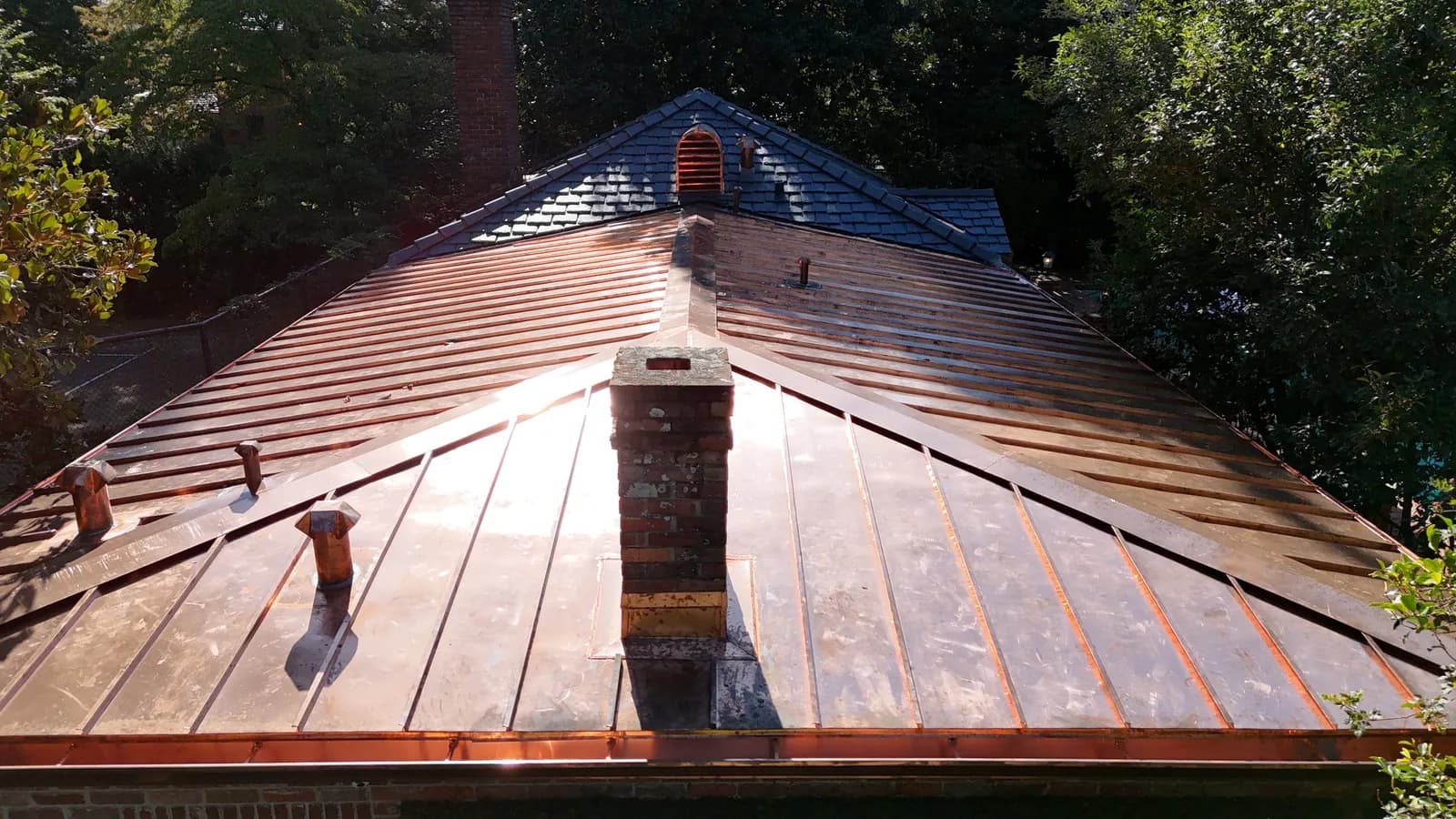
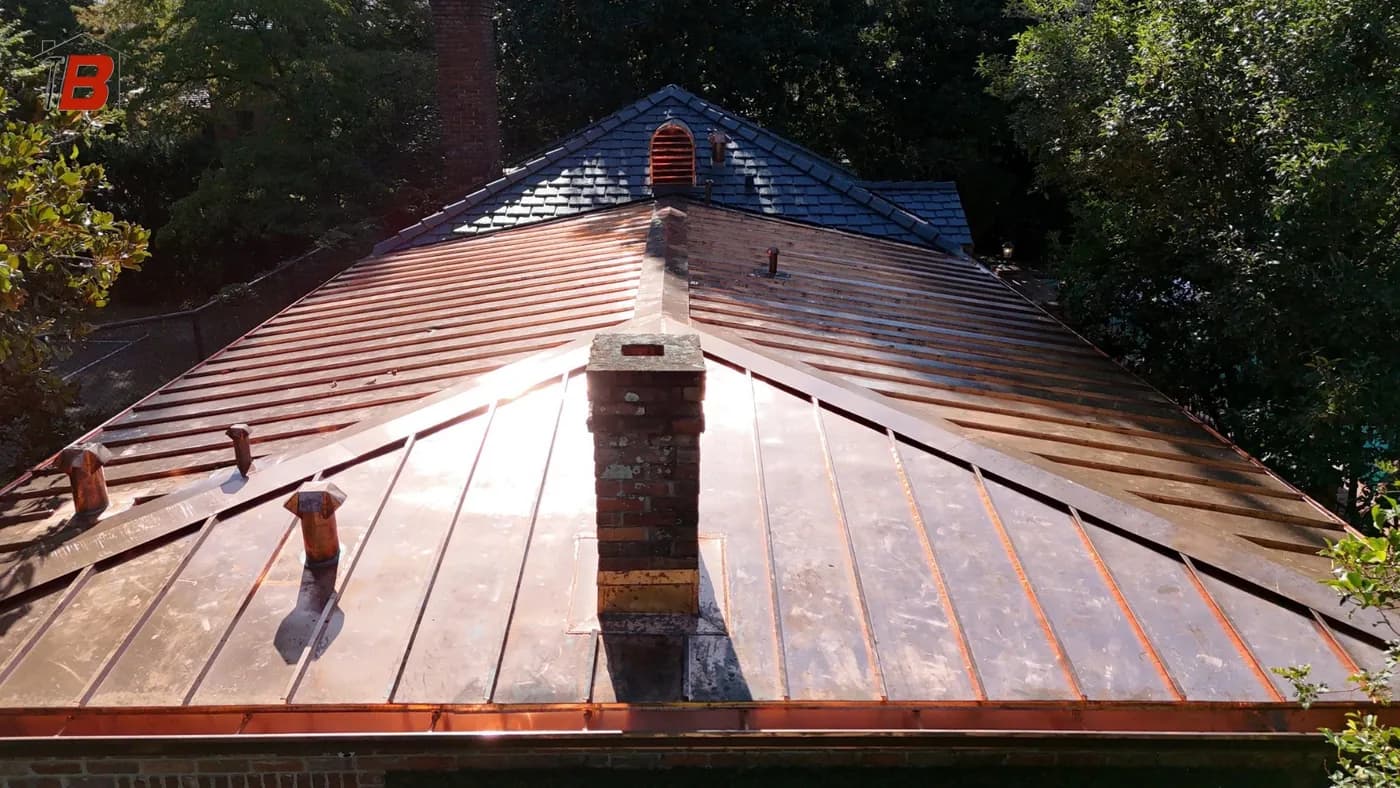
The premium residential metal system. Vertical panels with raised, interlocking seams running ridge-to-eave, secured to the deck with hidden clips — no fasteners penetrate the panel face. Snap-lock or mechanically seamed profiles in 24-gauge steel, 22-gauge for higher-end specs, or aluminum in coastal applications. The cleanest aesthetic and the longest-lived attachment method.
Best For
Long-term ownership, modern and contemporary homes, coastal/high-wind zones, low-slope dormers and additions
Exposed-Fastener (R-Panel / Ag-Panel)
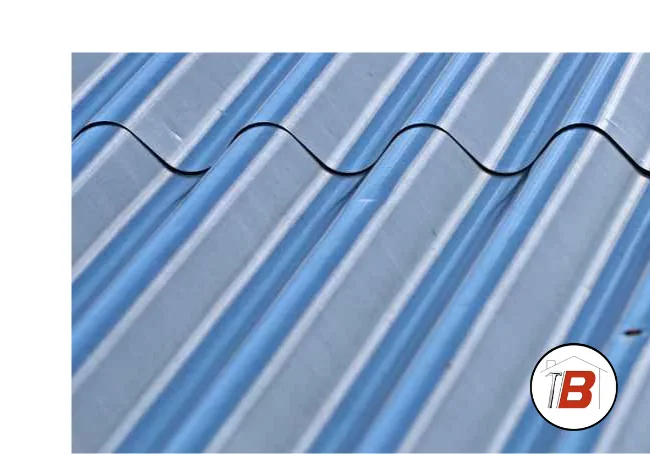
Wider ribbed panels secured to the deck with painted screws and EPDM-gasketed washers. Lower material and labor cost than standing seam, faster install, and a utilitarian aesthetic that fits agricultural, rural residential, and outbuilding applications. Gasket replacement is required at year 15–20 — a maintenance item standing seam doesn't have.
Best For
Rural residential, agricultural buildings, outbuildings, budget-driven applications, large simple roof geometries
Stamped Metal Shingles
Individual steel or aluminum shingles stamped to mimic wood shake, slate, or victorian profiles. Interlocking edges and a backing layer of underlayment provide weather protection comparable to standing seam. Common on historic-style homes where standing seam would look out of period but the homeowner wants metal performance.
Best For
Historic and traditional architectural styles, HOA-restricted neighborhoods, homeowners wanting metal performance with shingle aesthetics
Stone-Coated Steel
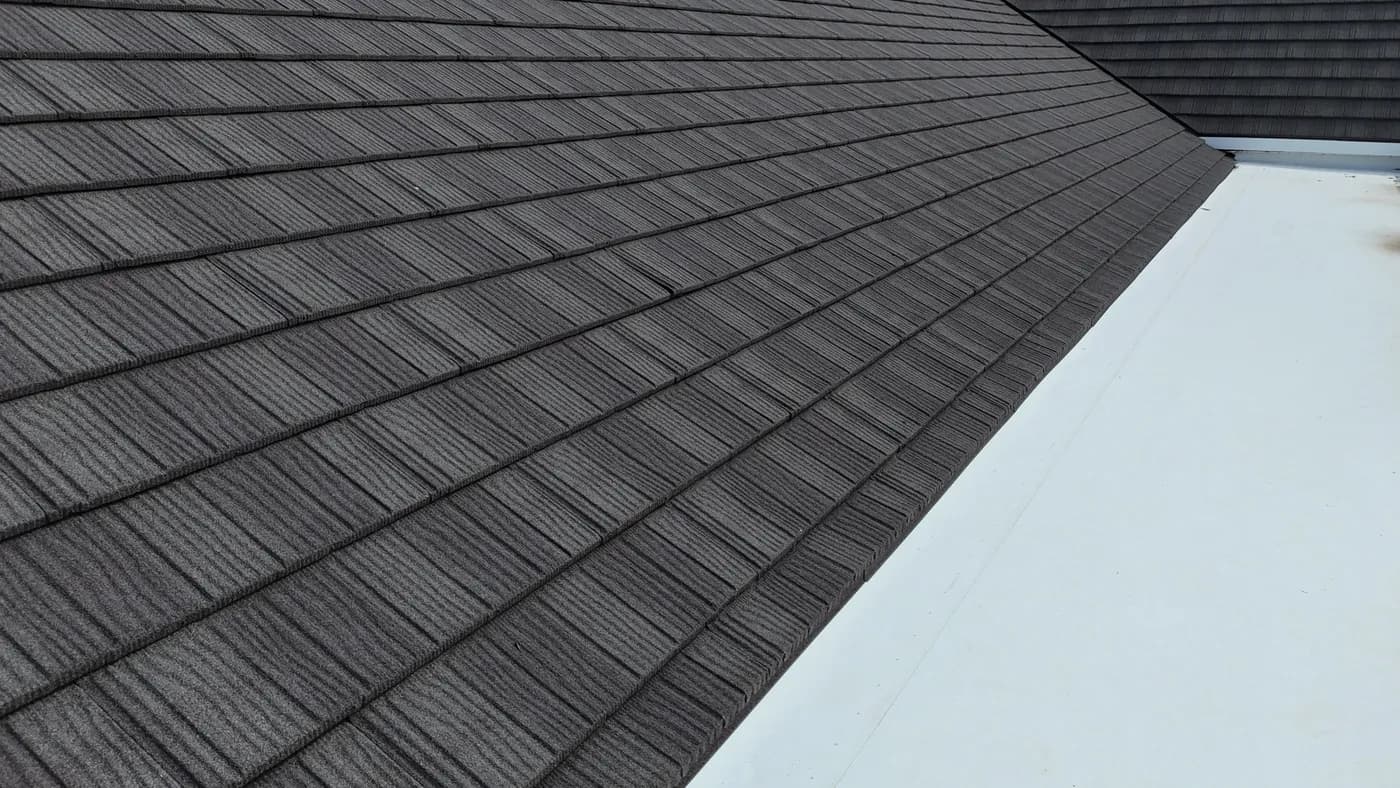
Steel panels surfaced with embedded ceramic stone granules — visually nearly identical to clay tile or thick architectural shake at roughly 1/7 the weight. Excellent in hurricane and hail markets. Manufacturer warranties typically 50 years on the substrate plus paint/coating warranties on the granule layer.
Best For
Florida, Gulf Coast, and hurricane markets; tile-aesthetic homes that can't support the structural load of real tile
Stone-Coated Steel — Spotlight
Tile or Shake Aesthetic, Steel Performance
Stone-coated steel is a heavy-gauge steel panel surfaced with embedded ceramic stone granules — the look of clay tile or thick architectural shake at roughly one-seventh the weight, with the hail and hurricane performance of metal. Manufacturer warranties typically run 50 years on the substrate plus paint/coating warranties on the granule layer.
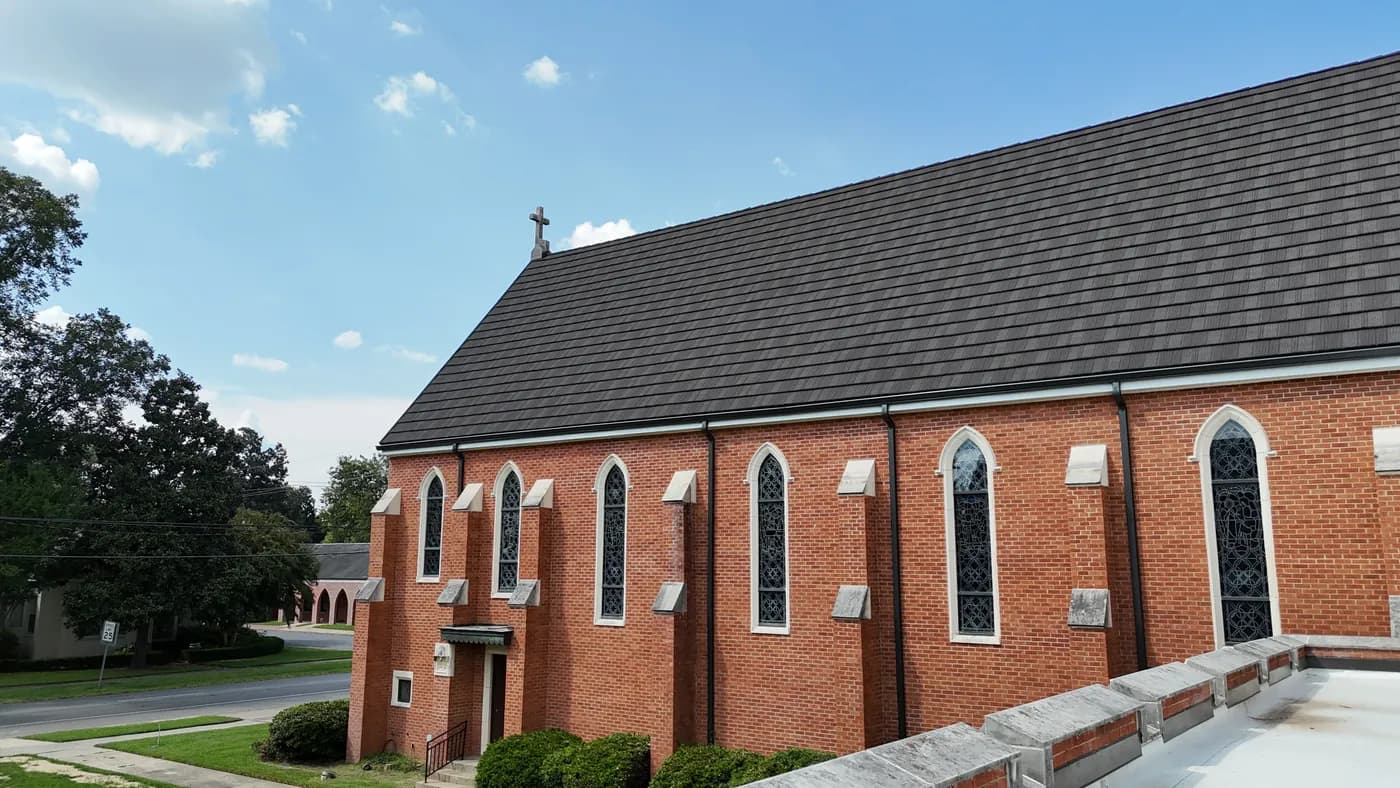
Shake-Profile Stone-Coated Steel
Gothic-style brick church reroofed with stone-coated steel shake panels — Class 4 impact, 140+ mph wind, and Class A fire performance with the visual character of cedar shake.
Detail — Granule Surface & Transition
Close-up of the embedded ceramic stone granule surface and the stone-coated steel to white TPO transition flashing — the granules hide minor cosmetic hail strikes that would show on plain painted steel.
Service Life
40–60 yrs
Weight (lbs/sq)
~140
Wind Rating
Up to 140 mph
Impact Rating
UL 2218 Class 4
Fire Rating
Class A
Best Fit
Hurricane, hail, tile-look
Where Metal Performs Best
Home Styles & Applications
Metal roofing fits more residential applications than most homeowners realize — from high-end modern builds to working farms, from hurricane coast to hail belt.
Modern & Contemporary Homes
Standing seam is the default roof material for modern residential architecture — clean vertical lines, low-profile seams, and a palette of muted greys, charcoals, and matte blacks that complement contemporary design language.
Low-Slope Additions & Dormers
Standing seam installs down to 1:12 pitch — far below the 3:12 minimum for asphalt shingles. The right answer for porch roofs, low-slope dormers, and modern additions where shingles wouldn't be code-compliant.
Hurricane & Coastal Zones
Aluminum standing seam (corrosion-resistant) and stone-coated steel are specified throughout coastal LA, MS, AL, TX, and FL. Wind ratings up to 140 mph and FBC HVHZ approvals make metal the responsible default near the water.
Hail Belt (KS, AR, North TX)
Class 4 impact-resistant metal handles the 1.5–2.5 inch hail strikes routine in these markets — and qualifies for the deepest insurance premium discounts available. Often pays back the upgrade differential in 6–10 years through premium savings alone.
Forever-Home Owners
If you're building or renovating a home you plan to own for 20+ years, metal is the only residential roof that will outlive the mortgage. The lifecycle math beats asphalt by a wide margin once you cross the 20-year ownership horizon.
Energy-Conscious Households
Cool-roof reflective finishes reduce attic temperatures by 30–50°F on summer afternoons. For homes with finished attics, second-floor bedrooms, or high cooling loads, the comfort and utility-bill impact is measurable.
Agricultural & Rural Residential
Exposed-fastener panels are the standard for barns, shops, outbuildings, and rural residential applications where the aesthetic is utilitarian and the budget needs to flex. We install both R-panel and ag-panel systems across our seven-state footprint.
Historic & Traditional Styles
Stamped metal shingles and stone-coated steel let traditional architectural homes get metal performance without the modern aesthetic of standing seam. We install victorian-profile, slate-look, and shake-look stamped systems on heritage-style homes.
Material Comparison
Metal vs. Asphalt vs. Slate vs. Tile
The factors that drive a homeowner's long-term decision: cost, lifespan, weight, hail performance, repairability, and insurance discount eligibility.
| Factor | Metal | Asphalt | Slate | Tile |
|---|---|---|---|---|
| Relative Cost | Higher | Lower-cost | Top-of-market | Premium |
| Service Life | 40–70 yrs | 20–40 yrs | 75–150 yrs | 50–100 yrs |
| Weight (lbs / sq) | 100–150 | 250–500 | 700–1,000 | 900–1,100 |
| Hail Performance | Excellent (Class 4) | Good (Class 3–4) | Excellent | Excellent (can crack) |
| Energy / Reflectivity | Excellent (cool roof) | Limited | Limited | Moderate |
| Insurance Discount | Often 20–35% | Class 3+ qualifies | Often qualifies | Often qualifies |
Cost Factors
What Determines Metal Roof Pricing
Metal pricing is driven by ten specific variables, with panel profile and gauge being the single largest cost levers. We provide a written, itemized estimate after a free on-site measurement and inspection — no per-square-foot guesses.
Relative tiers for a typical Southern home (1,800–2,400 sq ft of roof area):
- Exposed-fastener (R-panel): Lower-cost metal option
- Standing seam (24-ga steel): Mid-tier
- Standing seam (aluminum or premium): Top of the metal range
- Stone-coated / stamped shingle: Upper-mid tier
Pricing depends on roof size, slope, complexity, access, and material specification — we provide a written estimate after a free on-site inspection.
Request a Written Estimate10 Variables That Drive Metal Roof Cost
- 01Roof size (squares — 100 sq ft each — drive material and labor)
- 02Panel profile (standing seam premium, exposed-fastener budget)
- 03Gauge (24-gauge standard, 22-gauge upgrade, 26-gauge budget)
- 04Substrate (Galvalume steel, aluminum, zinc, copper — by ascending cost)
- 05Paint system (Kynar 500 / Hylar 5000 vs. SMP — affects warranty and fade)
- 06Roof complexity (number of valleys, hips, dormers, penetrations)
- 07Tear-off vs. install over existing layer
- 08Underlayment specification (synthetic, peel-and-stick, high-temp)
- 09Trim and flashing detail (snow guards, chimney crickets, ridge venting)
- 10Code upgrades (drip edge, hurricane attachment, HVHZ requirements in FL)
Long-Term Care
Maintenance, Repair & Storm Response
Metal roofs are low-maintenance, not no-maintenance. Annual inspections of fasteners, flashings, and sealants are what carry a metal roof from its warranty period into its service-life premium.
Roof Maintenance
Annual inspections, fastener checks, sealant maintenance, and warranty-compliant documentation for every metal roof we install or service.
Learn more →
Metal Roof Repair
Panel replacement, seam re-sealing, fastener remediation, flashing repair, and storm response on metal roofs of any age or manufacturer.
Learn more →
Storm Damage Documentation
Storm damage documentation, adjuster inspections, and claim-aligned repair or replacement when your metal roof has hail or wind damage.
Learn more →
Representative Project
Lake Charles, LA — Standing Seam Aluminum, Hurricane-Rated
Home Type
Coastal modern, 4 bed
Roof Area
28 squares (2,800 sq ft)
System Specified
24-ga aluminum standing seam, Kynar 500
Warranty
50-yr substrate, 35-yr paint, 20-yr workmanship
Coastal homeowner replacing a 17-year-old asphalt shingle roof that had been blown off twice by hurricanes and was generating ongoing insurance hassle. We specified 24-gauge aluminum standing seam (corrosion-resistant for salt-air exposure) over peel-and-stick high-temp underlayment, with concealed-clip attachment rated to 140 mph. Pre-install moisture scan identified two areas of damaged decking — replaced before underlayment install. New roof completed in 5 working days. Homeowners insurance quoted a 28% premium reduction on the wind/hail portion at next renewal. Manufacturer warranties registered, with annual inspection program established.
FAQ
Metal Roofing FAQ
- Standing seam metal typically delivers 50–70 years of service in our climate when installed correctly with a quality paint system (Kynar 500 / Hylar 5000) and an appropriate substrate (Galvalume steel or aluminum near the coast). Exposed-fastener panels reach 40–50 years with periodic gasket replacement at the screw heads. Stone-coated steel and stamped metal shingles fall in the 40–60 year range. The single biggest variable is the paint and coating system — premium PVDF paints carry 30–50 year fade-and-chalk warranties; lower-cost SMP paints carry shorter warranties.
- On most major carriers across LA, AR, KS, AL, MS, TX, and FL — yes. Class 4 impact-rated metal typically qualifies for the deepest homeowners insurance premium discounts available (often 20–35% off the wind/hail portion). In some high-risk Florida and Gulf Coast markets, an impact-rated metal roof is a precondition for coverage at all. Ask your carrier or agent which discount your metal spec qualifies for so you can weigh the after-discount cost-of-ownership math.
- Not when it's installed correctly over a solid roof deck with proper underlayment and attic insulation — which is how every residential metal roof we install is built. The 'noisy metal roof' impression comes from old farm and outbuilding installs where panels were attached directly to purlins with no decking or underlayment. On a finished home, interior sound levels during rain are comparable to a shingle roof.
- In many cases, yes — most building codes allow metal to install over a single existing layer of asphalt shingles, provided the decking is sound and the existing layer is dry. We perform a moisture and structural check first. Install-over saves 10–20% versus full tear-off and avoids the disposal cost of removing the existing layer. That said, if the existing roof has soft spots, ventilation issues, or two layers already, we'll recommend full tear-off.
- No. Metal roofing does not attract lightning. The Metal Construction Association and the National Fire Protection Association both confirm metal does not increase strike probability — and because metal is non-combustible and electrically conductive, a metal roof actually distributes a strike's energy more safely than a wood-and-shingle roof, reducing fire risk if a strike does occur.
- Pricing depends on roof size, panel profile, gauge, paint system, and complexity. Relative tiers for a typical Southern home (1,800–2,400 sq ft of roof area): exposed-fastener metal is the lower-cost option, standing seam steel is mid-to-upper, and standing seam aluminum or premium-gauge specs sit at the top of the metal range. Stone-coated steel and stamped metal shingles fall in the upper-mid tier. We provide a written, itemized estimate after a free roof inspection — including the projected insurance premium savings.
- Yes. We document hail and wind damage to existing metal roofs (cosmetic granule loss on stone-coated, panel deformation, paint impact) with photos and written reports, can be present for the carrier's adjuster inspection, and complete repair or replacement to manufacturer specification once the claim scope is approved. We do not chase claims that aren't there — but when damage is present, we make sure the carrier sees the full scope.
Metal Roofing in Your Market
Free Assessment
Get a Metal Roof Quote
Free roof inspection, written estimate, and a side-by-side comparison vs. premium asphalt — including the insurance premium impact. Real numbers, no high-pressure sales.