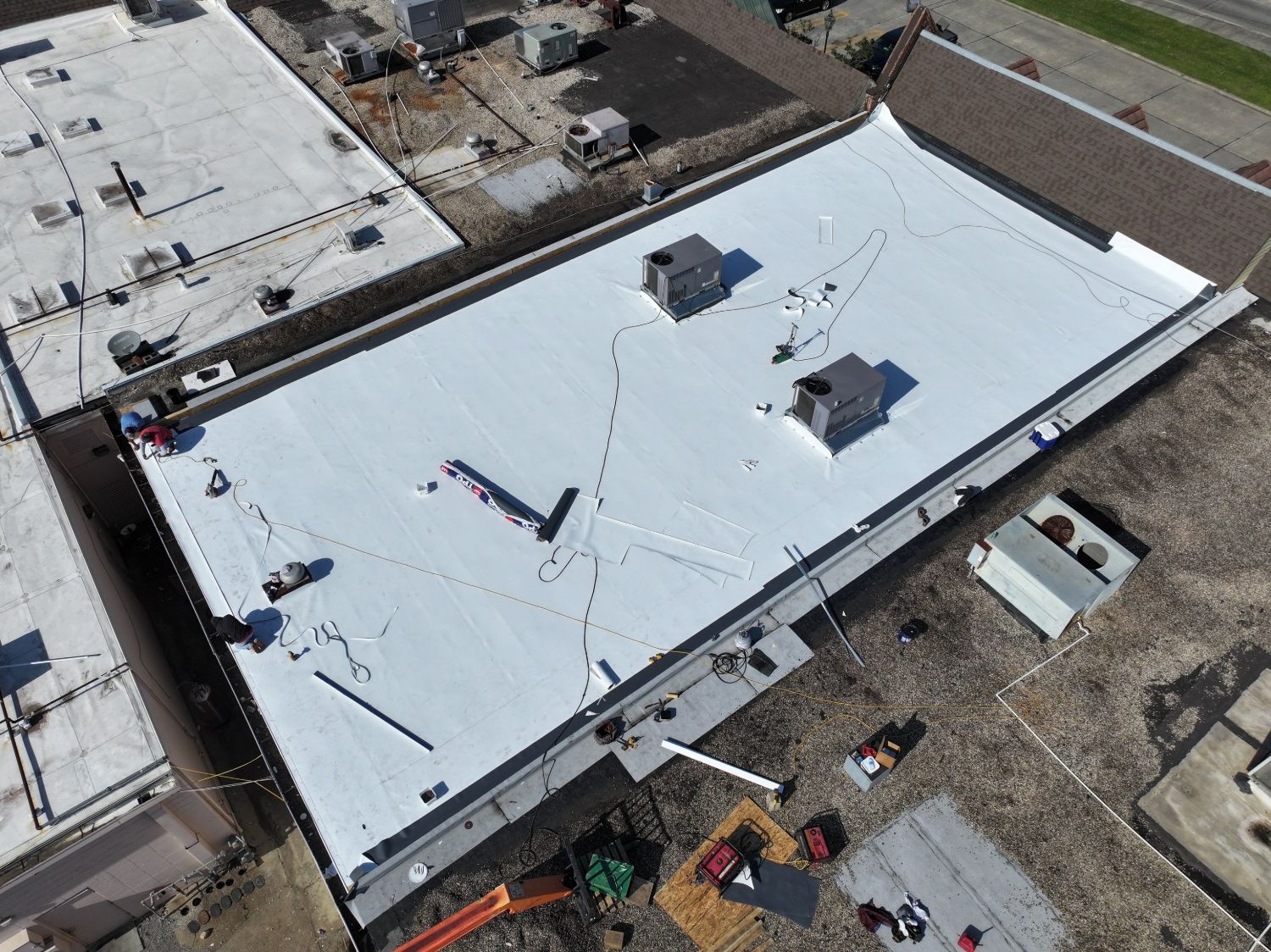
Budgeting for a commercial roof is a different exercise than pricing a house. A 60,000-square-foot low-slope roof over a shopping center has almost nothing in common with a residential shingle job — different systems, different failure modes, different cost drivers, and different math behind every square. For property managers and building owners across Louisiana, understanding those drivers is the difference between a defensible capital budget and a number that blows up mid-project. Here's what actually moves the price on a large-scale commercial roof.
Why Commercial Roofing Is Priced Differently
Most commercial buildings have low-slope (often called "flat") roofs that shed water across a wide, gently pitched plane rather than down steep faces. That changes everything about the roof. Instead of shingles, low-slope roofs rely on continuous waterproof membranes or built-up systems, layered over insulation and a structural deck. The way those systems are specified, attached, and detailed around penetrations is where most of the cost lives.
Scale also flips part of the cost math. Material can often be ordered through manufacturer-direct programs and purchased in volume, which can pull per-square material cost below what the same product would run on a single home. Labor and logistics move the other way: cranes and lifts, staging and mobilization, project management, safety planning, and phasing work so a business can keep operating all add cost a residential job never sees. The net effect varies project to project — which is exactly why a per-square figure borrowed from a neighbor's house tells you nothing about a commercial roof.
The Commercial Roofing Systems and How They Compare on Cost
System selection is the single biggest lever on a commercial roofing budget. Each system carries a different material cost, installation labor profile, service life, and warranty ceiling. Brown's Roofing is a GAF Gold Elite Contractor on the commercial side — GAF's top commercial tier — and a GAF CoatingsPro contractor, which means we install and warrant the full range of commercial roofing systems rather than steering every building toward one product.
TPO (Thermoplastic Polyolefin)
TPO is the most widely installed single-ply membrane on low-slope roofs today. It's heat-welded at the seams into a continuous waterproof sheet, and its naturally light, reflective surface helps in hot climates. It tends to be the most cost-effective single-ply option, which is why it anchors so many commercial budgets.
PVC (Polyvinyl Chloride)
PVC is a single-ply membrane with strong chemical and grease resistance, making it the go-to for restaurants, kitchens, and buildings with rooftop grease or chemical exhaust. It's also highly durable and flexible. PVC generally costs in the range of 15–25% more than TPO per square foot installed — a premium that pays off where chemical exposure or longevity demands it.
Modified Bitumen
Modified bitumen is an asphalt-based system applied in multiple plies for redundancy. It stands up well to foot traffic and is often a sensible choice on smaller or more complex low-slope roofs where single-ply detailing would be awkward.
Standing Seam and Commercial Metal
For steep-slope commercial roofs, visible roof faces, and buildings where a multi-decade service life justifies the investment — churches and architectural buildings among them — standing seam metal roofing is hard to beat for durability and wind performance. It sits at the higher end on cost but amortizes over a very long life.
Roof Coatings and Restoration
When the existing roof is structurally sound but aging, a roof coating can restore it and add years of service at a fraction of the cost and disruption of a full tear-off. This is one of the most powerful budget tools available to a property owner, and it's a core reason commercial cost ranges are so wide.
| System | Best Suited For | Relative Cost |
|---|---|---|
| TPO single-ply | Most low-slope commercial; reflective, weldable seams | Lower-cost to Mid-tier |
| PVC single-ply | Restaurants, grease/chemical exposure, high durability | Mid-tier to Higher (≈15–25% more than TPO per sq ft) |
| Modified bitumen | Smaller/complex roofs, foot traffic, multi-ply redundancy | Mid-tier |
| Standing seam metal | Steep-slope, visible roofs, long service life | Higher to Premium |
| Coatings / restoration | Extending a sound existing roof, avoiding tear-off | Lower-cost (relative to replacement) |

An automatic hot-air welder fusing a single-ply membrane seam. Continuous, monolithic seams like this are what make a single-ply roof watertight.
What Actually Drives a Commercial Roof's Price
Beyond the system itself, a handful of conditions account for most of the spread between two estimates on the same building.
Deck condition and tear-off versus recover. Wet insulation and a deteriorated deck can't be roofed over. A moisture survey often reveals that a "simple" re-roof actually needs partial tear-off, which adds labor and disposal. Where the deck is sound, a recover (installing over the existing roof) can save significantly.
Insulation, R-value, and code. Energy codes frequently require adding insulation when a roof is replaced. Bringing a roof up to current R-value with polyiso and a cover board is a real line item — and a long-term energy win — but it moves the budget.
Drainage and slope. Standing water shortens any membrane's life. Tapered insulation systems built to direct water to drains add material and design cost, and are especially worth it in Louisiana's heavy-rain climate.
Penetrations and rooftop equipment. HVAC curbs, vents, drains, skylights, and pipe penetrations each require precise flashing. A roof crowded with rooftop units costs more to detail and waterproof than a clean, open plane of the same size.
Roof size, access, and staging. A 20,000-square-foot roof and a 100,000-square-foot roof don't scale linearly. Crane access, material staging, tie-offs, and the need to phase work around an operating business all factor in.
Warranty tier. Longer manufacturer warranties — including no-dollar-limit (NDL) system warranties — typically require specific assemblies and a certified contractor. The warranty you want partly dictates the system you build, and therefore the cost.
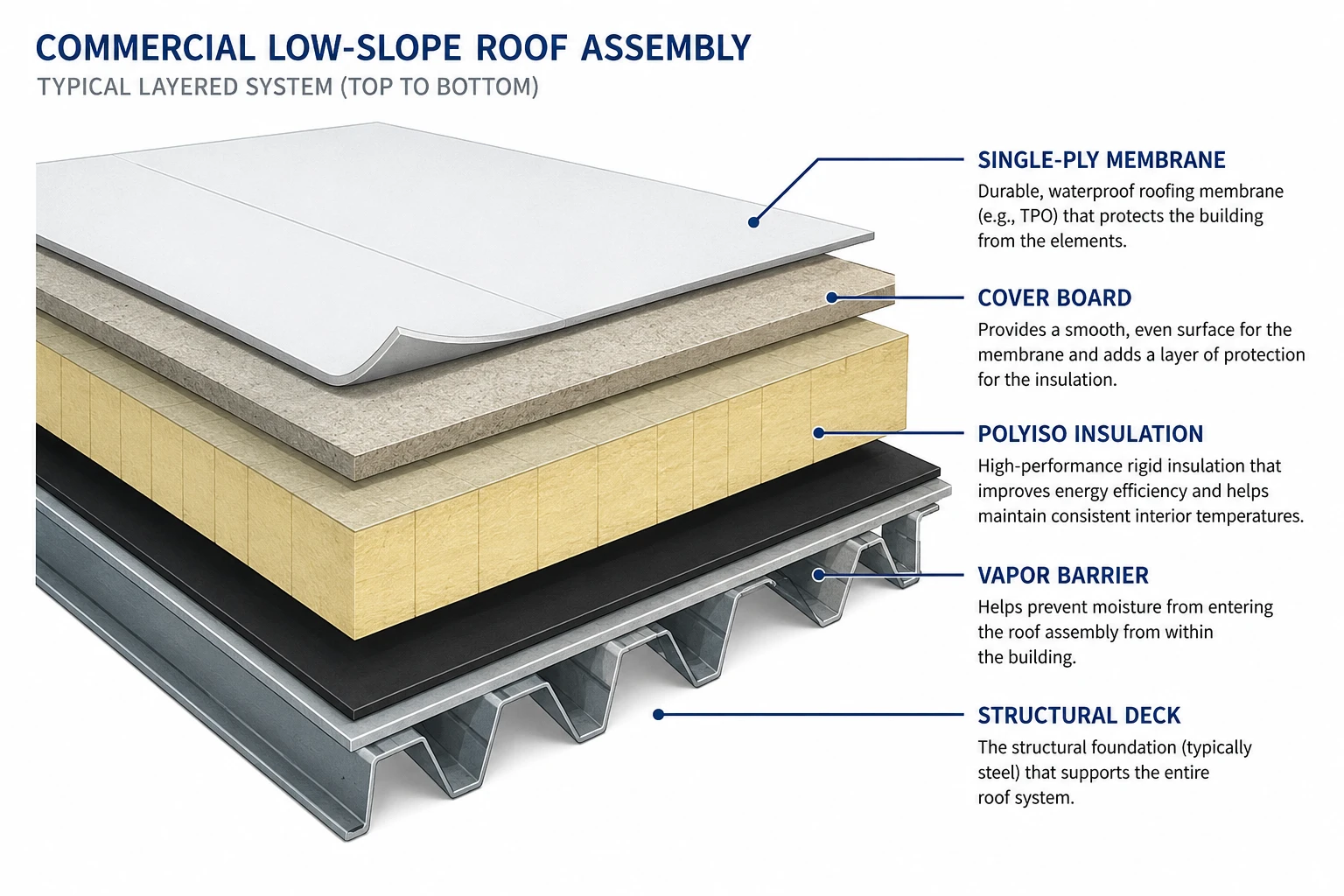
A typical commercial low-slope assembly, top to bottom: single-ply membrane, cover board, polyiso insulation, vapor barrier, and structural deck. Code-driven insulation and the layers below the membrane are real cost drivers.
Re-Roof, Recover, or Restore?
The biggest budget decision on most commercial buildings isn't which membrane — it's whether you need a full replacement at all.
A full tear-off and re-roof is the right call when the deck or insulation is compromised or the existing system is at end of life. A recover layers a new membrane over a single, sound existing roof, avoiding tear-off cost. A restoration coating renews a structurally sound but weathering roof and resets its service clock for years. As a GAF CoatingsPro contractor, we assess which path a roof genuinely qualifies for rather than defaulting to the most expensive option — because the cheapest defensible scope that solves the problem is usually the right one for the owner.
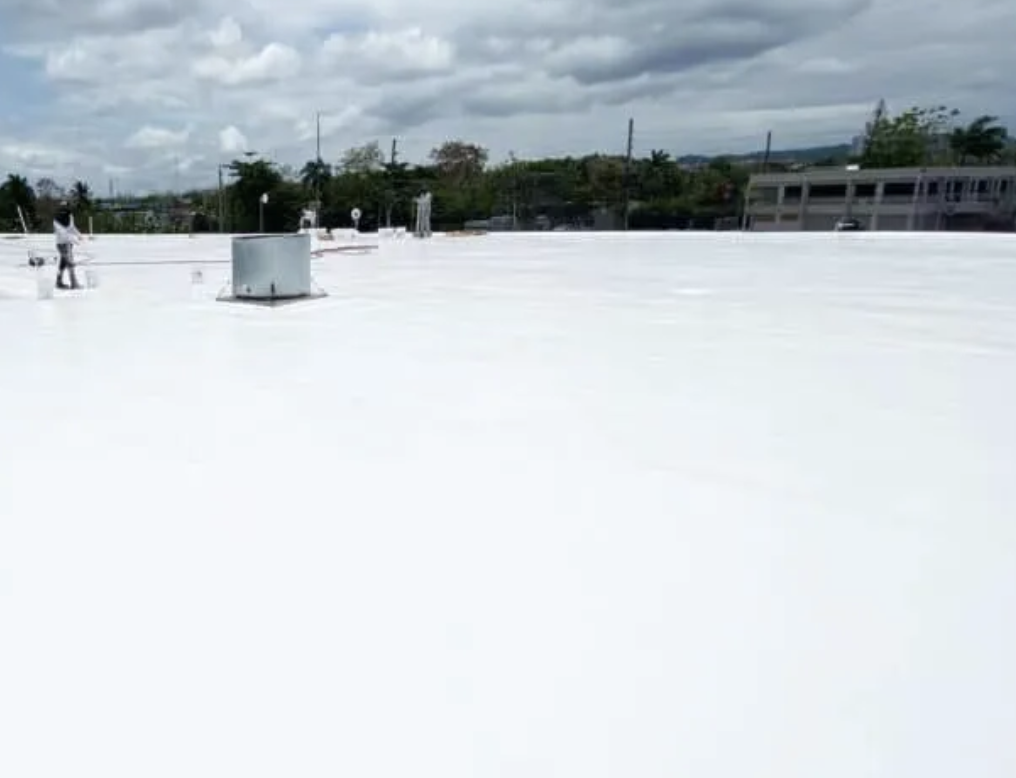
A reflective restoration coating renewing a sound but weathering low-slope roof — often a fraction of the cost and disruption of a full tear-off.
The Louisiana Climate Factor
Louisiana is hard on roofs: intense heat and UV, high humidity, torrential rain, hail, and hurricane-force wind. Each shapes both the system you should specify and what it costs.
Reflective single-ply membranes and light-colored coatings act as a cool roof, lowering rooftop temperatures and trimming cooling load — a meaningful operating savings on a large building in the Gulf South, where cool roofs perform best. Wind uplift resistance drives attachment method and edge-metal detailing, both of which carry cost. For owners pursuing maximum resilience, building to a FORTIFIED standard adds enhanced fastening and sealed-deck requirements. As an IBHS FORTIFIED Certified Contractor, Brown's Roofing installs to that standard; the FORTIFIED designation itself is issued only after an independent third-party evaluation, never by the installer.
Budgeting by Property Type
Different commercial buildings carry different cost considerations, even at similar square footage:
- Nursing homes and healthcare facilities demand work sequenced to avoid disrupting occupants, with strict attention to noise, odor, and safety — which can extend timelines and cost.
- Multifamily complexes and apartment communities often involve multiple buildings and steep- or low-slope mixes, rewarding coordinated scheduling.
- Shopping centers and retail require phasing around tenant operating hours and protecting storefronts and parking during the work.
- Churches, funeral homes, and architectural buildings frequently have visible, ornamental, or steep-slope roofs that call for metal or specialized detailing.
- Schools and campuses typically need summer-window scheduling and rigorous site safety around occupants.
Brown's Roofing is equipped to handle these property types across our Louisiana markets, including Baton Rouge, Monroe, Shreveport, and Lafayette. For projects with prevailing-wage or federal-spec requirements, project-specific credentialing is handled per project.
How to Get an Accurate Commercial Roofing Estimate
A trustworthy commercial estimate is built from the roof up, not pulled from a per-square average. Work through it in this order:
- Start with a full roof assessment. Core cuts and a moisture survey reveal wet insulation, deck condition, and the layers actually present — the facts that determine scope.
- Decide the scope honestly. Establish whether the building needs a tear-off and replacement, a recover, or a restoration coating. This is the largest cost fork.
- Account for code-driven upgrades. Confirm required insulation and R-value, and whether tapered insulation is needed for drainage. These are often non-negotiable on a replacement.
- Compare systems and warranties on equal terms. Match each proposal's system, attachment method, and warranty tier before comparing the bottom line.
- Verify commercial credentials. Confirm the contractor holds the manufacturer certifications required for the warranty you want — a GAF Gold Elite Commercial contractor, for example, can offer warranty tiers an uncertified installer cannot.
Frequently Asked Questions
How much does commercial roofing cost in Louisiana?
There's no single per-square answer. Commercial cost depends on the system (TPO, PVC, modified bitumen, metal, or a restoration coating), the deck and insulation condition, drainage and rooftop equipment, building access, and the warranty tier. An accurate number comes only from a roof assessment and a detailed written proposal.
TPO vs. PVC: which costs more?
PVC typically costs about 15–25% more than TPO per square foot installed. The premium is justified where you need chemical and grease resistance — restaurants and certain industrial buildings — or maximum durability.
Is a roof coating cheaper than a full replacement?
When the existing roof is structurally sound, a restoration coating costs far less than a tear-off and re-roof and extends the roof's service life by years. It only works on a qualifying roof, which is why an assessment comes first.
Does insurance cover commercial roof storm damage?
If a covered storm damages the roof and the policy applies, insurance may cover repair or replacement. Documenting the damage with a professional inspection is the first step toward a claim that holds up.
What's the most cost-effective roof for Louisiana heat?
Reflective single-ply membranes like TPO and PVC, or a light-colored coating, lower rooftop temperatures and reduce cooling costs — a strong fit for the long, hot Gulf South cooling season.
Get a Commercial Roof Assessment
Every commercial roof tells a different story once you get on it, and the only honest budget starts with a real assessment. Brown's Roofing provides building owners and property managers with a thorough evaluation, a clear scope, and a detailed written estimate — no per-square guesses over the phone. To schedule a free commercial roof assessment with same-day response, call (318) 329-6579.