
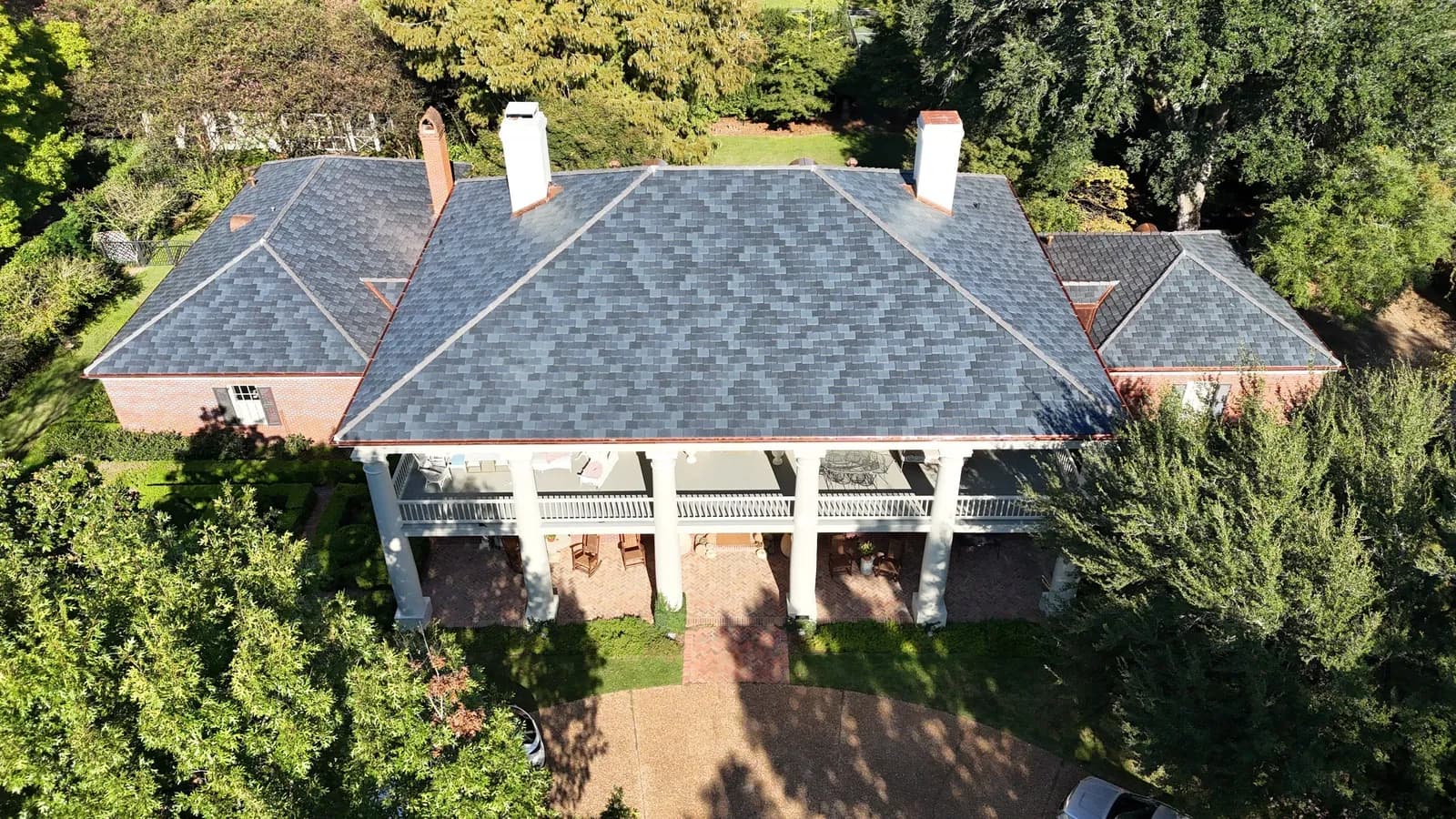
Slate Roofing
The Roof That Outlives the House
Natural slate is the longest-lived residential roof material on earth — with documented service lives over 150 years. We install both natural and synthetic slate, work on historic restoration projects, and tell homeowners when the right answer is something else.
What Is Slate Roofing?
The Premier Residential Roofing Material
Natural slate roofing is quarried, split, and graded stone — typically 1/4 to 3/8 inch thick — hand-installed in overlapping courses on a steep-slope roof. It has been the roof material of choice for premier residential, civic, and ecclesiastical architecture across Europe and North America for more than 500 years. American slate quarries in Vermont and Pennsylvania began commercial production in the 1830s; many of those original slate roofs are still in service today.
Synthetic slate is a 21st-century material engineered to deliver the slate aesthetic at a fraction of the weight and cost. Manufacturers like DaVinci Roofscapes, EcoStar Majestic Slate, and Brava produce polymer composites that are visually nearly indistinguishable from natural slate at distances of 50 feet — and that carry UL 2218 Class 4 impact ratings that natural slate doesn't offer. 50-year manufacturer warranties.
Slate makes financial sense in three specific situations: historic restoration (where preservation requirements demand it), premier estate construction (where the roof is expected to be the last one the home ever needs), and hail-prone markets specifying Class 4 synthetic (where the impact resistance pays back through insurance discounts). For most other homes, asphalt or metal is the more rational choice — and we'll say so.
The single biggest variable in a slate project isn't the slate; it's the trade. Slate installation is a craft skill that doesn't transfer from asphalt or metal — copper flashings, slate hooks, lead-coated copper saddles, and the rhythm of hand-laying overlapping courses all require specialty experience. Brown's Roofing follows published National Slate Association and Slate Roofing Contractors Association installation standards and brings in dedicated specialty labor when a project's scope warrants it.
Why Homeowners Choose Slate
Centuries of Service Life
A properly installed natural slate roof routinely lasts 100 years and can reach 150+ years — often outliving the structure beneath it. Slate is the only mainstream residential material where 'lifetime warranty' isn't marketing language; it's a literal description of how the roof performs.
Unmatched Aesthetic
Natural slate's mineral colors (gray, black, green, purple, red, mottled) age beautifully and develop character that no manufactured product replicates. The defining roof material on historic estates, government buildings, churches, and prestigious institutional architecture worldwide.
Fire & Storm Performance
Natural slate is non-combustible (UL Class A fire rating) and handles severe weather without degradation. Synthetic slate carries UL 2218 Class 4 impact ratings and tested wind ratings to 110+ mph — qualifying for the deepest homeowners insurance premium discounts.
Historic Restoration Authority
On historic-district homes, slate is often the only material that complies with preservation guidelines. We work with historic boards and HOA architectural review committees on color matching, slate sourcing, and installation methods that satisfy preservation requirements.
Insurance Premium Discounts
Slate roofs (both natural and Class 4 synthetic) typically qualify for 15–30% homeowners insurance premium discounts on the wind/hail portion. Natural slate's lifetime durability and synthetic slate's impact rating both make the underwriting math attractive to carriers.
Sustainable & Recyclable
Natural slate is a single-material, low-energy product (quarried, split, installed) that stays out of landfills for a century or more. Synthetic slate is typically manufactured from 30–80% recycled rubber and plastic. Both line up well with sustainability-conscious building decisions and energy-efficient home certifications.
Real Estate Premium
A slate roof — natural or high-end synthetic — is recognized at appraisal as a premium roof material that adds curb appeal and resale value. Properties with documented slate roofs and maintenance records routinely command higher prices than equivalent homes with asphalt.
Repairable, Not Disposable
Individual slates can be replaced one at a time over decades by a qualified slate roofer using a slate ripper. The roof system as a whole stays in service while individual components are maintained — the opposite of asphalt's tear-off-and-replace lifecycle.
Slate Roofing Specs
Natural slate requires a structural engineering review on most homes. Synthetic slate installs over standard residential framing and offers Class 4 impact ratings natural slate doesn't.
Slate vs. Tile
Considering tile? Clay and concrete tile match slate's longevity at lower cost — but lack the historic pedigree and restoration applications. We'll quote both side by side.
Compare with Tile →Slate Categories
Four Slate Options for Residential
From Vermont quarry-direct natural slate to engineered Class 4 synthetic, the right slate depends on whether you're restoring a historic home, building new at the high end, or specifying for hail performance.
Natural Vermont / Pennsylvania Slate
Premium quarried slate from the historic North American slate belts. Vermont slate offers the widest color range (gray, green, purple, red, black, mottled) and 100+ year service life. Pennsylvania black slate is the classic dark slate associated with historic American architecture. Hand-split, hand-graded, and hand-installed.
Best For
Historic homes, premier estates, restoration projects, multi-generational ownership
Imported Natural Slate (Spanish, Welsh, Brazilian)
Spanish slate (Galicia and León regions) is the world's highest-volume natural slate and offers excellent quality at a lower price point than Vermont. Welsh slate carries historical pedigree at a premium. Brazilian slate is a value-segment imported product common on contemporary high-end residential. We source by project requirement and historical context.
Best For
New high-end construction, lower price-point natural slate applications, contemporary architectural styles
Synthetic Slate (Polymer / Composite)
Engineered polymer slates from manufacturers like DaVinci Roofscapes, EcoStar Majestic Slate, and Brava — visually nearly identical to natural slate at roughly 1/4 the weight, 1/3 the cost, and Class 4 impact ratings that natural slate doesn't offer. 50-year manufacturer warranties. Often the right answer when structural capacity, budget, or hail performance favor synthetic.
Best For
Hail-prone markets, budget-conscious slate aesthetics, homes with limited structural capacity, HOA-restricted neighborhoods
Slate Repair & Restoration
We service existing natural and synthetic slate roofs with individual slate replacement, copper flashing renewal, ridge cap re-pointing, and full restoration of historic slate systems. Slate work is one of the few residential trades where the original 100-year-old roof can typically be brought back to full service rather than replaced.
Best For
Historic homes with intact original slate, slate roofs with localized damage, copper flashing renewal projects
Where Slate Performs Best
Home Styles & Applications
Slate has a narrower application range than asphalt or metal — but where it fits, nothing else does. Historic restoration, premier estates, and Class 4-spec hail-belt projects.
Historic & Heritage Homes
Pre-1940 American homes — particularly in the Northeast, Mid-Atlantic, and historic Southern districts — were originally roofed in slate. Restoration to slate (natural or period-appropriate synthetic) preserves architectural integrity and supports historic-district approval.
Estate & Premier Homes
Slate is the defining roof material on estate-grade construction. Properties that warrant the upfront investment in slate get a roof that's likely to be the last one the home ever needs — a meaningful feature on multi-generational properties.
Tudor & European Revival
Tudor, French Eclectic, Norman, and English Cottage architectural styles all originated with slate roofs in their European source contexts. Slate is the period-correct material for these styles in American historic preservation.
Steep-Pitch Architecture
Slate requires a 4:12 minimum pitch and looks best on steeper slopes — 8:12 and up. Steep-pitched architectural styles (Gothic Revival, Second Empire, Queen Anne) showcase slate's color and texture more than low-slope homes.
Hail Belts (Synthetic Spec)
In KS, AR, and North TX, where hail is a regular threat, synthetic slate with Class 4 impact rating gives homeowners the slate aesthetic plus the storm performance. Often the only way to get a slate look that survives a major hail event without damage.
Hurricane Coast (Synthetic)
Lightweight synthetic slate (200–300 lbs/sq vs. 700–1,000 for natural) doesn't add structural load to coastal homes already engineered for hurricane wind. Standard installation methods rated to 110 mph; supplemental methods push higher.
Premium Custom New Builds
On custom new construction with budget for premium materials and structural engineering for the load, natural slate is the once-in-a-lifetime roofing decision. The home's other systems will be replaced multiple times before the slate ever needs work.
Adaptive-Reuse & Institutional
Churches, civic buildings, schools, and adaptive-reuse properties with historic slate roofs require specialty trades for restoration. We provide slate inspections, condition reports, and incremental restoration programs for institutional and adaptive-reuse projects.
Material Comparison
Slate vs. Tile vs. Metal vs. Asphalt
How slate compares to other premium and standard residential roofing on the factors that drive long-term homeowner decisions.
| Factor | Slate | Tile | Metal | Asphalt |
|---|---|---|---|---|
| Relative Cost | Top-of-market | Premium | Higher | Lower-cost |
| Service Life | 75–150+ yrs | 50–100 yrs | 40–70 yrs | 20–40 yrs |
| Weight (lbs / sq) | 700–1,000 | 900–1,100 | 100–150 | 250–500 |
| Hail Performance | Excellent | Excellent (can crack) | Excellent (Class 4) | Class 3–4 avail. |
| Specialty Trade Required | Yes (slate roofer) | Yes (tile) | No | No |
| Insurance Discount | Often qualifies | Often qualifies | Often 20–35% | Class 3+ qualifies |
Cost Factors
What Determines Slate Roof Pricing
Slate pricing is driven by ten specific variables, with slate type, structural requirements, and specialty labor being the largest cost levers. We provide a written, itemized estimate after a free roof and structural inspection.
Relative tiers for a typical Southern home (1,800–2,400 sq ft of roof area):
- Synthetic slate: Lower-cost slate option
- Spanish / Brazilian natural: Mid-tier natural slate
- Premium Vermont / Welsh natural: Top of the residential market
- Slate restoration / individual replacement: Quoted per scope
Pricing depends on roof size, slope, complexity, structural requirements, and slate specification — we provide a written estimate after a free on-site inspection.
Request a Written Estimate10 Variables That Drive Slate Roof Cost
- 01Slate type (natural Vermont premium, Spanish mid-tier, synthetic budget)
- 02Roof size (squares — 100 sq ft each — drive material and labor heavily)
- 03Roof complexity (valleys, hips, dormers, turrets, copper flashing details)
- 04Pitch (steeper slate roofs require fall protection and slow installation)
- 05Tear-off vs. install (slate over existing layers is rarely appropriate)
- 06Structural assessment (natural slate may require framing reinforcement)
- 07Underlayment specification (synthetic high-temp, copper-fastened on premium)
- 08Flashing material (copper standard on slate; lead-coated copper on premium)
- 09Specialty labor rate (qualified slate roofers are a scarce trade)
- 10Historic-district or HOA architectural review compliance requirements
Long-Term Care
Slate Maintenance, Repair & Restoration
Slate roofs reward maintenance more than any other material. Annual inspections, copper flashing renewal at 40–60 year intervals, and proactive individual slate replacement are what carry a slate roof from one century into the next.
Slate Maintenance
Annual condition surveys, individual slate replacement, copper flashing inspection, and ridge re-pointing for slate roofs of any age.
Learn more →
Slate Repair
Damaged slate replacement using slate rippers and copper hooks, valley re-flashing, chimney saddle repair on natural and synthetic slate systems.
Learn more →
Storm Damage Documentation
Documentation of roof damage (damage photos and inventory for your records), structural assessment, and restoration scope for slate roofs in historic districts.
Learn more →
Representative Project
Historic District, Shreveport — Vermont Slate Restoration
Home Type
1908 Tudor Revival, contributing structure
Roof Area
34 squares (3,400 sq ft)
System Specified
Buckingham VA / Vermont blend natural slate
Warranty
Lifetime slate, 30-yr copper flashing, 25-yr workmanship
Original 1908 slate roof had 60% intact original slate; remaining areas had been patched with mismatched asphalt over the previous three decades. Working with the local historic preservation board, we sourced color-matched Buckingham Virginia and Vermont natural slate to blend seamlessly with surviving original sections. Existing copper valleys were replaced with new 20-oz copper; lead-coated copper saddles installed at chimney transitions. Project completed over six weeks with phased tarp protection. Historic district approved the completed work; homeowners insurance documented the lifetime warranty for premium adjustment.
FAQ
Slate Roofing FAQ
- Natural slate roofs routinely deliver 75–150 years of service. Vermont and Welsh slate specifically have documented service lives over 150 years on properties that have continued maintenance. Pennsylvania black slate typically reaches 60–100 years. Spanish and Brazilian imports are in the 75–100 year range. Synthetic slate from manufacturers like DaVinci, EcoStar, and Brava ships with 50-year manufacturer warranties and is engineered for that service life. The roof's actual lifespan depends heavily on flashing quality (copper outlasts everything), maintenance, and installation craftsmanship — slate work requires a specialist trade.
- Natural slate weighs 700–1,000 lbs per square (100 sq ft). Most homes engineered for asphalt shingles (250–500 lbs/sq) require a structural engineering review and often framing upgrades to support natural slate. We perform a structural assessment as part of the slate quote process — and if framing reinforcement isn't feasible or cost-effective, we'll recommend synthetic slate (200–300 lbs/sq), which most homes can support without modification.
- On most major carriers across LA, AR, KS, AL, MS, TX, and FL — yes. Both natural slate and Class 4 synthetic slate typically qualify for the deepest homeowners insurance premium discounts available (often 15–30% off the wind/hail portion). Natural slate's century-plus durability and synthetic slate's Class 4 impact rating both produce favorable underwriting math. Ask your carrier or agent whether your slate spec qualifies for a discount.
- Individual slate replacement is the standard repair on slate roofs. A qualified slate roofer uses a slate ripper to remove the damaged piece, slides a replacement under the surrounding slates, and secures it with a copper or stainless slate hook or two-piece copper hanger. The repair is invisible from the ground when done correctly. Historic slate roofs with localized damage almost always warrant individual repair rather than full replacement.
- Natural slate makes sense for historic restoration, premier estates, structural capacity, and homeowners with multi-generational time horizons. Synthetic slate makes sense for hail-prone markets (Class 4 rating that natural can't match), homes without structural capacity for natural's weight, budget-conscious projects (roughly 1/3 the installed cost of premium natural), and HOA-aesthetic situations where natural would be overkill. Both are legitimate paths — the right choice depends on the home, the market, and the budget.
- Pricing depends on slate type, roof size and complexity, structural reinforcement requirements, flashing material (copper is standard), and the specialty labor rate for qualified slate roofers. Relative tiers for a typical Southern home (1,800–2,400 sq ft of roof area): synthetic slate is the lower-cost slate option; Spanish or Brazilian natural slate sits in the mid-tier; premium Vermont or Welsh natural slate is at the top of the residential roofing market. We provide a written, itemized estimate after a free roof and structural inspection.
- Slate is a specialty trade with skills that don't transfer from asphalt or metal. We follow published National Slate Association and Slate Roofing Contractors Association installation standards, work to copper-flashing and slate-hook details on every project, and bring in dedicated specialty labor when a project's scope warrants it. We won't quote a slate project we can't execute correctly — and we'll tell you in advance if the right answer is to refer you to a regional slate specialist.
Slate Roofing in Your Market
Free Assessment
Request a Slate Consultation
Free roof and structural assessment, written estimate, and an honest recommendation between natural and synthetic slate. We'll tell you when slate is the right answer — and when it isn't.