
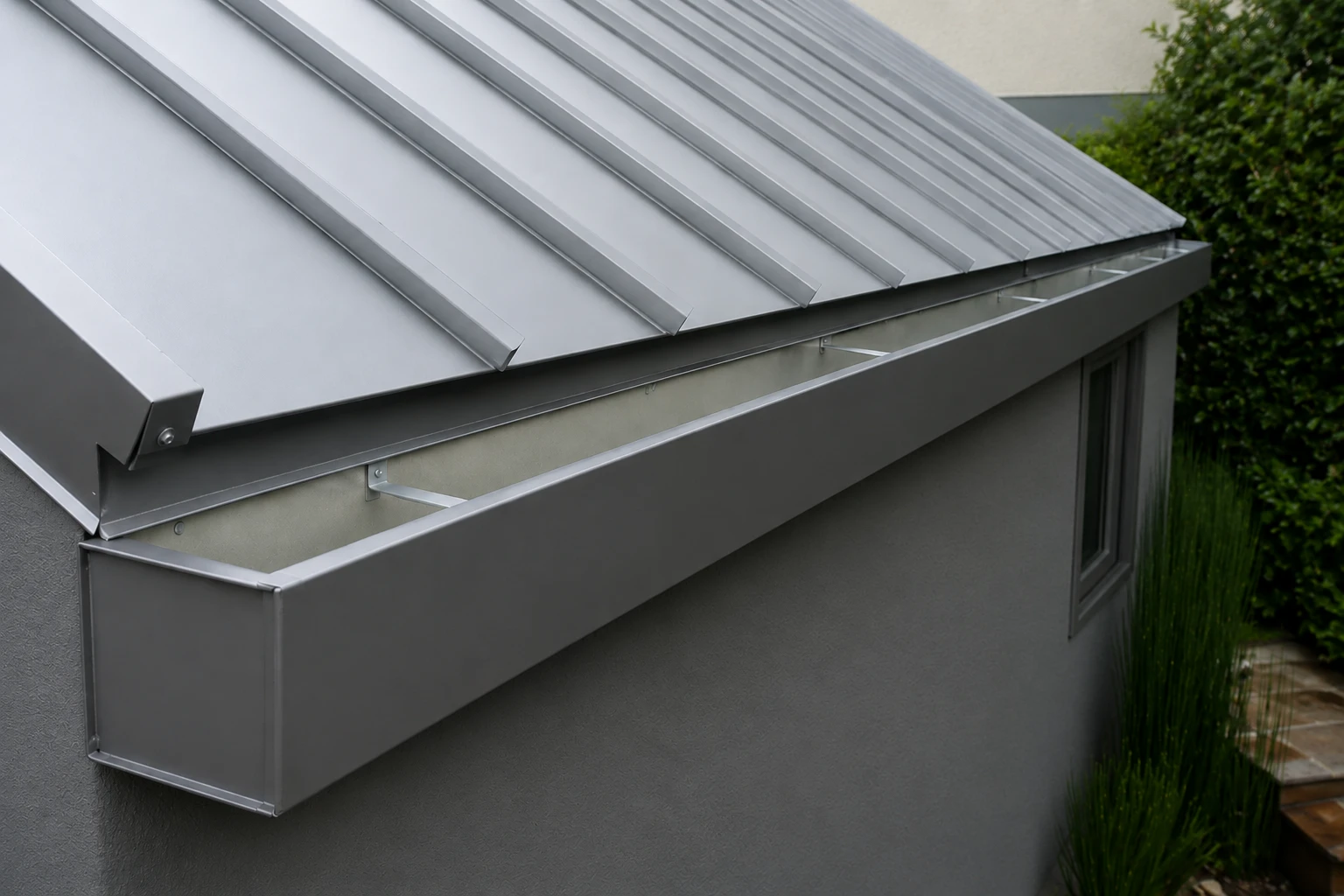
In June 2026, Brown's Roofing's Repair Division replaced roughly 700 linear feet of built-in box gutters on the standing seam metal roof of a school facility in Ruston, Louisiana, after repeated ice loading damaged the original system beyond practical repair. Projects like this are a useful reminder: a standing seam metal roof is built to last for decades, but the drainage tied into it is just as critical to how the building performs over the long run.
What Failed — and Why Ice Was the Culprit
When our technicians inspected the roof, the built-in gutter system showed clear damage from the weight of accumulated ice. North Louisiana isn't known for hard winters, but the occasional freeze event — the kind the region sees every few years — can put tremendous stress on a metal gutter. When water backs up and freezes, the added weight makes a built-in gutter:
- Sag along its length
- Separate from its supports
- Lose its drainage slope
- Pull away from roof transitions
- Open up new leak pathways into the building
In this case the distortion was severe enough that replacement, not patching, was the sound long-term call.
Scope of the Repair
The Repair Division completed the following work:
- Removed roughly 700 linear feet of damaged metal box gutter
- Fabricated and installed new custom box gutter to match the existing system
- Added new support straps throughout the run
- Replaced the box downspouts
- Re-tied the new assemblies into the existing standing seam roof
- Restored proper drainage and a clean, finished appearance
What a Box Gutter Actually Is (and Why It's Different)
Plenty of property owners have never heard the term "box gutter" until one fails. The simplest way to understand it:
A traditional gutter is like a bucket hung off the roof edge. If it's damaged, you can usually pull it down and replace it without touching the roof itself. A box gutter is a built-in drainage channel that's part of the roof assembly — it runs inside the roofline rather than hanging off the edge.
That integration is exactly what makes replacement more involved. A failed box gutter pulls the contractor into the standing seam metal roofing, the roof transitions, the drainage slopes, the waterproofing details, and the structural supports all at once. It's why built-in gutter work usually calls for genuine metal roofing experience rather than a general gutter crew. The design tolerances for this kind of work are spelled out in SMACNA's Architectural Sheet Metal Manual, the long-standing reference for custom sheet-metal drainage.
The Parts the Owner Never Sees
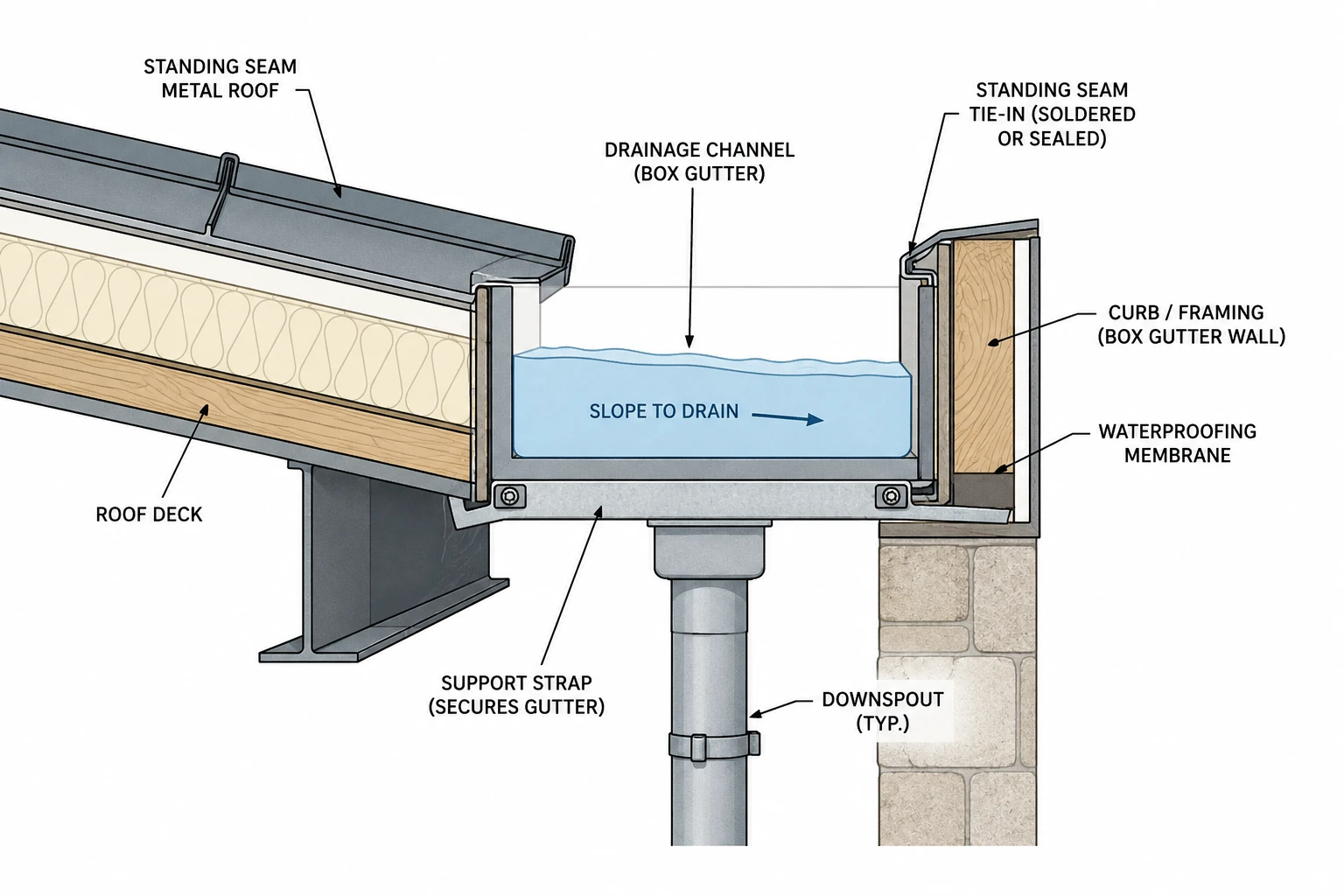
The visible channel is the easy part. The two details that actually decide whether a box gutter repair lasts are usually invisible from the ground.
Support Strap Spacing
Support straps carry the weight of the water and debris moving through the channel. Spaced too far apart, attached poorly, or left to corrode, they let the gutter shift — and that movement leads to ponding, failed drainage, separation at transitions, and eventually water intrusion. Getting strap spacing and attachment right is unglamorous work that pays off for years.
Standing Seam Tie-Ins
A standing seam roof is engineered as one continuous, watertight system. Where the new gutter meets that roof, the tie-in has to preserve that integrity. A sloppy tie-in can create a hidden leak that doesn't show up for months or even years — long after the job looks finished. This is the single biggest reason building owners look for an experienced metal roofing contractor for this work rather than a general construction crew.
Warning Signs of Box Gutter Failure
Catching these early usually means a smaller, less expensive fix:
- Rust staining running down exterior walls
- Water spilling over the gutter during heavy rain
- Visibly sagging gutter sections
- Interior ceiling leaks near the roofline
- Standing water that never fully drains
- Corrosion around seams and joints
- Visible separation between the roof and the gutter assembly
Why Schools, Churches, and Metal Buildings Rely on Box Gutters
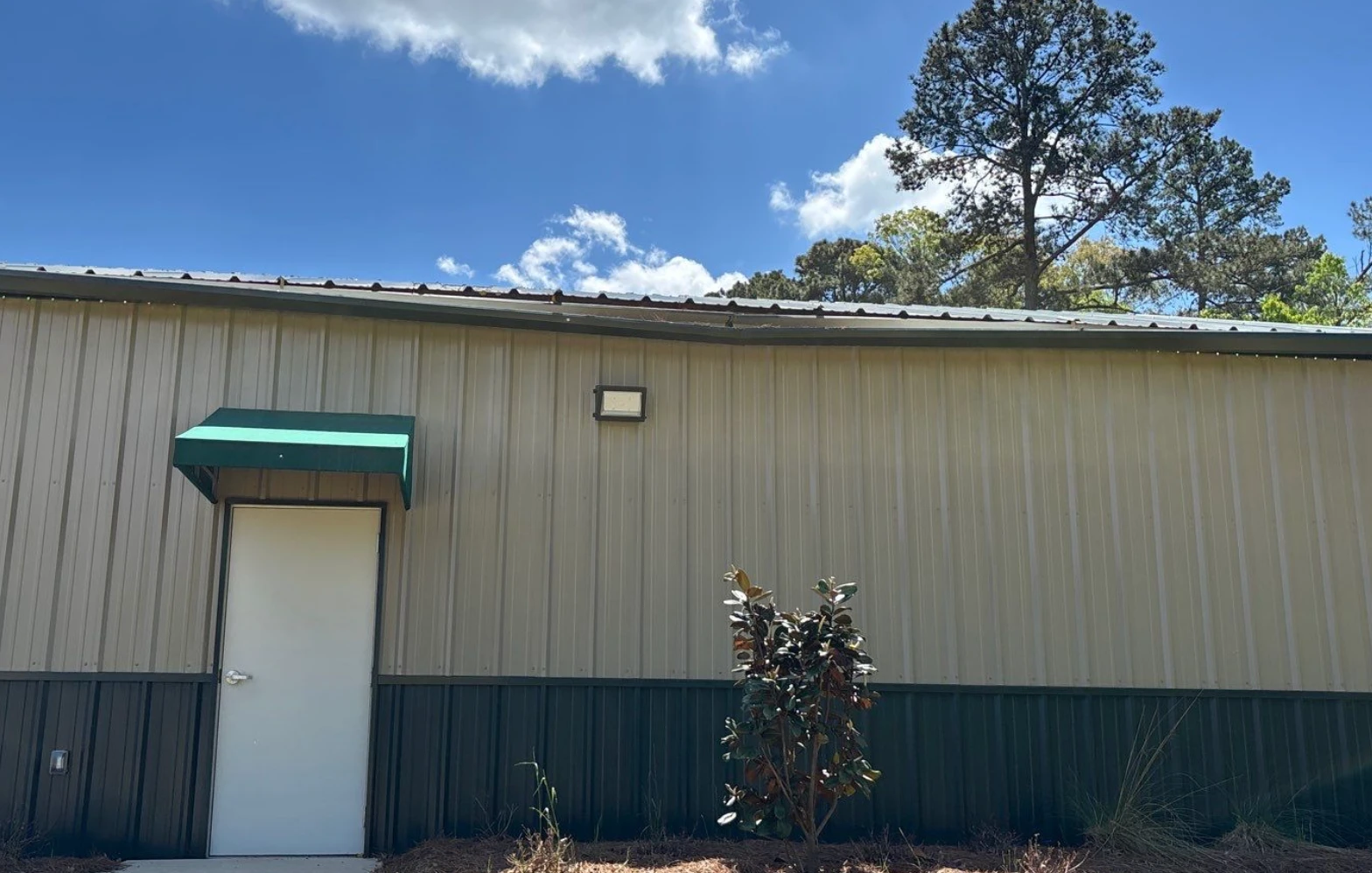
Built-in box gutters show up most often on buildings with large roof areas: schools, churches, gymnasiums, industrial facilities, shopping centers, and pre-engineered metal buildings (PEMBs). Those big roofs shed a lot of water quickly, so the drainage has to be designed and built to keep up. That's also why a failure on one of these buildings tends to be a bigger problem than a clogged residential gutter — there's far more water moving through the system, and the channel is built into the structure.
Standing Seam and Box Gutter Work Across North Louisiana
The Ruston project isn't a one-off. We have similar standing seam and box gutter replacements scheduled at church facilities in Stonewall and Minden, where built-in systems have reached the end of their service life through age, corrosion, and drainage problems. As the metal roofs installed across North Louisiana over the past few decades continue to age, we expect demand for this kind of specialized repair to keep climbing.
From our Monroe office we cover the Ruston and Lincoln Parish area, and our Shreveport crews handle the Minden and Stonewall side. Whether the issue is a leaking box gutter, a standing seam tie-in, or general roof repair on a commercial building, there's a local team that knows these systems.
Frequently Asked Questions
What is a box gutter?
A box gutter is a built-in drainage channel integrated into the roof structure itself, rather than a gutter hung on the outside edge of the building. It's common on schools, churches, and metal commercial buildings with large roof areas.
Can a box gutter be repaired instead of replaced?
Sometimes. If the damage is localized and the supports and slope are still sound, a targeted repair can work. When the channel has lost its slope, the straps have failed, or corrosion is widespread — as with ice-distorted systems — full replacement is usually the more durable answer. An inspection is what tells you which case you're in.
Why does box gutter work need a metal roofing contractor?
Because the gutter is part of the roof. Replacing it means working into the standing seam panels, transitions, and waterproofing details, then tying the new assembly back in without creating leaks. A general gutter installer typically isn't equipped for that.
How often should built-in gutters be inspected?
At least once a year, and after any significant freeze or storm. Built-in systems hide their problems well, so periodic inspection is the cheapest way to catch a developing failure before it reaches the building interior.
Schedule a Roof and Gutter Inspection
If your building has a standing seam metal roof or a built-in box gutter system, a periodic inspection is the simplest way to catch developing issues before they turn into interior damage. Brown's Roofing's Repair Division works on standing seam repair, box gutter replacement, commercial roof drainage, and metal building roofs across Ruston, Minden, Stonewall, and the surrounding North Louisiana communities. Call (318) 329-6579 to schedule a professional inspection — free, no obligation, with same-day response.